The home of architecture and design in the Asia-Pacific
Get the latest design news direct to your inbox!

Get the latest design news direct to your inbox!
The Man x Machine x Material collaboration by Jarrod Lim and The American Hardwood Export Council explores how generative AI can enhance design processes while also revealing the areas where human intuition remains irreplaceable.

October 29th, 2024
The architecture and design industry saw significant transformation in the ‘60s and ‘70s when CAD (Computer-Aided Design) systems like AutoCAD shifted manual drafting to digital design. Today, generative artificial intelligence (AI) is advancing design automation at unprecedented speeds, by assisting with idea generation that enables quick refinement and rapid prototyping.
While generative AI introduces exciting opportunities, it also raises questions about its role, capabilities and limitations. Will it outshine human creativity or is it more of a collaborative partner in bringing design visions to life?
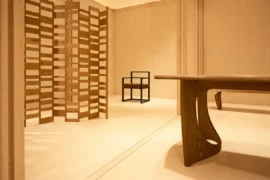
In the Man x Machine x Material collaboration presented by Jarrod Lim and the American Hardwood Export Council (AHEC), Lim explored the potential of generative AI in creating functional yet emotionally engaging furniture. For this project, Lim used ChatGPT, a generative AI tool, to co-create the Airstream table and Diffuse stools for AHEC’s booth at the recent Interzum SEA showcase at Iffina Indonesia Meubel & Design Expo.

As expected, generative AI offered fresh perspectives to Lim’s design process, which might not have been immediately apparent through traditional methods. The collaboration allowed Lim to introduce Indonesian cultural elements into his designs in innovative ways, expanding his creative range.
Related: Jarrod Lim pushes the boundaries of wood furniture
Generative AI’s ability to analyse vast amounts of data and propose design concepts can be a powerful asset, but it still requires human expertise to bring these ideas to fruition. In this collaboration, AI was instrumental in sparking new directions for Lim’s work. However, AI alone cannot replicate the depth of human understanding that is necessary to make key design decisions, especially when it comes to choosing materials and ensuring manufacturability.

One key lesson from the collaboration was the importance of explicit communication with AI. For instance, ChatGPT initially suggested timber materials that weren’t suitable for Lim’s needs. However, after refining his prompts, Lim successfully guided ChatGPT toward selecting American red oak, a sustainable and versatile material that complemented the project’s goals.
Despite AI’s strengths in generating ideas, it’s still in its early stages and remains distinct from human intelligence. Machines don’t possess the emotional intuition and contextual understanding that human designers rely on. While AI can quickly generate visually striking designs, it cannot sense the tactile warmth of wood or grasp the emotional resonance that certain materials bring to a project.
Related: Is there a place for human touch in the age of AI?
Lim’s hands-on experience was crucial in translating the AI-generated designs into functional pieces. The practical knowledge that designers accumulate over years of working with materials played a vital role in overcoming challenges where AI lacked technical insight, particularly when it came to the feasibility of production.
Rather than viewing this as a limitation of AI, Lim sees it as a natural part of the design evolution. He notes that, as AI technologies continue to develop, they will likely become more adept at understanding and incorporating practical considerations into the design process.
Despite the challenges, Lim’s collaboration with generative AI signifies a positive step forward in how technology can reshape the creative landscape. Reflecting on his experience, Lim emphasised that generative AI is not meant to replace the human touch but rather to enhance and accelerate the creative process.
“As we are still in the early stages of generative AI, it’s evident that this tool will become increasingly integral to the design process, similar to how 3D modelling transformed design years ago,” Lim explains.


Ultimately, Lim believes that AI and human creativity can work together harmoniously. By leveraging AI’s computational power alongside the human ability to tell stories and connect with emotions, designers can push the boundaries of innovation, creating designs that are both groundbreaking and deeply meaningful. The collaboration between man and machine isn’t a matter of replacement but rather a powerful partnership that has the potential to reshape the future of design.
Images courtesy of AHEC
We think you might also like Insight: How will AI and designers work together into the future?
INDESIGN is on instagram
Follow @indesignlive
A searchable and comprehensive guide for specifying leading products and their suppliers
Keep up to date with the latest and greatest from our industry BFF's!
The internet never sleeps! Here's the stuff you might have missed