The home of architecture and design in the Asia-Pacific
Get the latest design news direct to your inbox!

Get the latest design news direct to your inbox!
The Gingerboy dining concept draws on traditional Asian materials featuring a robust bamboo long-bar where clientele can sample Asian influenced cocktails and tapas. Stephen Crafti in Melbourne reports.
May 5th, 2008
Gingerboy, in Crossley Street, Melbourne, follows a succession of restaurants on this site. While the position, in one of the city’s more interesting lanes, was a positive, there were considerable constraints with the building, including connection to the pavement. “We were keen to turn this around,” says architect Zahava Elenberg of Elenberg Fraser Architects.
New expanded shugg-style windows certainly create that needed connection to the street, as does the rearrangement of spaces. Previously, the main entrance was to the side of the building. Now there are two doors, centrally positioned. Before the dining area and bar were disconnected, now the two areas are linked by a smoked mirrored wall as well a strong Asian theme. And although a concrete staircase dissecting the two spaces couldn’t be altered, the architects were able to make use of a nook below as a waiter’s station.
Tegue Ezard (chef of Ezard’s restaurant) wanted a more informal restaurant, where Asian food could be served quickly to the lunchtime trade, whether an individual dish or shared platter.
To provide a backdrop for this style of dining, Elenberg Fraser were inspired by the streets of Hong Kong, as much as the Asian restaurants in Melbourne’s Chinatown. “It’s like the fake Versace bags you might see in the back streets of Hong Kong, that slightly kitsch ambience,” says Elenberg, pointing to the new gold tiles that adorn the façade of Gingerboy.
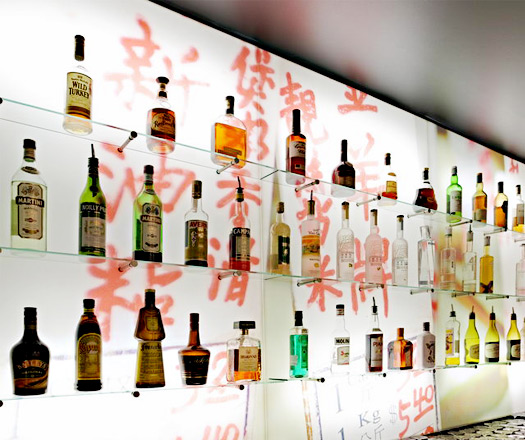
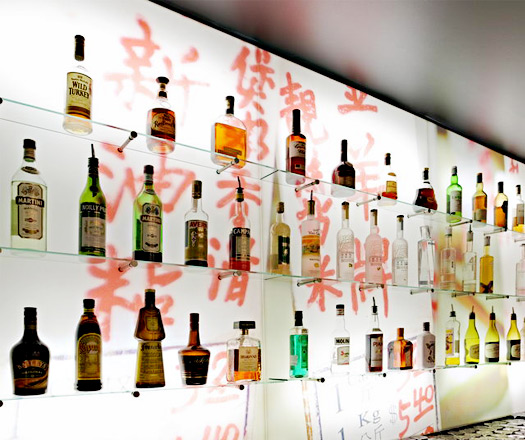
Materials, as well as colours, took their cue from the Asian aesthetic. The new bar that runs through to the kitchen is finished in bamboo. As evocative, are backlit photos behind the bar. Taken from pages of Ezard’s new cookbook, these images represent the highly graphic nature of many Asian cities.
Elenberg Fraser worked with graphic designers Round for this installation, as well as for general signage. “The fluorescent signage captures the feel of the place,” says Elenberg, who used Starck plastic chairs and bar stools in the restaurant. “We wanted to create a colourful and slightly eclectic feel to the spaces,” she adds.
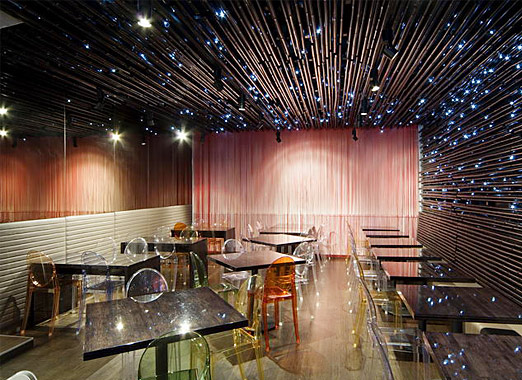
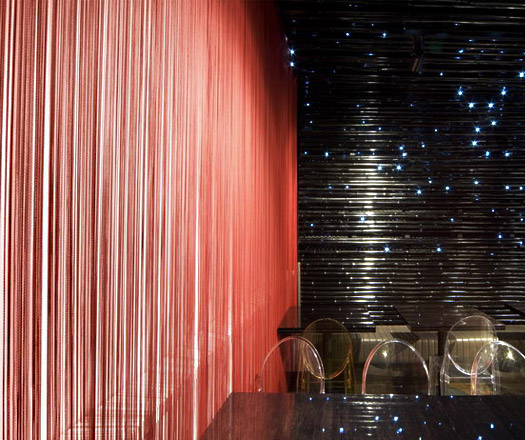
One of the most striking features in the dining area is the painted black bamboo that wraps around the walls and extends to the ceiling. Concealing hundreds of starlights as well as acoustic foam, there’s a considerable reduction in noise level. “One of the biggest problems with restaurants is minimising noise levels, particularly when you have hard surfaces,” says Elenberg, referring to the bamboo timber flooring.
Another major improvement has been the creation of an open kitchen. With steel shelving and vibrant red tiled walls, there’s a sense of theatre as well as connection to the bar and dining spaces. As this is the first Gingerboy to be unveiled (a number are planned across Australia), getting the feel right was paramount. “We wanted to established an identity from the start. It has that slightly opulent feel. But it can be quickly hosed down, a bit like the cafes you see on the roadsides in Asian cities,” says Elenberg.
Text by Stephen Crafti
Photography by Dianna Snape
Elenberg Fraser
mail@e-f.com.au
www.e-f.com.au

INDESIGN is on instagram
Follow @indesignlive
A searchable and comprehensive guide for specifying leading products and their suppliers
Keep up to date with the latest and greatest from our industry BFF's!
The internet never sleeps! Here's the stuff you might have missed