The home of architecture and design in the Asia-Pacific
Get the latest design news direct to your inbox!

Get the latest design news direct to your inbox!
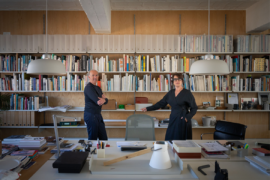
From the pages of Indesign #16 (c.2004), this reissued Luminary profile honours the life and legacy of the late Australian architect/designer, Michael Bryce.

January 21st, 2021
Minale Bryce specialised in graphic, industrial and urban design and signage. In its time, the design practice created corporate identities for many Australian institutions including the National Trust, the National Parks and Wildlife Service, the Australian War Memorial, the Commonwealth Games, the Wallabies Rugby team, the International Cricket Council, the Queensland Government and the Sydney Royal Easter Show – although Michael Bryce is probably best known for creating the Sydney 2000 Olympics bid logo and for his role as principal Design Advisor for the Games.
There’s no quick-scanning Michael Bryce’s CV, but even in summary his achievements and interests are considerable. The letters after his name give some indication: B. Arch, FRAIA, LFDIA, FRSA. “I’ve been on every board. I was a director of the Australia Council’s Design Board, the Industrial Design Council of Australia [and] the Australian Academy of Design.” He is Adjunct Professor at the Queensland College of Art, Griffith University and the College of Fine Art, University of New South Wales, and a member of the City of Sydney’s Look Committee.
When you take in the speeches, articles and papers delivered, the many awards received, awards adjudicated, associations supported and activities promoted, the volume and diversity is almost dizzying. The list extends from architecture, through the RAAF, Queensland Symphony Orchestra, horticultural award judging, to child safety programs, art galleries and government and sporting bodies, not to mention multiple design interests.
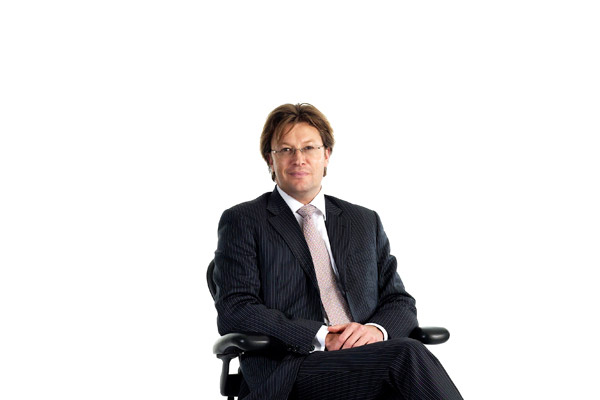
At 65 (at the time of original publication) he remains a man of great energy. He says he works because he loves the whole business of design. As he sits at ease in one of the company’s boardrooms, striped shirt crisp, tie impeccable, he is clearly not a designer out of the mould. It’s his training, he says, that has “defined why I’m a designer in a suit rather than in black. I’ve always had a foot in both worlds.” No doubt the executive persona has been advantageous in dealing with people in business. “I’m able to work with them because I know a lot of them. There’s a comfort in knowing that I’m a conservative person. I guess I am rather bureaucratic in my mindset.” On the other hand, he says, “it’s not been so good for me as a designer. I’ve been to a meeting where the client said, ‘Look, it’s great to see you here, but would you like to bring a designer along with you next time’”
It was the young Michael’s talent that established the course of his career. “I won colouring competitions. The Royal Easter Show had little kids’ sections for art. Every bit of money I could scrape together as a young man came from doing drawings and putting them in the newspaper. It was not really art, I used to copy things a lot. It was more like graphic design. I suppose my parents were ambitious for me. My father was a talented artist – he taught me art [and] a love of three dimensional [design.] He was my life model.” An aunt and uncle of his fathers were also artists. “I think there is something there in the genes,” says Bryce, who worked in his father’s sign-writing business before studying architecture at the University of Queensland.
After training as a cadet in the Air Training Corp all through high school, Bryce joined the University Squadron. He became a commissioned cadet officer at 19 and remained in the RAAF Reserves after university as an intelligence officer. He didn’t fly, but when he graduated from university and began working for architects in Brisbane, he continued in the Air Force Reserve and became, from 1964 to 1966, the honorary aide-de-camp to the Queensland Governor. “Three years at Government House was special – not getting paid for it, but life experience you’d never get again,” he says, recalling days of dressing up in tails and attending lavish functions with the Governor. “There were lots of balls. I started dating my future wife [then]. They were suave times.”
At university he also participated in what he calls “the stage part of my life – five years as compère of the university revue in which “the one continuous presence [on stage] was me in my dinner suit. I was the fill-in guy. If anything wasn’t ready I had to come out and tell a joke.” He did this with ease, he says, because of a natural confidence. “Of course, I drank a bottle of rum every night, too.” He sees the combination of these experiences, along with travelling, as basis of his self-assurance, his people and leadership skills. “I’m a very socially confident person and I’ve been able, not only to lead my practice in that way, but to also speak for the design profession. Not a lot of people can do that at all levels.”
In 1966, the newly married architect and his barrister wife, Quentin, took the obligatory trip overseas. For two years, Bryce worked as an architectural illustrator in London, saying “it was that [experience] that shaped my change from being an architect to being a graphic designer.” Some of his work was even included in an exhibition of architectural drawings at London’s Royal Academy of Art at the time.
Returning to Brisbane, he set up an architectural practice and maintained a “pretty hands-on” role in bringing up his young family. “At one stage we had five children under seven.” (Bryce unequivocally claimed his children as his proudest achievement and is pleased that two of them grew up to work with him at Minale Bryce.) As well as architectural projects and architectural illustration, producing perspectives for speculative builders and developers, he set up another company to do graphic design work and signage and gradually the graphic work won out. “We won three or four bronze medals [from the RAIA] and the civic design award. In 1981, the year I won ‘House of the Year,’ I gave up doing buildings. How wacky is that?”
Nevertheless, he quickly notched up his graphic design credentials – as design advisor for the Commonwealth Games in Brisbane (1982), as graphic designer for the Australian Pavilion at the 1985 World Expo in Tsukuba, Japan; then as master graphic designer for the 1988 World Expo in Brisbane and designer of the Queensland pavilion.
In 1988, through the Brisbane World Expo, Bryce met extroverted London-based design company principal, Marcello Minale. The two men became friends immediately and, by the end of the year, “we’d become part of a worldwide group, Minale Tattersfield Bryce. We’ve had a wonderful association over the years. Marcello was the driving force behind the growth of the company into all these strange places: Osaka, South America, Casablanca and so on,” says Bryce. The strength of that association, and his involvement in such a large international design network – they also merged with an office in Paris – have had a significant impact on Bryce’s working life. “We are truly international. We speak to the French office every day. We swap staff. We know the personalities.” Cohesion within the company results “because we do the same kind of work.” Sadly, in the year 2000, Minale was murdered. The company reeled under the loss. “It’s OK now, but we’ve been in re-build mode for a while,” says Bryce, although numbers are significantly reduced from earlier times. There are now seven or eight in the Sydney office, and around 14 in Brisbane. The French office reduced from 150 people to 50. And the London office roughly the same.
Of his involvement in the Sydney 2000 Olympic Games bid, in 1992, Bryce says, “I like to think that we were part of that, that we got that bid. The night that John Fahey and Kieren Perkins jumped in the air, they were wearing the tie. The front page of The Times newspaper – I’ve got it pinned on my wall at home – had them holding the logo out. So I suppose the Olympic Games, for me, are terribly important, even though, from that point onward, it never got that good again. After we got over the initial shock of the bid logo not being used [for the Games themselves], I went through various roles. I ended up Chairman of the Design Advisory Committee and then Principal Design Advisor.” While there were frustrations, he says, one of his proudest achievements was in “saving the Olympic Games for Australian designers. I was probably the only person, at that time, who could have done that. “There are other designers in Australia who are perhaps more famous than me or who have bigger practices – Ken Cato, Emery Vincent, Flett Henderson (FHA) – but I was President of the Design Institute [so] I was used to looking after other designers.” He cites the instance of FHA having won the design competition for the permanent logo, then having to compete to design its implementation and the ‘total look’ of the Games. Ultimately, he says, it was on his recommendation that FHA was engaged to handle both aspects. Even though his advisory role did come with “a certain amount of power and respect, it was a constant tussle with bureaucracy. It had its great moments – and its low moments.”
Circuitously, in the early 2000s, he found himself once again part of the pomp and circumstance of Government House. In 2003 Quentin Bryce (who has been the Principal of Women’s College at the University of Sydney, Sex Discrimination Commissioner and Human Rights Commissioner) became the Governor of Queensland. The couple now lives at Government House, Brisbane, where she ran a dauntingly hectic schedule “with 38 staff – six or seven security guys, 10 gardeners, footmen, butlers, houses managers, estate manages, executive officers, typists, A-de-Cs and housekeepers. It’s funny to think that I’m now living back in the same building, and we have A-de-Cs [ourselves.]” Bryce assumed the position comfortably, saying that “it’s privilege, but it’s also responsibility. The two must go hand in hand.”
He spoke about respect and power, both in his own regard and as far as the design profession is concerned. “I’m sure people in the design profession now think of me as one of those fatherly leaders. They ask me to open things. They invite me, when there’s an event, to sit in the front row and I get to say a few words sometimes. I do think there’s respect there for me. What I’m concerned about is – is there respect for the young designer? “I believe in the power of design. I also believe designers don’t have much power. And we must get them some respect and power. I wouldn’t have got where I’ve got – on those boards and in those companies – if I hadn’t been an architect. Everybody understands that because it’s one of the professions. [But] people can’t really get a grasp on what designers do, and what [they should] pay for it.” Believing the value of what graphic designers do is often underrated, he was keen to establish a new organisation of designers, under the auspices of the Design Institute of Australia. “I’m trying to start a thing called Design Business Australia” – a forum which would allow design business leaders to discuss shared concerns, to work for the benefit of the industry as a whole, and to present relevant issues to the media. “If there’s any mark for me [to have made in my career] it’s in the process of making design a profession – although I’m not sure if it is yet, really.”
INDESIGN is on instagram
Follow @indesignlive
A searchable and comprehensive guide for specifying leading products and their suppliers
Keep up to date with the latest and greatest from our industry BFF's!
The internet never sleeps! Here's the stuff you might have missed