The home of architecture and design in the Asia-Pacific
Get the latest design news direct to your inbox!

Get the latest design news direct to your inbox!
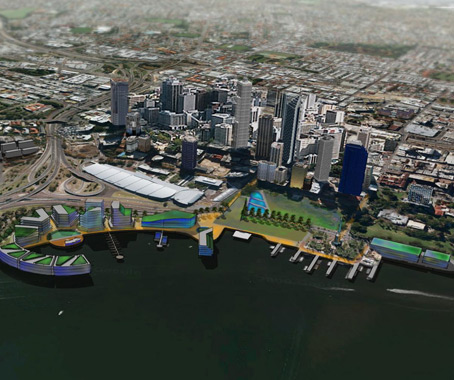
The Perth foreshore debate continues with an alternative proposal published by waterfront resistance group The City Gatekeepers. Paul McGillick discusses.
February 24th, 2012
The resistance to the proposed Foreshore re-development in Perth continues to gain momentum with a large rally held on the Esplanade last Sunday.
The local press also continues to run with the story and even managed to interview the Minister for Planning, John Day… given that the Premier, Colin Barnett, rules his government with an iron fist and is rumoured to be not-for-turning re the Foreshore.
At least there is now public discussion about a project that is going to transform the city of Perth irremediably – because this is a project which has hitherto been pushed by stealth with a strong whiff that certain well-positioned people know what’s best for the people of Perth.
The pro-development people have made it clear that opening the issue up for public debate runs the risk of opposition and even – horror – a review of the whole matter. You see, that’s the problem with asking the public what they think: they might actually disagree with your views on how they should live their lives.
The Gatekeepers, who have been organising resistance to the project, have now published an alternative proposal to highlight the defects of the current plans.
It deserves serious and open-minded attention.
The original motivation was to connect the Perth CBD to the river. However, the current plan does precisely the opposite by erecting a series of high-rise towers, creating a visual and physical barrier. The alternative, however, does create connection while allowing for development.
It also achieves an appropriate scale, maintains traffic flow along Riverside Drive without compromising pedestrian access and puts public amenity before private and bureaucratic benefit.
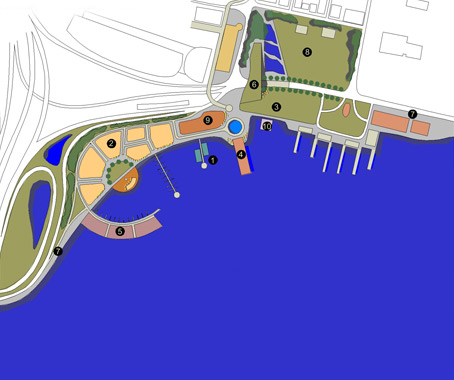
1 Floating public swimming pools
2 Contemporary buildings up to 10 storeys
3 Community gathering and entertaining
4 Hotel on water’s edge
5 Apartments on finger wharfs
6. Land bridge over Riverside Drive
7 Continuous cycling and pedestrian path at water’s edge
8 Passive and active recreation on The Esplanade
9 Museum and modern art gallery and Indigenous Cultural Centre
10 Performing arts stage floating on water
Dr Paul McGillick is Editorial Director of Indesign Publishing
INDESIGN is on instagram
Follow @indesignlive
A searchable and comprehensive guide for specifying leading products and their suppliers
Keep up to date with the latest and greatest from our industry BFF's!
[re]vision is a celebratory event held annually in the appreciation of the Master of Architecture program’s graduation year at the University of New South Wales. The exhibition is a chance for students to present their graduation projects through an exhibition to the building industry and its architectural industry.
The internet never sleeps! Here's the stuff you might have missed