The home of architecture and design in the Asia-Pacific
Get the latest design news direct to your inbox!

Get the latest design news direct to your inbox!
City of Perth and Geyer undertake a respectful refurbishment of a modernist icon, writes Anna Flanders.
November 14th, 2011
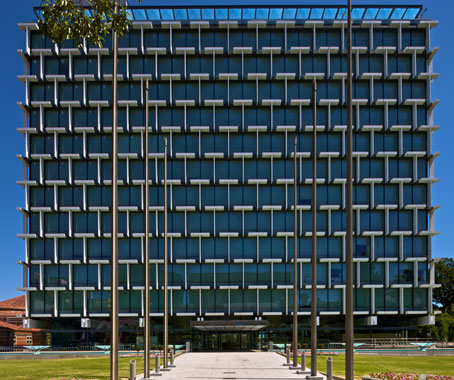
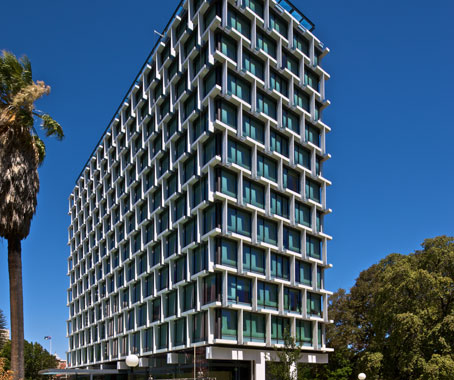
Modernist icon, hideous folly, or an eyesore – the City of Perth’s Council House is a 12-storey building that divided the community at its opening by Her Majesty Queen Elizabeth II in 1963. It again polarised opinion in the 1990s, when it was almost demolished and the state government at the time refused to put it on the heritage register.
Today, however, the building sits firmly listed on the register and stands as one of not only Perth’s, but also Australia’s most significant post-War glass curtain wall commercial buildings.
Photography: Tyrone Branigan
The result of a 1959 design competition won by Melbourne-based Jeffrey Howlett and Don Bailey, Council House also forms part of the history of one of Perth’s most revered architecture firms – Cox Howlett & Bailey Woodland.
In 2009, interior architects, Geyer, were charged with taking the historic building into the future with a fit-out to rationalise the City of Perth’s business units and engage greater functional efficiencies. The firm created a master plan and, in 2010, began construction of a test floor. This prompted the city council to commit to the roll-out of another 6 floors over a number of years.
Steve McDonnell, Design Leader at Geyer, looked back to take the refit forward. The complete opposite to a heavy-handed 1990s refurbishment, Geyer’s sensitive revamp honours the modernist intent of the building and responds to Perth’s 1960s enthusiasm for Scandinavian furniture.
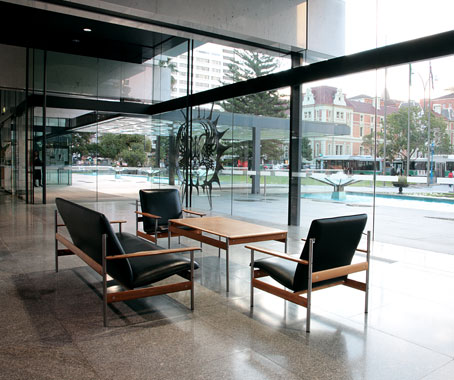
Council House has a small footprint, restrained palette of materials and efficient use of structure. This efficiency is reflected in the fit-out for the test floor on Level Four, which uses minimal materials, furniture with a light floor presence and only the necessary space for each area.
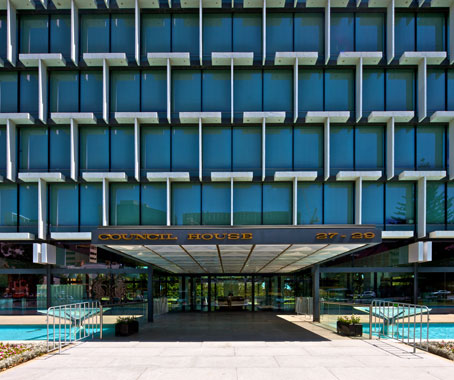
The building’s ground floor foyer is referenced in the use of grey granite, Carrara marble, the same blue colour used for the foyer lifts, and black glass mosaics. A timber acoustic panel ceiling takes cues from the grooved timber ceiling in the council chamber.
“We are not copying what was there but referencing it,” says McDonell. “Like the base building, we wanted nice detailing rather than ostentation. So, we’ve tried to be honest with our materials. And, within reason, we have tried to keep as much transparency in the building as possible. But at the end of the day people still need to work in it, so there are requirements.”
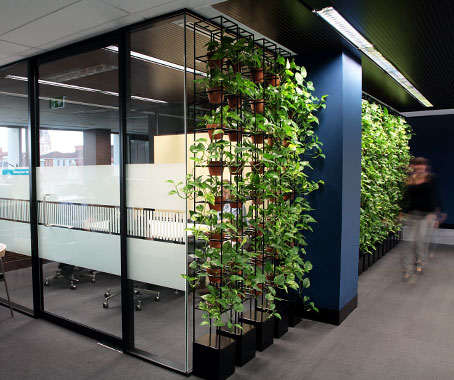
Three glass-walled meeting rooms, for example, cluster on the east side of the building at the lifts, creating transparency. The necessary privacy comes from a living wall – a tribute to the Parks and Gardens Department on this floor – and tinted graphic glass.
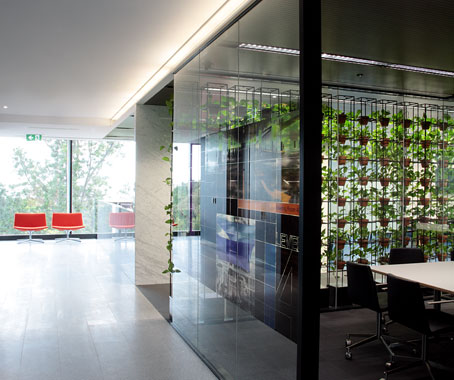
Also key to the fit-out is the use of Danish furniture, in line with Perth’s obsession with Scandinavian design in the 1960s, aided by pioneering Perth furniture importer David Foulkes Taylor. Paustian’s Spinal base range has been used in meeting rooms, with lines reminiscent of the original chair designed in the 1960s by Howlett for the council chamber.
“Part of my brief to myself is that I want to stop ’furniture as landfill’,” he says. “There is no reason why this furniture can’t be around for as long as the building’s original furniture.”
The café features ply furniture by Australian brand, Derlot, and a bench that overlooks the Swan River. McDonnell designed this space to be as light as possible.
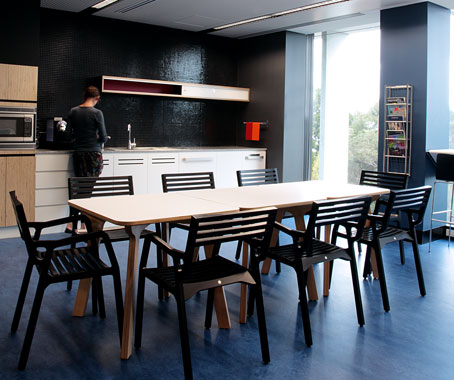
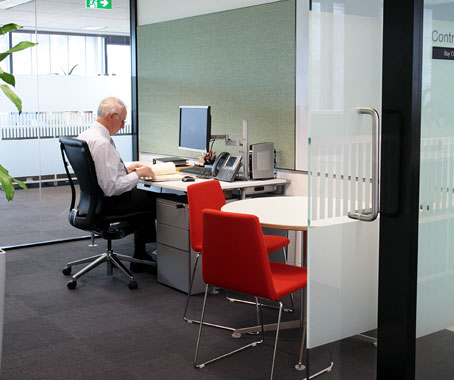
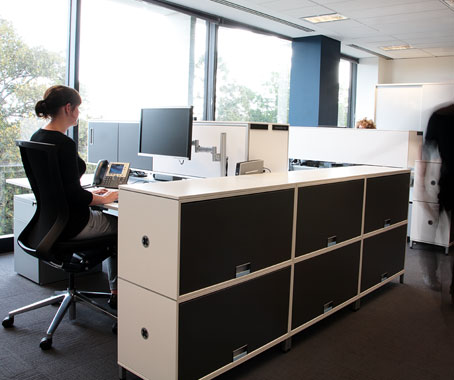
“I wanted it to be energetic and more about community,” he says. And, the main work floor features black and hints of red in scattered furniture and Steelcase ’c:scape’ workstations and desking systems. “We’ve reduced the amount of built-in furniture and the majority of storage modules can be stacked or even moved. It means the fit-out can be changed to meet new requirements or taken on a move rather than having to be removed, thrown out and replaced.”
Photography: Michelle Taylor
Geyer’s desire for efficiency and respect for the existing shell has certainly morphed into a new reality on the test floor of the City of Perth building. The Geyer refit has pared back the interior to inject a contemporary resolution that respects the modernist roots of the building while providing a functional, energised work environment for the current occupants.
Geyer
geyer.com.au
INDESIGN is on instagram
Follow @indesignlive
A searchable and comprehensive guide for specifying leading products and their suppliers
Keep up to date with the latest and greatest from our industry BFF's!
The internet never sleeps! Here's the stuff you might have missed