The home of architecture and design in the Asia-Pacific
Get the latest design news direct to your inbox!

Get the latest design news direct to your inbox!
As ever, the design giant’s movements reflect the industry pulse. So, what does its recent string of fashion collaborations tell us about the future?

Screenshot from Hypebeast preview.
May 9th, 2018
Gone are the days when IKEA was the pariah of the design world, reviled for its tendency towards cheap materials and suspiciously recognisable designs. In recent years, the flat-pack kings have become less pariah and more barometer of trends within the industry, pioneering instead of copying the movements of the top end. In short, of late IKEA has been more forward and less backwards.
Reading said barometer in our current moment, it seems to be pointing towards a new fluidity that is seeping between the cracks of different disciplines and loosening the militantly kept borders between areas of design such as architecture, fashion and furniture.
Although these disciplines have always had their novelty involvements with one another, they have often been tokenistic and oblique, such as an architectural slant to a padded jacket shoulder or a chair that references the signature pattern, style or geometry of a couture brand.
However, in recent years, these crossovers have seemed to become more literal, with designers from, say, the furniture industry collaborating with a bathroom manufacturer on a one-off collection.
Perhaps it’s a reflection of an increasingly critical consumer market, which, with the world at its fingertips, seeks originality while still not having completely shed the influence of 1990s logomania; or perhaps it’s the natural endpoint of a society hell-bent on getting as close to our celebrities as possible. In either case, there’s no denying the shifting landscape.
If there’s one thing IKEA has always been chasing, it’s the satisfaction of a mass audience, with a clinging to the zeitgeist, which has always been evident in its business model. And at present, this zeitgeist seems to sit with streetwear.
A recent survey completed by market researchers at Piper Jaffrey found that the demand for ‘streetwear’ – as exemplified by grunge-heavy brands such as Supreme and Vans – has skyrocketed among the youth market (ever the holy grail of commerce).

Virgil Abloh (pictured left) with a prototype of one of the rugs set to launch at IKEA.
This has been to the surprising disadvantage of old, formerly untouched monoliths such as Nike, which not so long ago ruled the roost with its successful channelling of the athleisure craze, among other trending topics.
One of the undeniable profiteers of the streetwear phenomenon has been Virgil Abloh, founder of streetwear label Off-White and recently appointed artistic director of Louis Vuitton. (The latter, formerly synonymous with its logomaniacal, celebrity-touted handbags and luggage, has pre-empted and subsequently thrived within the streetwear craze, hence its cunning appointment of Abloh.)
Which brings us to back to IKEA, and its latest choice of collaborator. Considering the preamble you’ve just sat through, it will come as no surprise that the most recent IKEA contributor is none other than Abloh, the reigning king of streetwear.

Abloh’s appointment to the imminent furniture collection follows in the substantial wake of his IKEA-stamped contemporaries: Jasper Morrison, Naoto Fukasawa, Patricia Urquiola, Walter Van Beirendonck, Studio Truly Truly, Tom Dixon and fellow streetwear baron, Stampd’s Chris Stamp. The collection of the latter was a surprise expansion to IKEA’s prototypical offerings, including everything from lean-to LED light rods to hyper-minimalist clothing and IKEA’s first-ever skateboard.
Despite having made his name in slouchy cuts and graphic prints, Abloh brings to the IKEA table a background in architectural studies (yet another reminder of the oft-overlooked crossovers between design disciplines). Although the final designs have yet to be released, he’s teased some works-in-progress via his social media accounts, describing the vibe as “democratic design” for a millennial audience.
So far, it looks like consumers can expect at the very least some rugs, chairs and bags from Abloh’s collaboration. In fact, it seems the output will be quite rug-heavy. On April 30, Abloh – in true Abloh style – live-streamed a selection of prototypes from an undisclosed location in New York City. Two graphic rugs – one emblazoned with “KEEP OFF” and the other with “BLUE” – and an Off-White take on the classic FRAKTA bag were among the items shown. According to Abloh, the designs merge Sweden’s furniture traditions and construction methods with his own creative influences, which come from pop art and conceptual art.
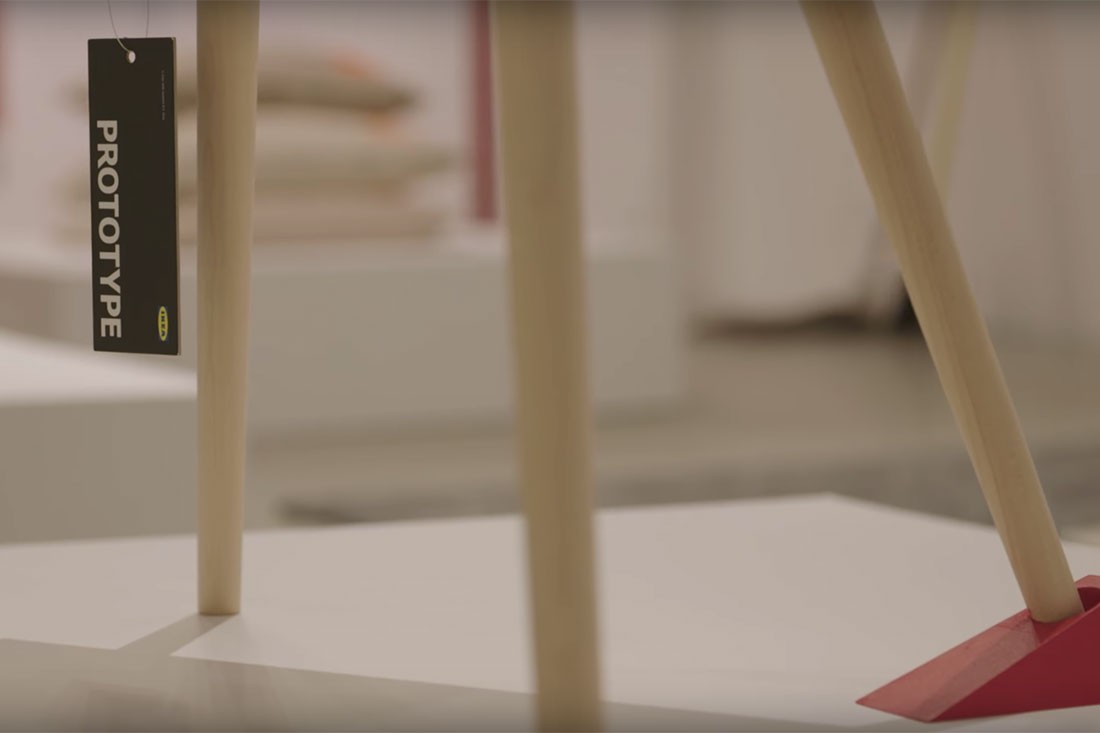
A prototype of the Markerad chair, designed by Virgil Abloh for IKEA. Image taken from Hypebeast launch video.
“What we’re seeing is not the finished product; it’s a milestone in the creative process,” Abloh reinforced.
Aside from IKEA’s aesthetic influences seeping into the range, other elements that brand familiars will recognise are affordability and availability, with the video promising that all items in the collection will fall within the regular IKEA price range.
For consumers, this represents the true benefit of such collaborations: good, affordable furniture with a designer signature that clears it beyond the bar of mass-production.
Watch the full livestream of the IKEA X Virgil Abloh collaboration on YouTube. Or read about IKEA’s recent collaboration with Tom Dixon.
–
Want more stories like this straight to your inbox? Sign up for our newsletter.
INDESIGN is on instagram
Follow @indesignlive
A searchable and comprehensive guide for specifying leading products and their suppliers
Keep up to date with the latest and greatest from our industry BFF's!
The internet never sleeps! Here's the stuff you might have missed