The home of architecture and design in the Asia-Pacific
Get the latest design news direct to your inbox!

Get the latest design news direct to your inbox!
Turning VOC-free, recycled paper into environmentally-friendly lightweight board.
March 3rd, 2008
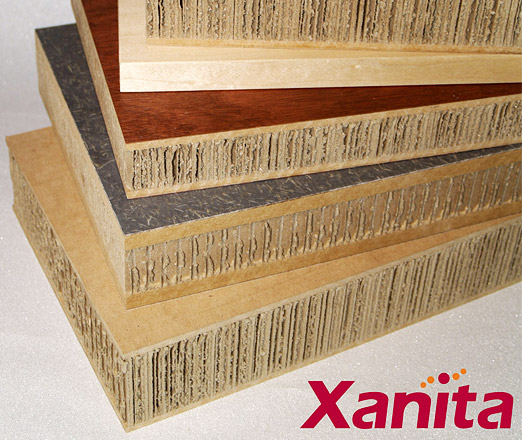
As far as environmentally-friendly, lightweight boards go, Xanita have significantly raised the bar in the manufacture of medium-density fibre board using 100% post-consumer recycled paper waste, which is 100% VOC-free.
Their proprietary process uses specially recycled kraft paper fibres, formed into a small, closed-cell honeycomb structure from 10 to 50mm in gauge, to which direct inkjet printable acid-free white, recycled paper is applied. This form of board is branded “X-Board” (XB).
For permanent applications, rather than laminating printable paper to the core, various thickness “skins” of e-zero MDF, particle board or plywood are press-applied to the core. This board is termed “X-Board Plus” (XB+) and is tipped to replace many applications where heavy-weight, formaldehyde-based solid MDF or particle board is used. Examples include office workstations, screens, kitchen and reception bench tops, entertainment units, bookshelves, and other contemporary designed furniture.
Both boards offer a composite panel with extremely high strength-to-weight ratio and flexural rigidity. In fact ‘X-Board Plus’ is approximately 75% lighter than solid MDF or particle board and it can be machined and direct edge-banded with no extra investment in machinery, making design specification as simple as specifying MDF.
Boards are supplied up to 250mm thick, with timber veneers or decorative laminates applied by 65 year old panel pressing specialists Sharp Plywood in Brisbane, who ship nationally.
A full range of specially manufactured lightweight board fittings are now available from Häfele Australia. Visit Xanita and Sharp Plywood representatives in the Design for Sustainability Hall at DesignEx in April this year.
Complete the application form here to receive a free sample of XB or XB+.
Xanita
1300 882 214
xanita.com.au
INDESIGN is on instagram
Follow @indesignlive
A searchable and comprehensive guide for specifying leading products and their suppliers
Keep up to date with the latest and greatest from our industry BFF's!
The internet never sleeps! Here's the stuff you might have missed