The home of architecture and design in the Asia-Pacific
Get the latest design news direct to your inbox!

Get the latest design news direct to your inbox!
Visions from the Victorian Eco-Innovation Lab.
May 14th, 2009
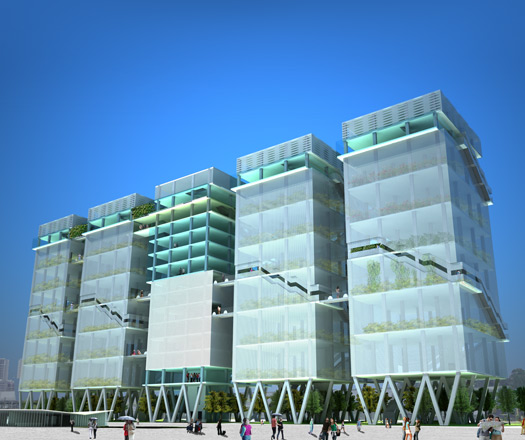
The last remaining large-scale vacant site available for development in Melbourne’s CBD has been targeted for an eco-city of the future.
The Victorian Eco-Innovation Lab (VEIL), funded by the Victorian Sustainability Fund, has applied its innovative thinking to transform the land, dubbed E-Gate, into a radical new zero-carbon development, the future of our built environment.
Between the CBD and Docklands, this district will be known as the Ecological Business District (EBD). Professor Chris Ryan, Director of VEIL, believes that in order to transform our economy to deal with climate change, we must target the areas of production, infrastructure, built environments and life-styles.
The EBD development aims to support those who choose to reduce their carbon footprint and “all people who live and work on the site will meet Victoria’s 2050 environmental targets twenty-five years ahead of time.”
VEIL ran a series of workshops last year with design staff from the Universities of Melbourne, Monash, RMIT and Swinburne. These creative scholars connected with international and local experts to develop ideas for this new model of sustainable living, based on “living better, consuming less,” to be developed in the next 6 – 10 years.
www.ecoinnovationlab.com
Hero Image: ’Vertical Farm’ Design by Yongpeng Shen at RMIT as part of the Victorian Eco-Innovation Lab (VEIL)
INDESIGN is on instagram
Follow @indesignlive
A searchable and comprehensive guide for specifying leading products and their suppliers
Keep up to date with the latest and greatest from our industry BFF's!
The internet never sleeps! Here's the stuff you might have missed