The home of architecture and design in the Asia-Pacific
Get the latest design news direct to your inbox!

Get the latest design news direct to your inbox!
Dr Yu Kongjian, the founder of multi-disciplinary design and engineering firm Turenscape, is a leader in the development of landscapes that combat flooding while repairing ecological damage and winning hearts.

Dr Yu Kongjian photographed in his workzone at Turenscape's Beijing Headquarters. Portrait by Shawn Koh
July 31st, 2018
In Asia’s rush towards urbanisation, a post-industrial framework of water management has largely been adopted. It is characterised by draining water away from our cities as quickly as possible, using pipes and concrete drains.
Dr Yu Kongjian, founder and Principal Designer of Turenscape and Dean of the College of Architecture and Landscape Architecture at Peking University, presents the idea of Sponge Cities – a concept synthesising modern water management systems with the ancient Chinese agricultural wisdom deployed in rice paddies and ponds.
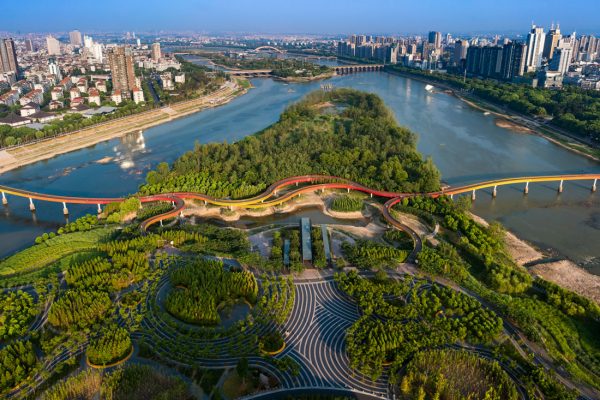
Yanweizhou Park during dry season. Photo by Dr Yu Kongjian, courtesy of Turenscape.
Sponge Cities retain and slow down the flow of water through the use of terraces, ponds and dykes. Urban landscapes become active systems that absorb excess water during monsoon rains, retain and filter it within a meandering landscape, and release it for use during dry seasons.
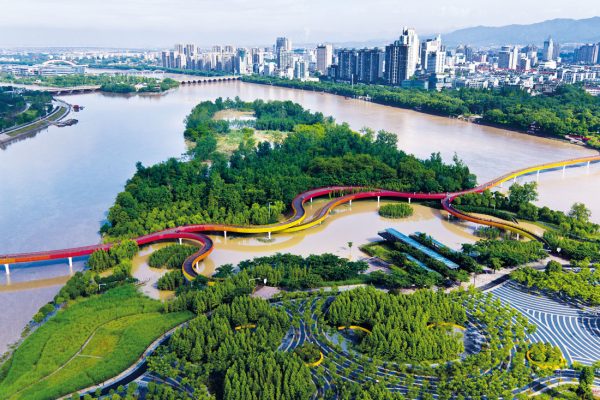
Yanweizhou Park during wet season. Photo by Dr Yu Kongjian, courtesy of Turenscape.
The Sponge City solution to urban inundation has been applied in over two hundred cities in China and beyond, gaining credence as the Chinese government’s adopted urban ecology framework.
Water-scarce Singapore certainly has reason to take a leaf or two out of Turenscape’s book.
Retaining water is thus a key national policy issue – a familiar refrain in Singapore.
When asked for his thoughts on Singapore’s ecological development, Dr Yu raises several pertinent points. “Singapore has built so much, all its rivers are channelised. Ramboll Atelier Dreiseitl did a great job with Bishan-Ang Mo Kio Park, but you have 100 more canals to deal with,” he jests.
“There is strong bureaucracy and an established infrastructural framework – but if you can integrate an ecological mindset into the civil engineering system, Singapore can become a sponge nation, reach its goal of being self-sustainable, and solve the problem of floods,” he adds.
Singapore will soon see an initial test bed of some of Dr Yu’s strategies, as Turenscape was awarded noteworthy Rail Corridor commissions for the adaptive reuse of Tanjong Pagar Station and integrated housing at Choa Chu Kang with MKPL Architects.
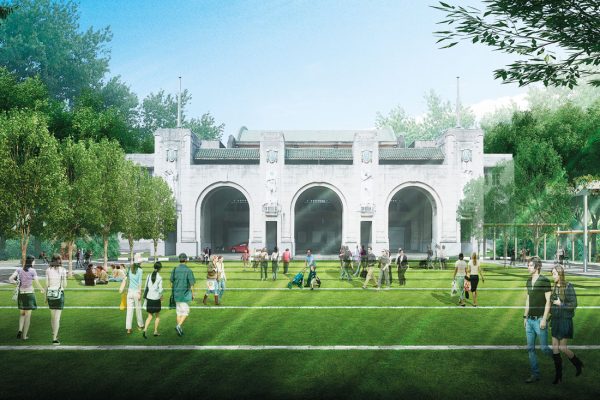
The exterior of the former Tanjong Pagar Railway Corridor with MKPL Architects. Rendering by Norm Li for Turenscape/MKPL team.
Their proposals involve transforming the linear corridor into a social nexus that retains cultural heritage as well as ecological flows through the site.
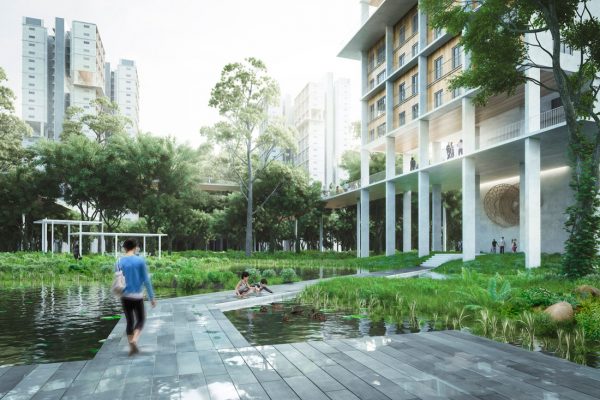
The exterior wetlands of the integrated housing at Cho Chu Kang project with MKPL Architects. Rendering by Norm Li for Turenscape/MKPL team.
Read the complete article in Cubes 91: Designing Resilience.
INDESIGN is on instagram
Follow @indesignlive
A searchable and comprehensive guide for specifying leading products and their suppliers
Keep up to date with the latest and greatest from our industry BFF's!
The internet never sleeps! Here's the stuff you might have missed