The home of architecture and design in the Asia-Pacific
Get the latest design news direct to your inbox!

Get the latest design news direct to your inbox!
Caroline Burns, Geyer’s Regional Leader, Asia, and a speaker at the upcoming BEX Asia 2012 conference, talks to Narelle Yabuka about sustainable workplace design.

indesignlive.sg
October 4th, 2012
How do you define the term ‘sustainable workplace’?
In its broadest sense, a sustainable workplace is one with the ability to evolve with the business and support business longevity and corporate social responsibility goals (CSR). Within this definition there is a responsibility towards the environment, ensuring that the corporate real estate of the organisation leaves the smallest possible footprint on the planet, insofar as this is practical and reasonable.

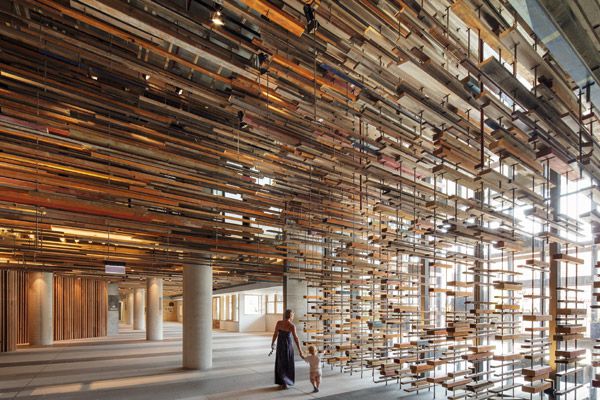
BHP Billiton project by Geyer
In general, how does Southeast Asia perform in terms of sustainable workplace design?
The governments of many Southeast Asian nations have demonstrated leadership in establishing sustainable building and corporate interior certification schemes, and green labelling schemes for products and materials – for example Green Mark and the Green Labelling Scheme in Singapore. Multinationals are also active in the region and have applied global CSR/ESD goals to their premises, particularly new ones. Many of these seek certification (“LEED plus Local”) but others have their own internal targets, which are equally valid.
The scale of new construction and new fitout in the region gives rise to greater opportunity to create sustainable workplaces, and the interior design and engineering consulting professions are fully supportive and valuable advisers in this regard. Developers and investors also increasingly see green buildings as commercially viable.

Are there any particular challenges related to the achievement of sustainable workplace design in this region?
There are a couple of major challenges that immediately come to mind. The tropical climate across most of the region creates a dependence on air-conditioning, which means natural methods of heating/cooling and ventilating are generally impractical and not commercial. If we take the need for air-conditioning as a given (at least for the immediate future) there is a significant untapped opportunity for private and public sector leadership in developing more energy-efficient ways of cooling. Greater occupant tolerance for temperature variation would also help reduce the load on building HVAC systems.
The other significant challenge is the short term, cost-driven focus of many Asian business leaders, including corporate real estate executives. Many sustainable workplace initiatives have a payback period of 3 to 5 or even 10 years, however most projects are implemented within a capital budget that takes no account of operating savings. Further, short-term leases promote a ‘disposable’ approach to interior fitout that is contrary to sustainable values.

Tell me about one of Geyer’s sustainable workplace projects in Southeast Asia. In what ways does it push the boundaries?
One of the standout exceptions to my point above is BHP Billiton, as exemplified by their 230,000sqm regional headquarters in MBFC, which achieved Green Mark Platinum and LEED Gold certification. After significant research and modelling, BHP Billiton decided to install the largest LED office interior lighting scheme in the region. Although this required significant additional capital expenditure, the 4 to 6 year payback period was considered a very worthwhile investment.
Is there a social dimension to sustainable workplace design?
Absolutely. Sustainable environments require occupants to modify their behaviours and perceptions, something that some organisations don’t realise when they decide to create a sustainable workplace. For example, interior lighting levels may be lower, people may need to take responsibility for recycling their waste in the office, and may have to walk further to access printer hubs.
The other social dimension relation relates to the alignment of corporate and personal values concerning the long-term health of our environment. In this regard sustainable workplaces are a symbol of a company’s adherence to its values, and a contributor to the attraction and retention of staff.
Geyer
geyer.com.au
Caroline Burns will be speaking at Bex Asia on 10 October on “Hitting the Green (Mark) – Designing Sustainable Workplaces”. Bex Asia will be held from 10 – 12 Oct at Marina Bay Sands. Watch this space for more updates.
INDESIGN is on instagram
Follow @indesignlive
A searchable and comprehensive guide for specifying leading products and their suppliers
Keep up to date with the latest and greatest from our industry BFF's!
Discover the latest styles from Italy with Living Tiles. The Living Tiles Rozelle showroom will host an evening of Nuova Italia on Thursday 2 June. What: Nuova Italia 2011 Product LaunchWhere: 133 Victoria Road RozelleWhen: 2 June 2011, 6-9pm Living Tileslivingtiles.com.au
The internet never sleeps! Here's the stuff you might have missed