The home of architecture and design in the Asia-Pacific
Get the latest design news direct to your inbox!

Get the latest design news direct to your inbox!
Kam Leng Hotel in Singapore was envisioned as a “black and white photo coming alive”. Architect Tiah Nan Chyuan tells Yvonne Xu about the project’s compelling design process.

indesignlive.sg
March 29th, 2013
When it opened about a year ago, Kam Leng Hotel would receive keen guests at its doors, enquiring when the property was going to be completed. But travellers were not the only ones who needed the convincing.
“The contractors working on this project constantly asked us if it was really okay to leave the walls and floors as such, with all the cracks and peeling paint,” architect Tiah Nan Chyuan recalls. “[It] took them a while to understand what we were trying to achieve.”
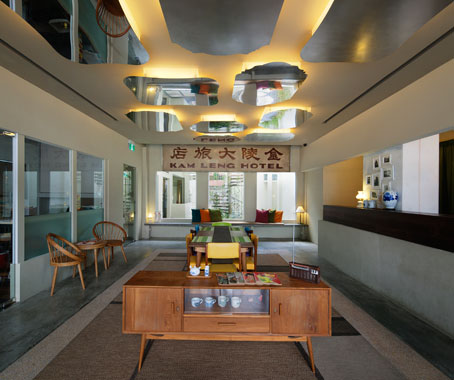
Tiah and his team at FARM had been tasked to get a long-abandoned building on Jalan Besar spiffed up for a reopening as a 70-room boutique hotel, and they’d gunned for a simple scheme: not to redesign it so much as to rediscover the history, style and feel of the original early 1900s property – cracking walls, paint, and all.
“It took a very brave client to actually accept this, I guess,” Tiah reflects, glad that they eventually sold the idea to hotel developer JL Asia on grounds of cost saving. But it isn’t hard to believe that it really is the design team’s sheer enthusiasm for the old building that got them the green light.
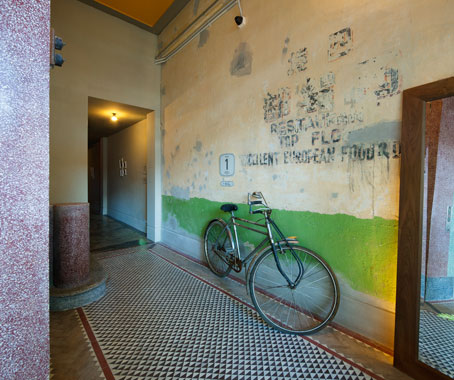
Even before the call from JL Asia, the team already had, in a way, their eye on the space. “We sneaked into the building before, to explore – [so] we were familiar with the building. The rooms were abandoned for some time. We loved how the building was left untouched,” Tiah reveals, adding that, because there was little information on the building available then, the project took on an “air of mystery” that intrigued and engaged the design team even more.
“We tried to dig up as much information about the building as possible. We had conversations with conservation gurus Studio Lapis about the history of the building and they offered some very interesting insight.
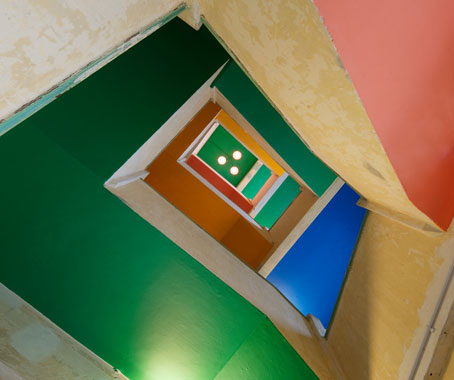
“We tried very hard to retain as much of the original atmosphere as we could. We had this idea that the existing building would provide a monochromatic backdrop to the experience while light splashes of colours would emerge upon interaction with the spaces – like a black and white photo coming alive with colours,” Tiah explains.

This idea was carried through in the design of the rooms, as well as in signage and furniture where colours pick up or fade away to highlight corners or define planes. The design process was an organic one that evolved as the team started to discover the site, and was greatly influenced by colours and motifs seen in films and graphic design culture from the 1900s.
The limited budget Tiah worked with also yielded other surprising rewards. “Our regular carpenters could not meet the allocated budget for the rooms; out of desperation, we sourced for furniture pieces from the surrounding local furniture shops and we found this guy round the corner who actually did old school rattan and solid timber furniture pieces at very old school prices!” Tiah shares. “We got him to fit out all the bedside tables in the rooms. We would have loved for him to fit out everything but he could not manage the order as he was a one-man show. For decorative pieces, we sourced for knickknacks from Thieves market, again round the corner. I mean seriously, how many hotels will actually use things from the Thieves market? It was eye opener and very fun at the same time.”
Photography: Jeremy San Tzer Ning / Stzern Studio
FARM
farm.sg
INDESIGN is on instagram
Follow @indesignlive
A searchable and comprehensive guide for specifying leading products and their suppliers
Keep up to date with the latest and greatest from our industry BFF's!
The internet never sleeps! Here's the stuff you might have missed