The home of architecture and design in the Asia-Pacific
Get the latest design news direct to your inbox!

Get the latest design news direct to your inbox!
Madeleine Blanchfield shares insights into her design philosophy, her journey into architecture, and the challenges and triumphs of working with heritage buildings to create homes that adapt to their owners’ evolving needs.

March 21st, 2025
In this episode of SpeakingOut!, proudly supported by Tongue & Groove, the partner of The Interior Space at the 2025 INDE.Awards, we speak with Madeleine Blanchfield, the founder of Madeleine Blanchfield Architects.
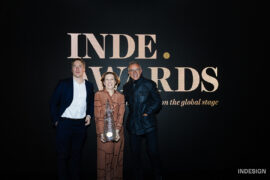
Blanchfield’s firm, established in 2009, specialises in new residential builds, large-scale renovations, and interiors. Her award-winning project, Vessel, took home The Interior Space category at the 2024 INDE.Awards, showcasing a balance between heritage preservation and contemporary design.

A Passion for Architecture: Madeleine’s Journey
From a young age, Madeleine Blanchfield knew she wanted to be an architect. A childhood school project – drawing a house plan – sparked an early fascination with designing spaces, despite lacking the technical skills at the time. Her love for creativity, problem-solving, and the intersection of art and mathematics led her to pursue architecture.
At one point, she was awarded a scholarship to explore another career path, but she ultimately chose architecture, committing to the rigorous education and professional journey that followed. Since then, her career has been defined by a thoughtful and innovative approach to residential architecture.
Vessel: A Stage for Life
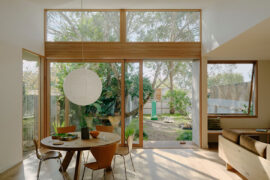
Blanchfield’s award-winning project, Vessel, reimagines a Victorian terrace home as an urban sanctuary tailored to its owners’ multifaceted lives. Designed for a professional couple, the home had to accommodate contrasting uses – hosting lively gatherings, serving as a workspace, and offering moments of quiet retreat.
The front of the home retains its original grandeur, featuring restored heritage rooms, while the rear was completely rebuilt. The design embraces flexibility, allowing the home to act as a stage for different aspects of life. The challenge was ensuring each function felt natural and harmonious within the space.

Navigating Heritage Challenges
Working with heritage buildings always presents challenges, but for Blanchfield, these constraints can lead to creative breakthroughs. In Vessel, the requirement for a pitched roof initially seemed like a limitation. However, it inspired a key design feature – internal voids that rise into pyramid-like skylights, bringing light and spatial dynamism into the home.
This approach exemplifies how navigating restrictions can result in unexpected and compelling design solutions. Rather than resisting heritage requirements, Blanchfield embraced them, crafting a unique architectural language that respects the past while introducing innovation.
A Philosophy Rooted in Purposeful Design
Blanchfield’s passion for residential architecture stems from its deeply personal nature. She thrives on the opportunity to transform spaces, uncovering each site’s hidden potential. For her, the most rewarding part of the process is taking a concept from sketch to completion, witnessing a client’s joy as they step into their thoughtfully designed home.
Every site offers something unique, and Blanchfield’s philosophy is about maximising that potential. She believes the best designs arise from the most complex challenges, where creativity is required to deliver truly exceptional spaces.

The Impact of Vessel
The four-year journey of Vessel, extended due to COVID-related delays, was well worth the wait. The project exceeded expectations, offering a serene yet dynamic environment. It balances heritage sensitivity with modern adaptability, providing a space that is both visually striking and inherently functional.
Blanchfield describes walking into the finished home as a moment of affirmation – the design feels just right. It remains open-ended, allowing the owners to define how they use it, reinforcing the project’s core philosophy of flexibility and livability.
Madeleine Blanchfield’s insights remind us that the best architecture responds not just to physical constraints but also to the evolving needs of its inhabitants. Her dedication to purposeful, transformative design has cemented her reputation as a leading architect in Australia’s residential space.
We thank Madeleine for sharing her journey and expertise. A special thanks to Tongue & Groove for supporting this episode of Speaking Out!. To hear the full interview, check it out here.
Don’t miss the opportunity to showcase your innovative projects – enter the 2025 INDE.Awards now!
INDESIGN is on instagram
Follow @indesignlive
A searchable and comprehensive guide for specifying leading products and their suppliers
Keep up to date with the latest and greatest from our industry BFF's!
The internet never sleeps! Here's the stuff you might have missed