The home of architecture and design in Asia-Pacific
Get the latest design news direct to your inbox!

Get the latest design news direct to your inbox!
Marcel Heijnen’s Residue photo-series serves as a reminder of impermanence, human mortality and the quiet passing of our built environment. Iliyas Ong has the story.
December 17th, 2013
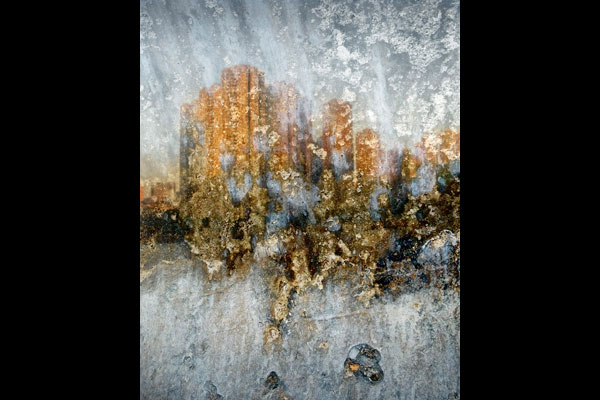
Figment, Hong Kong
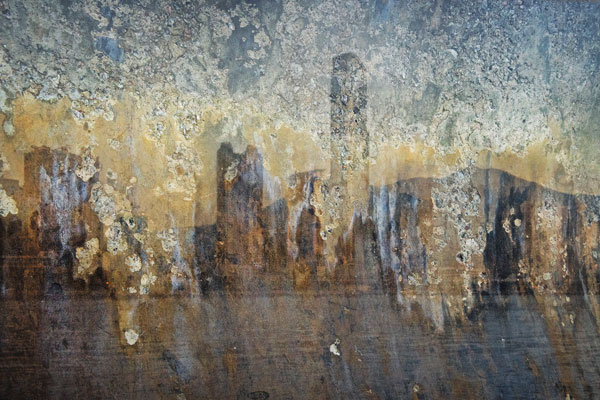
At first glance, the photographs of Marcel Heijnen’s Residue series look like violent watercolours. They have the muted colours and gauzy outlines expected of the medium, but go closer and you’ll notice those colours are actually bristling patches of rust and ancient concrete. Gaze closer still and you’ll realise those outlines are modern skyscrapers, the layer of detritus superimposed against them. There’s a certain tension in the shots: the past and the present as combined into a single image.
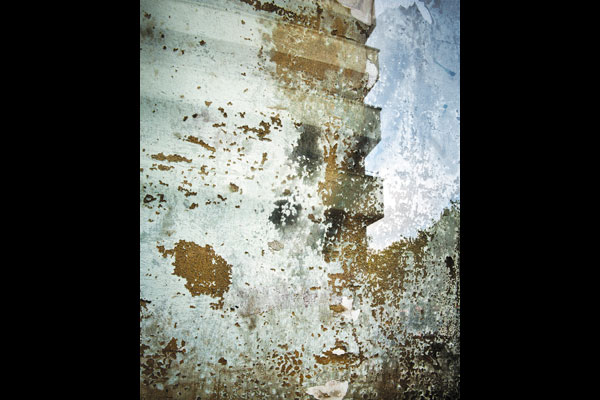
Defu, Singapore
Heijnen has been shooting images such as these for about five years now, travelling between Singapore, Hong Kong, Jakarta and various cities in China to use as backdrops. And despite their surreal quality and the 49-year-old’s background in graphic design, these images haven’t been digitally post-processed. All the Dutchman uses are a large glass panel, his camera, and an imaginative eye.
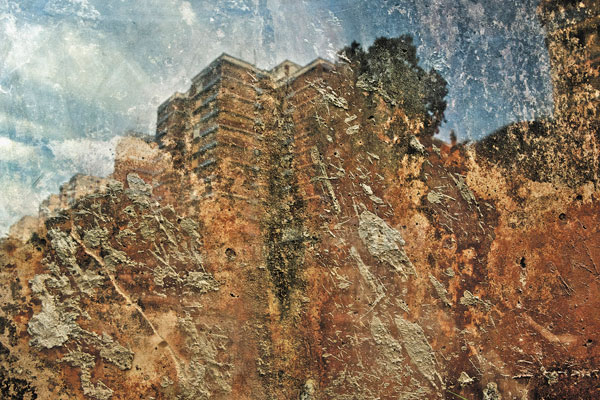
Sediment, Singapore
It’s a deceptively simple process: Heijnen finds a heavily scarred wall over whose vicinity looms contemporary high-rise buildings. He props the glass panel against the wall and angles it to catch the reflection of the surrounding blocks. Then he aims and releases the shutter, capturing the stark texture of the wall and the ghostly contours of the towers in the same image.
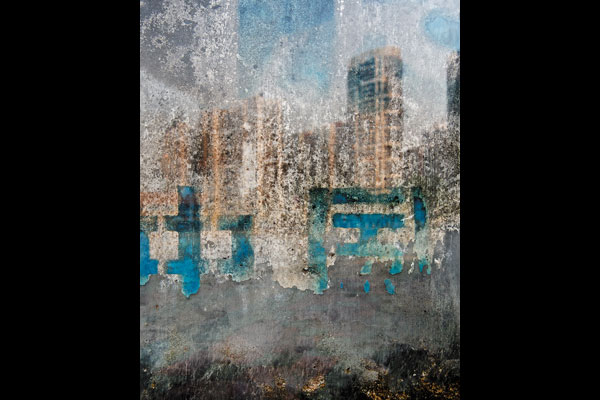
Moult, China
“It’s almost as though the two—wall and buildings—start merging,” Heijnen says. “They are collapsed into one. It is still a reflection, but you don’t see it as a reflection anymore. The image is flattened. It looks very organic because it’s about nature trying to balance things out. We build very straight buildings out of glass and concrete and steel, but nature has its own way of reclaiming them. It’s almost as though I’m looking at these cities through a layer of decay. And I find decay inherently beautiful.”
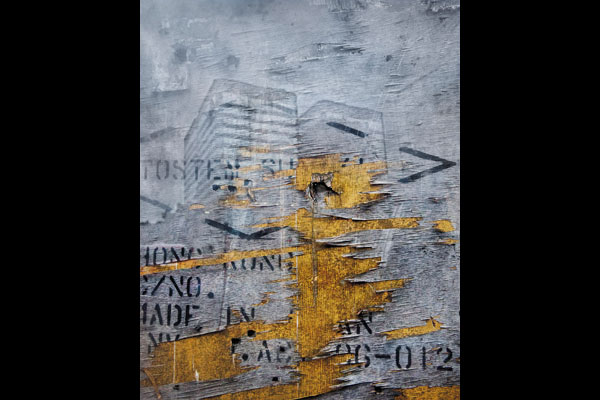
Weft, Hong Kong
But Residue isn’t about fatalism, clarifies Heijnen. Rather, the photographer is inspired by the Japanese concept of ‘wabi-sabi’: an acceptance that nothing is perfect, nothing lasts, and nothing is finished. Unlike the Western notion of ‘memento mori’ (remember that you will die), which laments impermanence, Residue celebrates it.
“It’s about the remnants of things left behind,” Heijnen explains. “And that can be seen in many ways. Is it the residue of memory? The residue of nature? The residue of what we’ve built and that which has been torn down? There are still traces of what was there before, so that’s where the title comes from.”
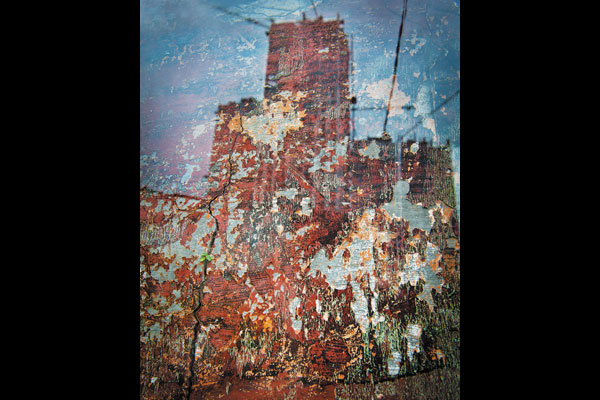
Offspring, Indonesia
When shooting in Singapore, Heijnen, who has lived here for 19 years, avoids the usual suspects—Marina Bay Sands, the Singapore Flyer—and instead heads out to the heartlands. HDB estates, at once brutal and gossamery, figure prominently in Residue. “HDBs are more quintessentially Singaporean,” he notes. “If you see the skyline of, say, Melbourne or San Francisco or Sydney, they’re pretty close to one another: tall buildings with water and low-rises in front. But nowhere else in the world will you find HDBs, with those kinds of colours and patterns.”
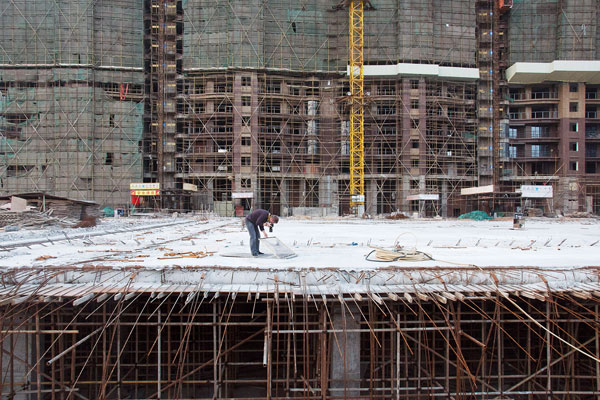
Heijnen at work. Photo © Dawn Mok
Heijnen is also fascinated by the speed at which Singapore undergoes redevelopment. According to the photographer, while in Europe city buildings tend to remain unchanged, it isn’t far-fetched to imagine the urban landscape here as a shifting, nebulous entity—almost organic. Which makes Residue’s representation of decay and impermanence in the city all the more poignant.
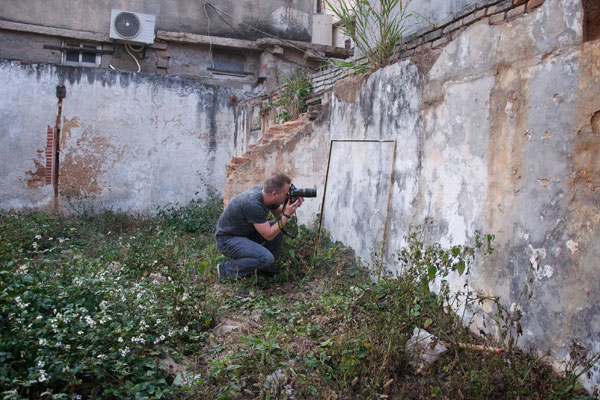
Heijnen at work. Photo © Dawn Mok
“Nature never does anything that’s ugly,” Heijnen muses. “You’ll never see an ugly tree or an ugly flower. Whatever nature does is always beautiful. Whatever we do as human beings is not always beautiful.”
Top image: Swell, Hong Kong
Marcel Heijnen’s 4th solo exhibition Residue is on from now till 19 January 2014 at Artistry. Heijnen has also launched a new book titled “Residue”, a 140-page hardcover of new and signature works.
Marcel Heijnen
marcelheijnen.com
Artistry
artistryspace.com
A searchable and comprehensive guide for specifying leading products and their suppliers
Keep up to date with the latest and greatest from our industry BFF's!
The internet never sleeps! Here's the stuff you might have missed