“Consideration of aesthetics is often met with a sniff of disapproval – a lingering suspicion of a louche moral code perhaps.” – Margie Fraser
|
We asked indesignlive’s Queensland correspondent to respond to the recent controversy surrounding the Kurilpa Bridge Project in Brisbane by Cox Rayner Architects. Below is her response.
Is making a fuss good in itself? By fuss I mean, in this case, debate. The new Kurilpa Bridge in Brisbane has spawned a barrage of debate and public fuss over its design of a level seldom witnessed before in the city.
Is it a good thing that people are so up in arms or, alternatively, so enamoured of our latest CBD public structure? Well, yes. It’s got to be good that apathy no longer reigns, and that there’s plenty to debate centring on the built environment. Recently, discussion of the proposed North Bank development caused similar schisms.
Not so many decades ago, development went wildly unchecked in this state and the punter didn’t even consider that he/she had a voice in the matter beyond a lucky gig on a talk-back show or a Letter to the Editor. Not that a lot of the development could be considered “designed” but that’s partly the point.
Some of us remember the dark days of white shoe brigade-ism only too well.…Now a new breed of developers is not only supporting fine design, but indeed demanding and creating it – thank you Mr Ross Nielsen, Mr Tony John, Mr Don O’Rourke, Mr Toby Lewis and others.
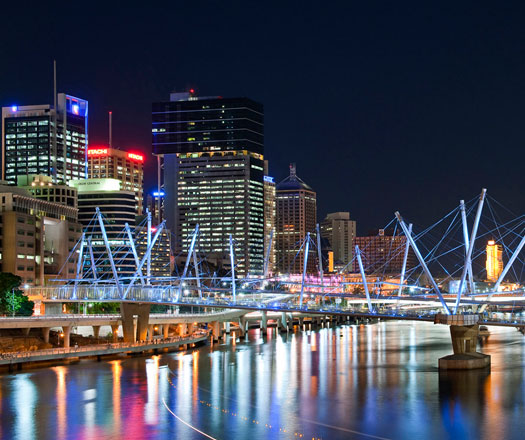
So – to Kurilpa Bridge – alternatively branded in blogs “pick-up sticks”, “prawn trawler”, “adventure playground” and “projectile vomit” (produced from swallowing steel poles) et cetera et cetera. Well at least we’re not being polite and reticent any more.
Recently I interviewed Professor Michael Sorkin who was visiting Queensland from his home town of New York. The esteemed urban designer, architect, author and futurist couldn’t believe what all the fuss was about.
“Why is anyone even focussing on the aesthetics?” he asked incredulously. “It doesn’t matter – it’s such a tiny spec in the scheme of things. What matters is the fantastic amenity it provides to the walkers.”
With Sorkin’s ideal of creating sustainable cities through ditching the car and getting about on foot, there’s much to be said for the viewpoint. Nevertheless it’s good that people have a voice – it proves a sense of ownership and consequent pride of place. And after all, Sorkin believes also that great public spaces provide the opportunity for our democratic right to assemble.
Besides the finer points of citizenship and aesthetics, though, one of the key objections from bloggers, letter writers and talk show participants has been about the project’s expense. Always a sore point. Sophisticated design debate hardly includes having a whinge about government spending priorities – but, rightly or wrongly, community outrage at money spent on anything beyond the “essentials” is a well-flogged horse in this country.
Pragmatism is deemed one of our most honourable virtues. Consideration of aesthetics, on the other hand, is often met with a sniff of disapproval – a lingering suspicion of a louche moral code perhaps – if the practical and financial requirements are not first met.
So, ignoring the money police – I for one have no idea what a bridge should cost and I don’t know why so many people think they do – what are the effects of debate? Lately Brisbane has come of age in terms of events and venues which promote public discourse.
Festival programs such as those of the Writers and Brisbane Festivals regularly create platforms for discussion, as do programs at our State Library and Art Gallery, and private societies established for ‘cultural pursuits’. Institutes such as the Brisbane Institute, the Australian Institute of Architects, the universities and others all provide stimulating and well-patronised talkfests.
Our city design is allowing and promoting more active engagement in public life; where citizens can participate in activities beyond drinking at bars, swimming in public pools, and going to the movies or a football match. These are the practical outcomes of good design, and indeed of design debate.
And a recent walk over the Kurilpa Bridge reinforces that notion. It was interesting to observe people’s enjoyment at simply ambling across the bridge for the sake of the walk, getting a new vantage point on the river and the surrounding land marks; pausing to contemplate the local histories recorded in the walls of its resting spots, and last but not least beginning or ending the journey with the great architectural landmarks of the new Santos building on the north bank and GoMA and SLQ on the south.
Critique aside, most people – from the design profession or beyond – will agree that it’s a wonderful experience to walk across the bridge. Have a walk, have your say, and make a fuss.
Margie Fraser is a contributor to indesignlive.com and DQ, Habitus and Indesign magazines.