The home of architecture and design in the Asia-Pacific
Get the latest design news direct to your inbox!

Get the latest design news direct to your inbox!
New book, Learning Spaces, reports on how design is transforming schools and learning experiences in the 21st century
October 29th, 2009
Learning Spaces is a new book exploring how design is transforming schools and learning experiences in the 21st century, and follows on the heels of the Federal Government’s $16 billion commitment to national education infrastructure over the next three years.
Architect/education academics Clare Newton and Kenn Fisher are the editors of the nation’s latest word on education design, Learning Spaces, being launched in Melbourne this week.
Designing for education is a specialised business and requires expertise in contemporary educational models about how design influences and enhances learning, and can benefit the development of school and university communities and local neighbourhoods.
Learning Spaces is designed to be an aid for better communication between designers and educators and explores the links between learning and design in its combination of journal articles and papers, case studies, interviews and advice from practitioners, professionals and academics.
Schools and curricula are changing. Young people today are natives in the world of information technology, and adept at learning using digital media and it is this increased connectivity between students and their local and global environments that is transforming school environments from teaching institutions to learning organisations.
Yet, there are other factors also at play. Schools are becoming stronger assets for their local communities, with facilities used after hours and as a setting for lifelong learning meaning briefs to architects are increasingly seeking design responses which address the issues of sustainability.
Newton says space is irrevocably linked to teaching strategies.
“Elements such as the shape and size of the spaces, the furniture and finishes are silently influencing how teachers and students behave,” she says.
In tracking recent transformations in the planning and design of formal education settings and their impacts on learning, Learning Spaces uncovers how the most innovative learning environments often evolve as a design response to strong educational direction in schools.
The pair are the first interdisciplinary team to win the Australian Institute of Architect’s 2008 Sisalation Prize and join a long line of successful Australian architectural researchers to publish books in the institute’s Take series.
Details:
Take 8: Learning Spaces – the transformation of learning spaces for the 21st century
Available from Architext bookshops (Melbourne and Sydney), architext.com.au or download an order form at architecture.com.au
Words: Stephanie Madsion
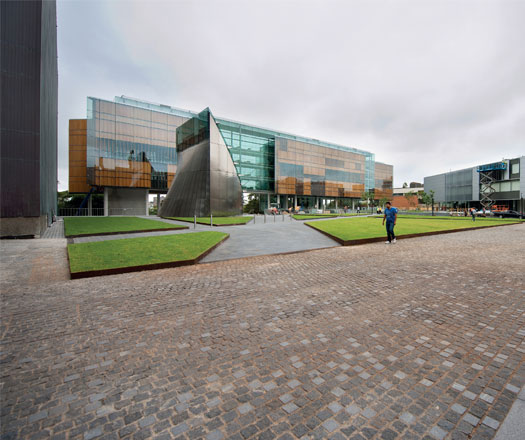
Hero Image: Sydney University Law Building. Photographer – John Gollings
INDESIGN is on instagram
Follow @indesignlive
A searchable and comprehensive guide for specifying leading products and their suppliers
Keep up to date with the latest and greatest from our industry BFF's!
Habitus celebrates its first birthday this issue, with plenty of exciting content and a few design tweaks to more distinctly define the sections of the magazine. Enjoy the dedicated product section up front, with all the latest from around the world and some Springtime ideas for outdoor living. In Singapore, meet Nathan Yong, founder of […]
The internet never sleeps! Here's the stuff you might have missed