Woods Bagot, ADCO Constructions, workplace, craftsmanship, architecture, design, timber, Melbourne
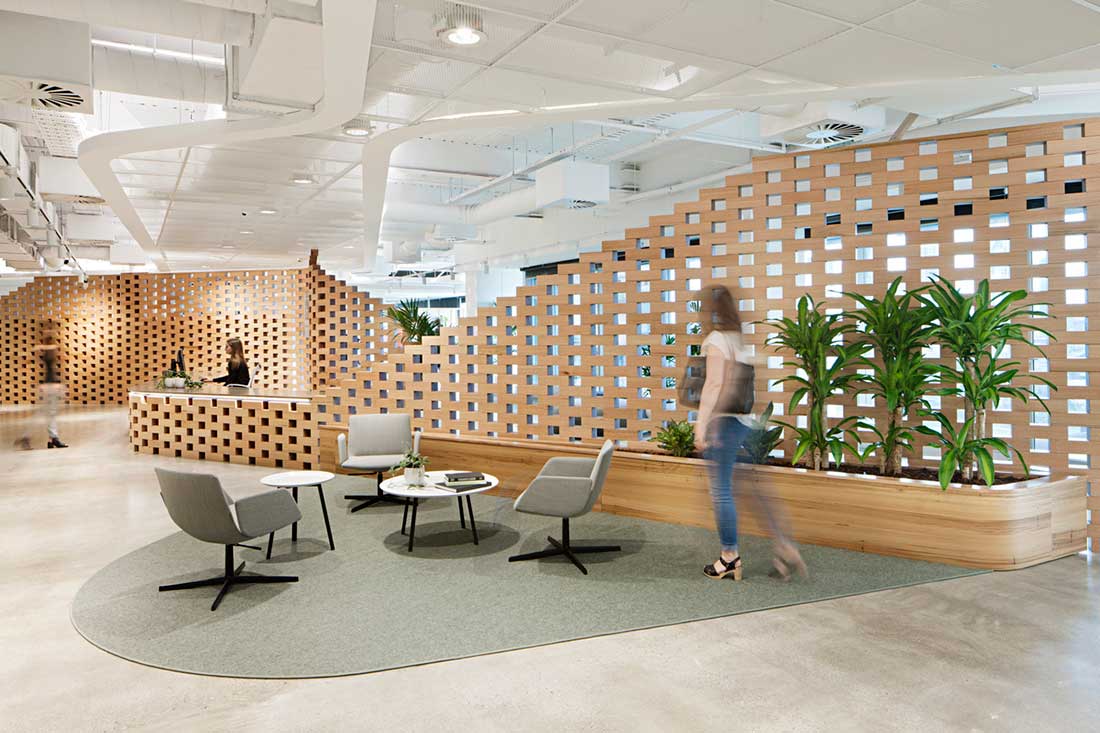
ADCO Constructions’ new workplace in South Melbourne is a contemporary environment that showcases ADCO’s approach to craftsmanship and materials and helps foster company culture through circulation and connections. Designed by Woods Bagot, the workplace achieves all this through one seemingly simple yet highly considered device: a curving timber screen.
The screening element challenges the conventions of materiality by offering a different perspective on two commonly used construction materials – brick and timber. “Referencing the family-run firm’s approach to construction, the design reimagines how traditional building materials can be reinterpreted through innovative methods of assembly,” says Brittany Pearce, Interior Designer. The lattice blockwork, which would customarily be rendered in brick, is crafted instead in timber. “It highlights the well-considered and executed construction that is the backbone of the business,” Brittany says. And like a spine, it runs through centre of the workplace with various areas radiating from its curves.
The screen serves a multitude of purposes, acting as a feature wall that unifies and demarcates space. It forms the reception area and planter box at the point of arrival, and snakes through the workplace to define open and collaborative workspaces. Social and client spaces are anchored to and flow around the screen, and its meandering form facilitates fluid circulation through the office. Its porous nature allows sight lines to be maintained and supports ADCO’s approachable and cohesive company culture. “The arrival experience offers an immediate view into the heart of the business and its people, and the framed views expose the dynamics of the team as they work, share and socialise,” Associate Debra Longin explains.
The curves and timber that are characteristic of the screen are continued throughout the workplace in collaboration and socialising spaces. Curving walls define open meeting rooms and the flexible boardroom, and timber is used for the kitchen joinery in the kitchen and as freestanding shelving unit for planters and display. The exposed ceiling demarcates social areas and a suspended metal-mesh feature with white trim follows the curves of the timber wall and provides another graphic line throughout the space. Similarly the floor finishes mimic the curves, with rugs that extend from the timber screen or express the shape of the metal-mesh ceiling.
With one highly considered design installation that facilitates multiple design intentions, Woods Bagot has delivered a workspace that fosters ADCO’s organisational values and expresses its commitment to construction innovation and craftsmanship. “The fitout demonstrates our point of difference,” says Glen Blamey, ADCO Constructions Senior Manager. “We look at construction from every angle and provide resolution to the greatest level of detail.”