The home of architecture and design in the Asia-Pacific
Get the latest design news direct to your inbox!

Get the latest design news direct to your inbox!
Resurrection and eternal life. Two formidable themes that permeate the soon to open Eternity Playhouse in East Sydney. Owen Lynch goes backstage.
September 19th, 2013
Formerly the Burton Street Tabernacle, a purpose-built place of worship for Woolloomooloo’s Baptist congregation, the Darlinghurst building was completed in 1887 then further extended in 1892 and 1922.
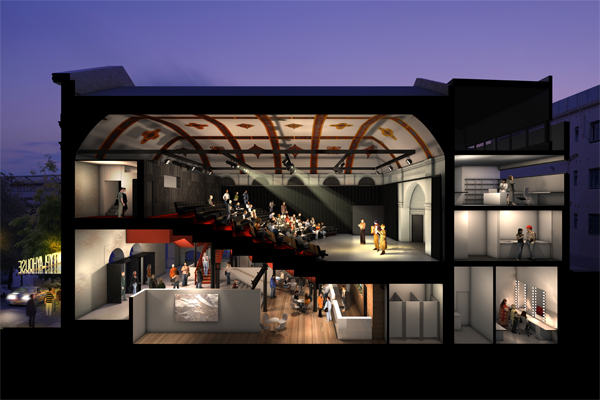
Eternity Playhouse Cross Section © TZG
As a focus of Baptist worship for over 100 years, the last service was held on the site in 1996. The City of Sydney acquired the space in 2003, deciding to convert the heritage site to a community hub and theatre. Nearly a decade on, the $7.9 million restoration and adaptive reuse of the Victorian-era church, is on the eve of completion.
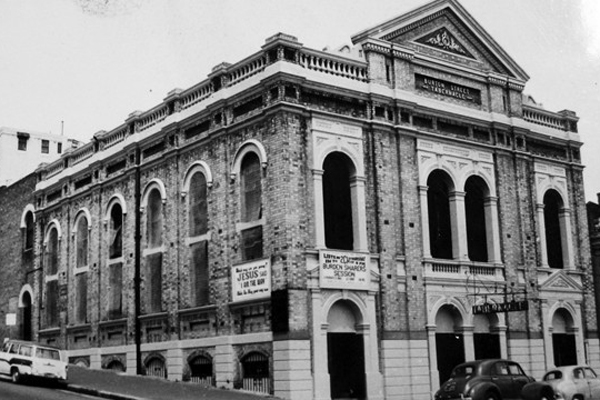
Burton Street Tabernacle c.1958 © NSW Baptist Archives
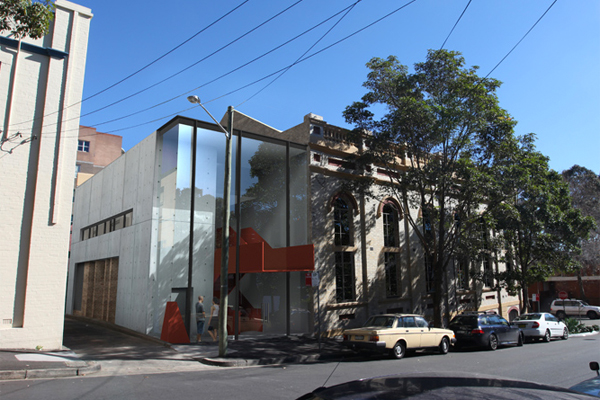
Completed Eternity Playhouse from Palmer Street (Artists Impression) © TZG
Central to the expansive refurbishment was an emphasis on restoration and cultural preservation. As well as re-roofing the entire building, intricate internal plaster detailing and re-pointing of external brickwork was undertaken, the original highly decorative timber ceiling was also uncovered in the process, having been plastered over in the early 20th Century.
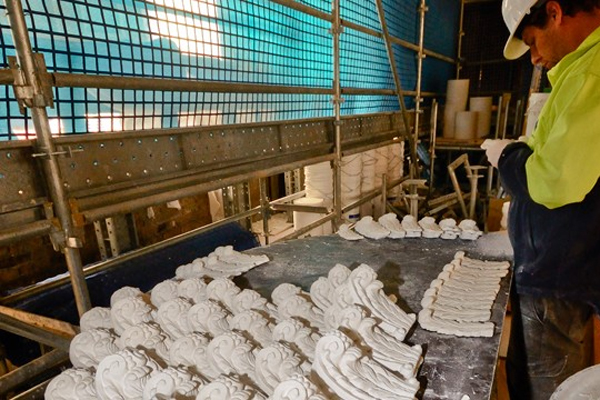
Plaster work Restoration © City of Sydney
Acclaimed for their work on the City of Sydney’s Paddington Reservoir Gardens project, architects Tonkin Zulaikha Greer (TZG) were engaged to repurpose the Tabernacle into a functioning, contemporary theatre space.
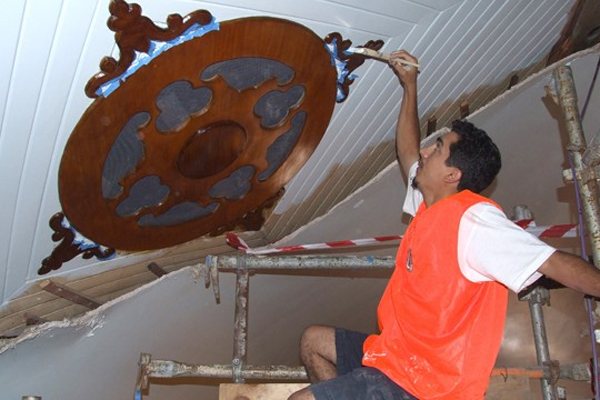
Auditorium Timber Ceiling Restoration © City of Sydney
On site today, Architect Peter Tonkin of TZG shared his thoughts on the new venue: “I love this auditorium – the intimacy of the big stage and the audience will be direct and powerful.” A sentiment shared by Lord Mayor Clover Moore, “What you see now is not what you saw when it was the Burton Street Tabernacle. We got that delicate restoration in stage one and a beautiful theatre in stage two… Whilst it’s intimate it’s very grand and imposing.”
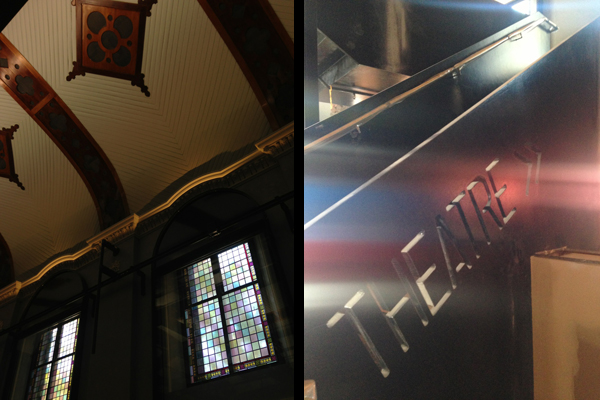
L. Auditorium ceiling with restored windows / R. Steel Lobby Staircase Signage © Owen Lynch
By increasing the rake of the auditorium’s seating on the first floor and undertaking deep excavation into the foundations, the ground floor becomes a sleek lobby with a bar; aesthetically this is an agreeable counterpoint to the finely detailed blonde-brick exterior.
Polished concrete floors lie underfoot, a tiered ceiling of recycled timbers (reclaimed during the restoration process) descend overhead and proud black steel formwork encases twisting staircases and forms balustrades , all matched in the colour treatment of the vertical roof supports. In the lobby we also glimpse the first hints of the multi-storey stained glass windows that flank the main auditorium upstairs.
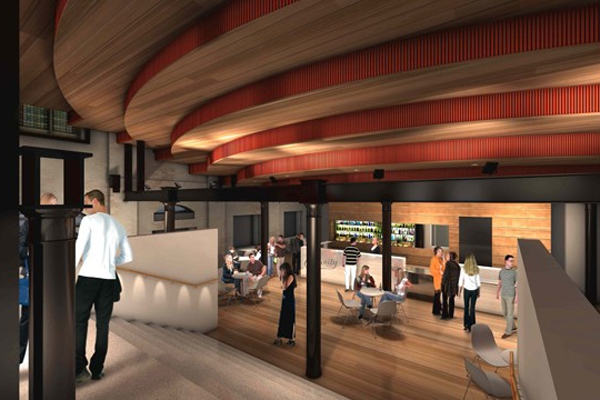
Artist’s impression of lobby and bar © TZG
“The quality of the architecture, both heritage and our new overlay, means that this is really a new unique theatre,” explains Tonkin, “The sense of daylight and processional movement through space for the audience, from the bar up to the theatre [becomes] an exciting, people watching, involving journey.”
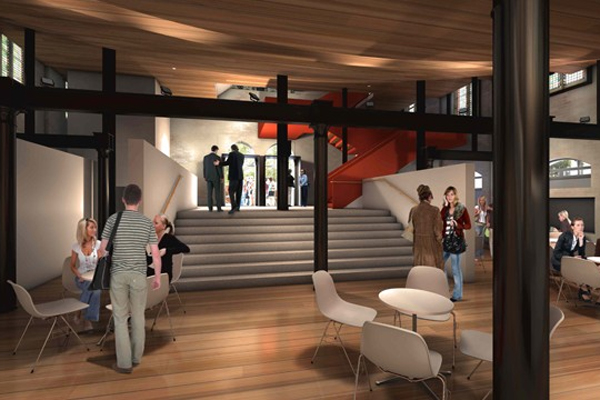
Artist’s impression of lobby from the bar © TZG
With resurrection of the site also comes future-proofing. The grand old building is now fully wheelchair accessible through lifts and ramps, she harvests sunlight through the roof’s photovoltaic panels and also makes use of harvested rainwater. Internally the theatre employs energy saving air-conditioning and lighting technology for use theatrically and in general operation.
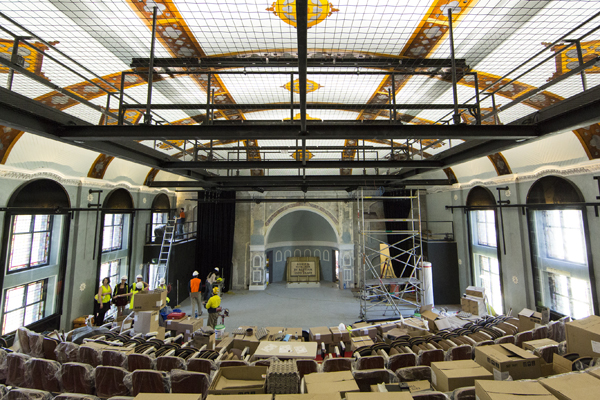
The Eternity Playhouse nearing completion © City of Sydney
A new life and a new function, echoed in the building’s new name. Inspired by a sermon at the church in 1932, parishioner Arthur Stace quite literally took the message to the streets. For twenty years he would inscribe pavements across the city over a million times with the word “Eternity” in chalk, in an unmistakable copperplate script. A well known chapter of inner-Sydney’s colourful past and a legacy carried on in cultural applications like this one and the New Years Eve 2000 celebrations on Sydney Harbour Bridge.
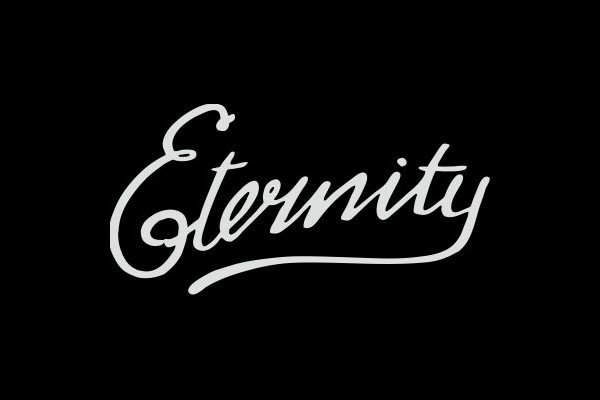
Arthur Stace’s now famous ‘Eternity’ copperplate script
The Eternity Playhouse starts its new life as a theatre in November 2013 with the official opening this weekend in Sydney.
TZG
City of Sydney
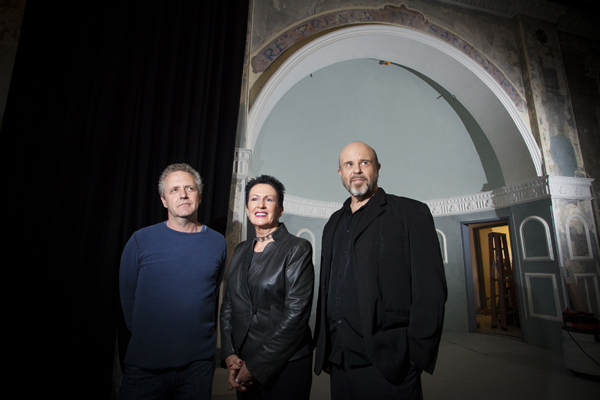
Hero Image: Glenn Terry (Darlinghurst Theatre Company), Clover Moore (Lord Mayor of Sydney), Marshall Napier (Actor). Image © City of Sydney
INDESIGN is on instagram
Follow @indesignlive
A searchable and comprehensive guide for specifying leading products and their suppliers
Keep up to date with the latest and greatest from our industry BFF's!
The internet never sleeps! Here's the stuff you might have missed