In the blue-chip suburb of Brighton, nestled alongside Elster Canal and leafy Elsternwick Park, a new development is breaking down barriers.
Known as the Brighton Social Housing Development, by SJB in collaboration with Homes Victoria and the Building Communities Consortium, this one-of-a-kind project demonstrates that social and market rental housing can co-exist.
“And, in fact flourish together when done well,” says Tristan Wong, director of SJB. “When sufficient rigour is also applied to creating great internal spaces, outdoor gardens, open space, communal amenity and high quality housing for all.”
The project will offer 300 well-designed and affordable dwellings; a 50:50 split of social housing and market rental/private housing, plus specialist disability housing.
Its point of difference is the project’s intertwined social and sustainable aspirations, achieved by creating what SJB’s director of architecture, Fiona Coakley, says is a ‘true tenure blind project’, with no discernible difference between the quality and offering of each.
“This is a project that aims to break down stigmas around social housing, whilst at the same time offering up a highly sustainable, Five Star Green Star outcome,” she says.
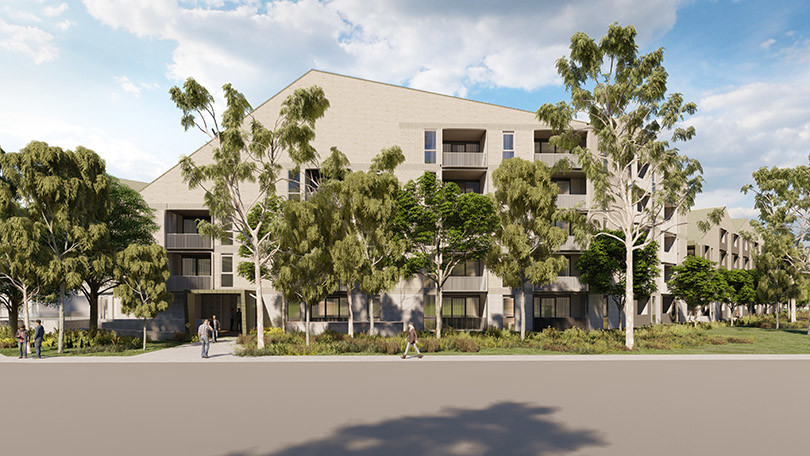
The social housing is held and managed by a housing provider, with the finishes, fittings, and fixtures requiring robustness and longevity carefully considered.
“Aside from that, the quality of spaces, access to open space, gardens, playgrounds and other amenity are accessible to all,” Coakley says.
It’s a far cry from the large slab buildings of the 60s and 70s, where many of these elements were not well considered or integrated, and lacked the spirit and community feel we now see in evolving and developing social housing projects.
In the Brighton project there will be an almost 20 per cent increase from the 127 outdated dwellings previously on the site, and a strong ‘identity’ that honours the past but also looks to the future.
It features four buildings that meander across the long, linear and well-vegetated site. By creating generous communal courtyards, interaction is fostered between residents of both social and private dwellings, as well as the broader public by connecting adjacent Salisbury and Airlie Streets.
The low-rise height, extensive use of brickwork and incorporation of gently pitched roofs across the buildings responds sensitively to the surrounding setting – echoing a domestic approach and scale to building design.
Related: Public housing with Manuel Der Hagopian of G8A
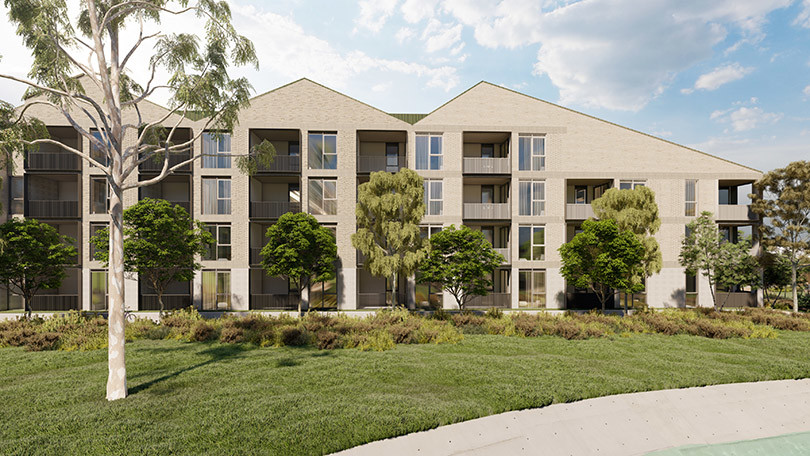
The facades are textural, tactile and robust – well suited to their needs of providing homeliness, the highest quality of housing and longevity. This set of buildings nestle into their neighbourhood seamlessly, and the extensive greenery, mature trees, and gardens further enhance a sense of ‘home as sanctuary’.
The design phases involved extensive engagement with the community with some 120 estate residents, neighbouring residents, local business owners and service providers contributing thoughts and feedback.
“There is a desperate and ongoing need for greater investment and development of social and affordable homes,” Wong says. “This has ensured the design has evolved more in line with the Brighton community and that their voices and ideas will be captured in the final design outcome.
“Supporting projects which vastly improve our collective social fabric and built environment are of the highest relevance and importance for our studio,” he says.
SJB
sjb.com.au
Imagery
Courtesy of SJB
We think you might like this article about public housing with G8A’s Manuel Der Hagopian.