There has been a great debate on the fate of bricks-and-mortar retail in our digital world. And the general consensus is that it is a glass-half-full, half-empty situation. The shift towards online shopping does put a huge strain on traditional retail, but with that challenge also comes myriad opportunities for retailers and designers to invent new spaces and new ways to engage customers.
One of these new spaces is Habitat by Honestbee. Designed by Wynk Collaborative (who also designed the Honestbee office in 2016) and launched in October, Habitat by Honestbee is the physical embodiment of the app-based company’s grocery shopping service.
Grocery shopping used to be a chore. Thanks to online supermarkets, grocery shopping apps and their various free delivery promos, this chore has been made considerably easier in our digital world. “So how do you craft a new experience to attract and retain customers? That was the gist of the brief,” says Si Jian Xin, Design Partner at Wynk.
.
“We wanted this place to be more of a community space than a consumption space.”
Si Jian Xin
.
“We wanted people to not just come to shop, eat and leave but also to hang out, bring friends and meet people here. We wanted this place to be more of a community space than a consumption space,” Si elaborates.
While putting retail and F&B concepts in one venue is a tried-and-tested design recipe, according to Leong Hon Kin, another design partner at Wynk, in Honestbee’s case the brief is further layered with the need to integrate the app into the physical space. He says. “How would the app influence the space, and vice versa?”
The design research involved an excursion to the markets in Paris and London, and extrapolating the experience with consumer preferences in Singapore. The concept that emerged from the outing was to make the space feel like an open-air market, where one is free to meander and discover using the app as both an all-access pass and a wallet.
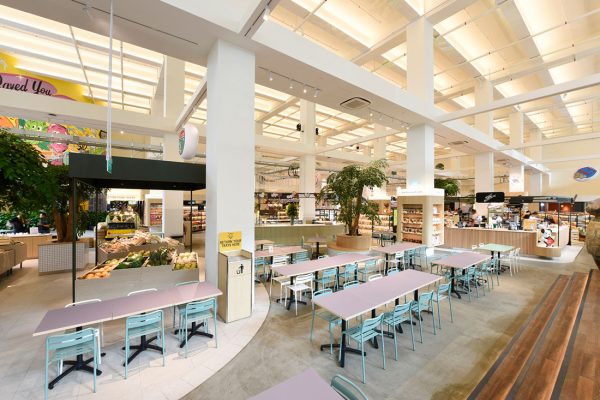
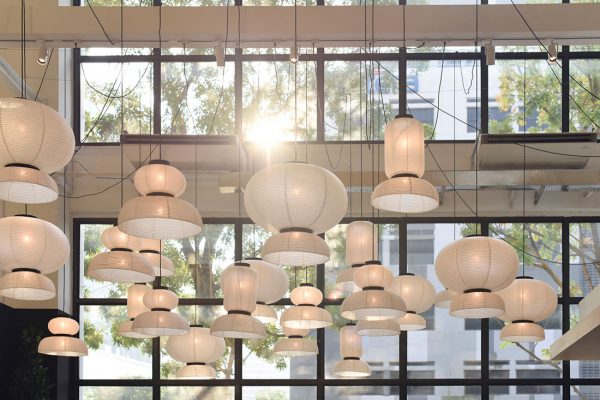
The architectural shell of Habitat by Honestbee was formerly a warehouse with ten-metre encased solid walls. Wynk has evoked the feeling of an open-air market by knocking down the solid walls and replacing them with generous glazed surfaces to bring the natural light in.
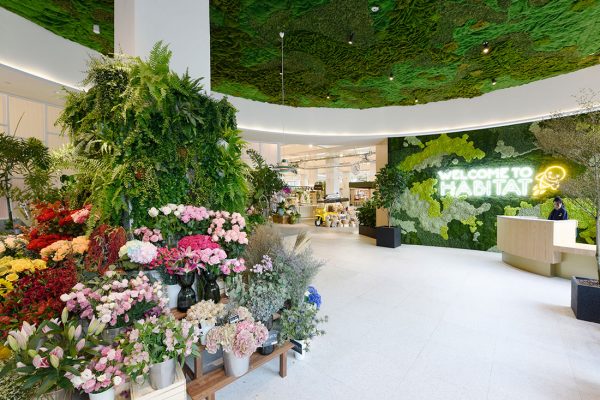
After scanning the app, shoppers enter the venue’s main space through a gallery of window displays that open up to a bright, lofty space occupied by its florist concept Hanaya.
The differences in scale and lighting between the two zones, and Hanaya’s floral décor and display, work wonderfully in tandem to set a festive welcome.
The space beyond is dedicated to the fresh supermarket produce and no less than 15 F&B concepts. The loftiness of the space is retained by keeping everything – barring the café mezzanine that serves as a stage for live music – at the ground level.
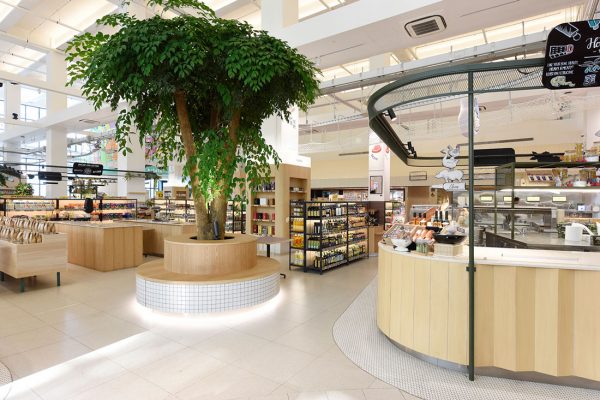
Display shelves, usually maximised to available height are kept below 1.5-metres, leaving the view unobstructed and enabling shoppers to quickly orient themselves.
“The experience is very non-linear, both in the physical sense and the experiential sense,” says Leong.
The F&B concepts are placed along the periphery of the interior, leaving the central part free from services. In addition to these F&B concepts, there are plenty of informal spaces that invite people to linger.
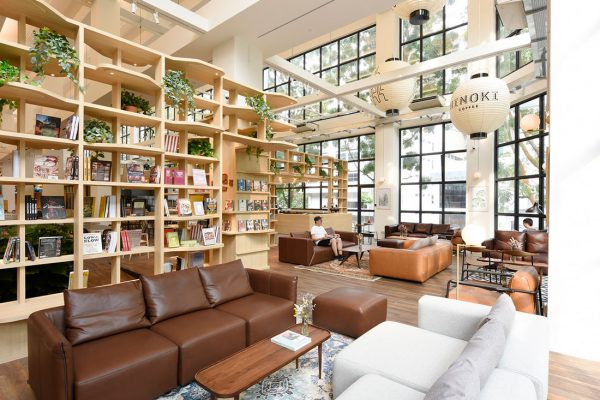
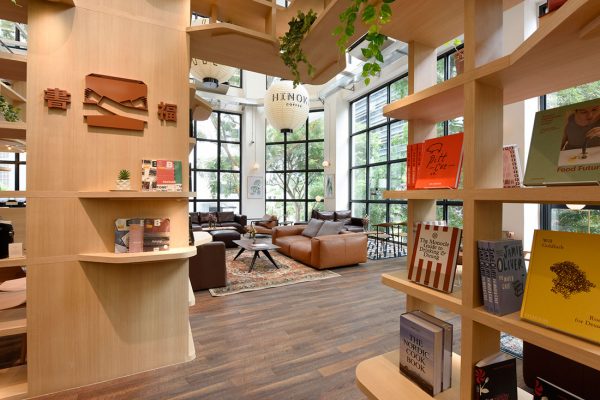
You will not have a security guard shooing you for sitting on a base of a bookcase at the bookstore, or on an empty nook that otherwise would be used to display products in the spirit room, like so often happens in conventional retail and supermarket environments.
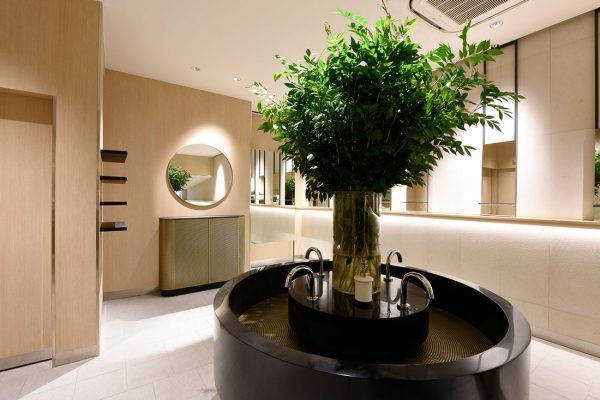
Even the banal act of waiting for a friend outside the toilet has been transformed into an experience through the way the space is done up like a beauty store, complete with moveable shelves displaying beauty products sold at the venue, of course.
The material and colour palette is pared down to let the product shine, consisting of mostly pale wood and glazed tiles in pastel colours. “We refrained from being too specific to certain brands or identity, so the space will allow seasonal brands or display to take over or switch concepts whenever needed,” says Leong.
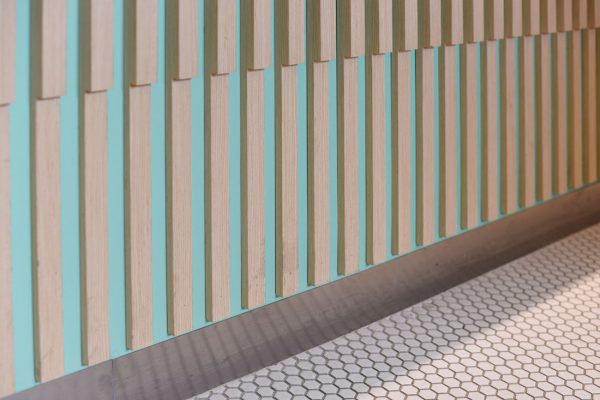
“Like a spatial canvas for content,” adds Si.
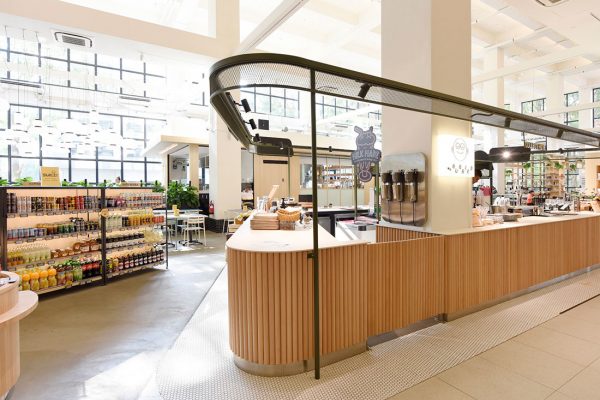
Some of the design elements created to accommodate the changing contents include the band of mesh on the upper part of the counters for signage, the curving corners of the counters that can serve as product displays, and the Bodega, a permanent pop-up space featuring perforated mesh shelves that can hosts a wide range of special exhibitions and collaborations.
.
The experience is very non-linear, both in the physical sense and the experiential sense.”
Leong Hon Kit
.
And what’s retail in the digital age without a little tech spectacle? Installed along the beam is a conveyor belt carrying shopping bags for online shoppers.
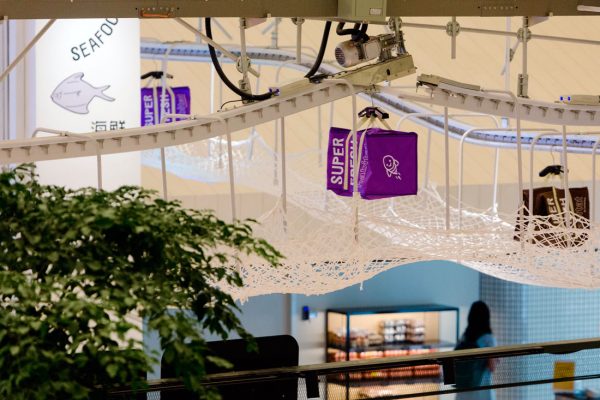
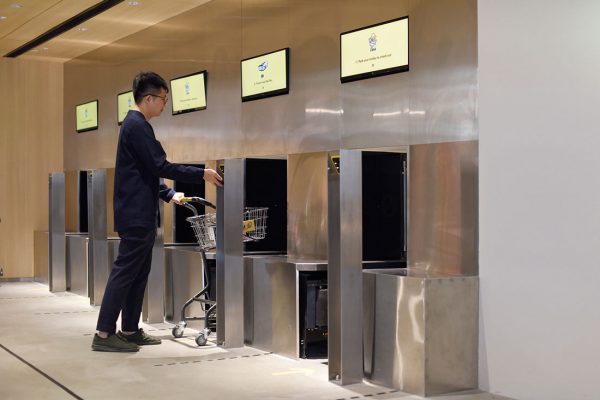
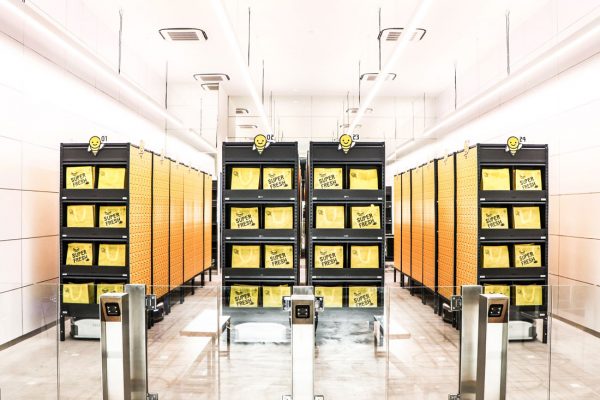
The checkout experience offers two world firsts: a cashless auto checkout process where you push through your cart for packing, and a robotic collection point where you collect the shopping bags from robotic shelves.
Photos courtesy Honestbee.
The word ‘Instagrammable’ also comes to mind. Asked if it is a requirement for retail these days, Si demurs, “It is inevitable, but ultimately people will want to take photos in a nice space. So we will always strive to create a nice space.”
There will be plenty more nice spaces designed by Wynkt at the Habitat by Honestbee. Watch this space!
Photography by Jovian Lim, courtesy of Wynk Collaborative, unless otherwise stated.
We cover the changing retail design landscape with articles on Retail 3.0 here.