The home of architecture and design in the Asia-Pacific
Get the latest design news direct to your inbox!

Get the latest design news direct to your inbox!
To be completed in 2014, the new mega retail and entertainment hub in the State of Qatar looks set to further DP Architects’ lead in retail design in the Middle East.
May 10th, 2011
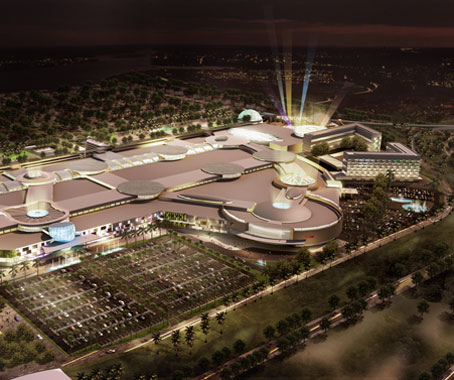
Sitting on a site area of 433,837 sqm, the QR6 billion (S$2 billion) Doha Festival City will be yet one more impressive landmark in the State of Qatar when it is finished in 2014.
DP Architects, which recently received the ICSC Gold award for The Dubai Mall in 2010 (new retail project category), will be responsible for the design of the retail aspect of the super complex while Arab Engineering Bureau has been appointed project architect.
Apart from a retail component featuring leading international, regional and local brands, Doha City Festival will also have an entertainment and theme park, hospitality and conference facilities, and auto showrooms.
The interior design, also by DP Architects, is inspired by nature and the elements of wind, water, wood and earth.

Project rendering
Within the retail loops there will be four distinct interior zones – Water Concourse, Garden Promenade, Rainforest Broadwalk and Fashion Galleria – each offering a different experience for shoppers.
“The idea is to bring the different ambiences and atmospheres of Mother Nature into a mall environment and also to reinterpret the elements in novel forms,” says Mike Lim, Associate Director at DP Architects.
“Take for instance the element of water: instead of a mere fountain or water feature, it could be something that engages the use of technology and greenery.”
One of DP Architects’ design goals is to achieve no less than a LEED Silver rating for the project. This, says Mike, “calls for sensitive and innovative design solutions while creating a very spacious interior shopping experience that allows for interactivity with the outside”.
Doha Festival City is located 15 km from downtown Doha on Al Shamal Road, one of the main arterial routes to Doha city centre.
DP Architects
dpa.com.sg
INDESIGN is on instagram
Follow @indesignlive
A searchable and comprehensive guide for specifying leading products and their suppliers
Keep up to date with the latest and greatest from our industry BFF's!
The internet never sleeps! Here's the stuff you might have missed