The home of architecture and design in the Asia-Pacific
Get the latest design news direct to your inbox!

Get the latest design news direct to your inbox!
A modern take on the classic Windsor chair with bright colours and new geometry
March 1st, 2013
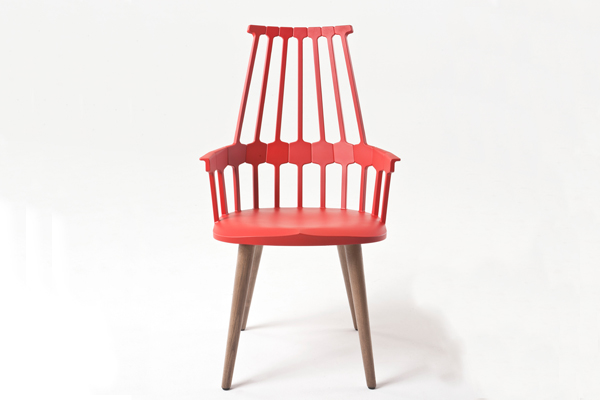
Kartell revisits the classic 18th century Windsor chair in the new Comback designed by Patricia Urquiola. Whereas standard chairs were continuous at the back legs and the upright of the back, the Windsor chair’s legs and uprights were turned on a pole-lathe and round-tenoned into the seat.
In the contemporary take of the Comback (from comb-back) the back and arms are formed not from steam bent wood and spokes, but from batch-dyed thermoplastic technopolymer. This is shaped in a single mould into an array of ‘teeth’ emanating from a vertebrae of hexagons.
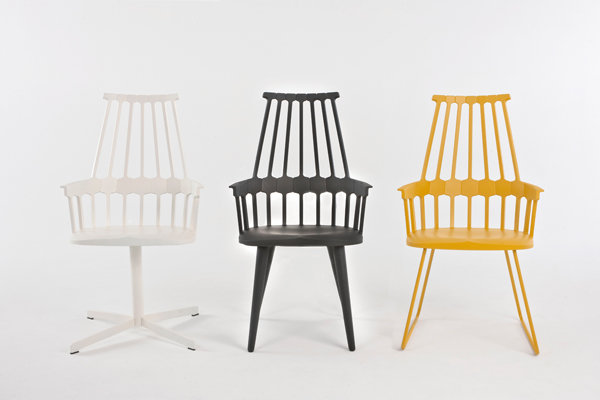
The seven ‘teeth’ of the upper back spread out towards the lumbar region, where the reinforced hexagonal rim acts as an axis from which the teeth of the lower back radiate down at a different angle to the seat.
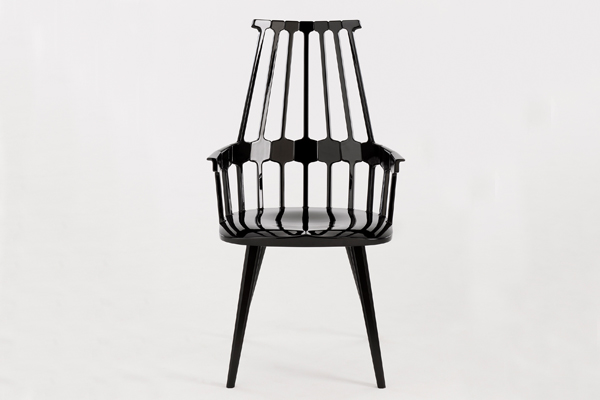
This perfectly proportioned paean to times past is newly arrived in Australia. It asserts itself as emblematic of current times with its geometry, emphasised by colours such as Orangey Red, Yellow, Grey Blue, White, Black and Hazelnut.
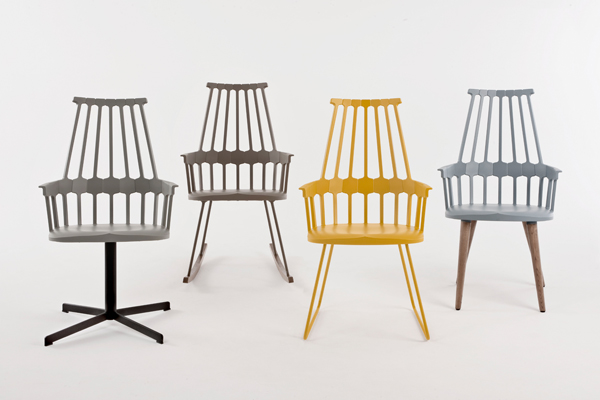
The Comback is available in four versions. The Swivel chair, the Sled chair, the Wooden chair and, in an ultimate loveletter to the 18th century, the Rocking chair.
The Swivel chair has four legs and a swivel shaft in White or Black. The Sled chair has two slim, tubular legs in White, Black, Orangey Red, Yellow, Grey Blue or Hazelnut.
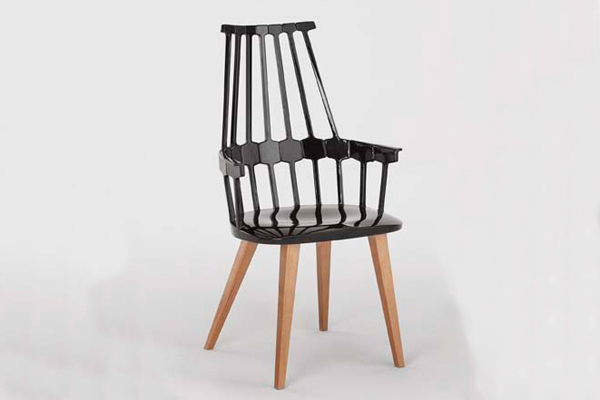
The Wooden chair has four oak-stained Ashwood or white or black painted Beechwood legs. The Rocking chair has two rocker runners in Oak-stained Ashwood.
The Comback embodies the artisanal elegance of design of the 18th century, with a new geometry that speaks to modern times and interiors.
Space Furniture
INDESIGN is on instagram
Follow @indesignlive
A searchable and comprehensive guide for specifying leading products and their suppliers
Keep up to date with the latest and greatest from our industry BFF's!
The internet never sleeps! Here's the stuff you might have missed