The home of architecture and design in the Asia-Pacific
Get the latest design news direct to your inbox!

Get the latest design news direct to your inbox!
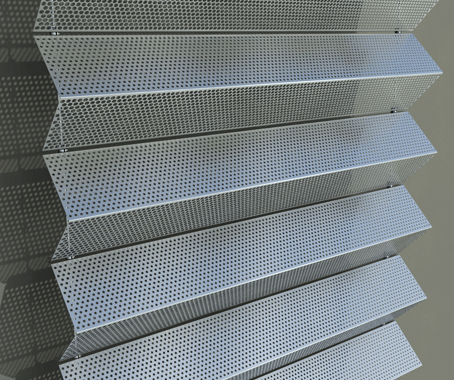
Atmosphere is a lightweight aluminium facade system which offers infinite variability combined with functional sustainability, and can be installed quickly and cost effectively.
November 17th, 2010
Atmosphere offers the designer a myriad of possibilities. A number of ’standard’ profiles have been developed and can be incorporated into a design, however in addition the system allows the designer to create their own element profile.
A combination of different element profiles, colours and finishes can be incorporated into each installation. Elements can be varied across a facade, even leaving panels missing to give the face a truly unique characteristic.
In addition, the facade can be tailored to suit the orientation, with extended shading characteristics on the northern and western faces.
As we all continue to focus more on offering sustainable benefits in any project, Atmosphere’s perforated nature balances the ability to reduce the solar energy hitting the building while still allowing natural daylight to flow in.
Atmosphere reduces the impact of solar energy hitting the building by up to 78%, hence reducing the energy consumed by HVAC equipment for comfort control. Preventing the solar energy from entering through the glass is far more effective than mechanically reducing the temperature once the heat has entered the building.
The Atmosphere system, currently under provisional patent protection, is simple and lightweight. Atmosphere appears to float from the building envelope and negates the requirement for a heavy RHS structure to support the facade. The tensioned cable system can be installed quickly and efficiently, reducing the cost when compared to traditional facade systems.
The unique installation system ensures Atmosphere can be installed on existing buildings as part of a sustainability retrofit, or simply to update the external appearance of a tired facade.
Locker Group
locker.com.au
INDESIGN is on instagram
Follow @indesignlive
A searchable and comprehensive guide for specifying leading products and their suppliers
Keep up to date with the latest and greatest from our industry BFF's!
NAWIC and Richard Crookes Constructions (RCC) invite you to visit their current project, The Kinghorn Cancer Centre (TKCC). TKCC is a new cancer research centre that combines integrated multidisciplinary cancer care and translational cancer research. TKCC is located adjacent to and linking into the adjoining Garvan Institute of Medical Research and the Victor Chang Cardiac […]
The internet never sleeps! Here's the stuff you might have missed