The home of architecture and design in the Asia-Pacific
Get the latest design news direct to your inbox!

Get the latest design news direct to your inbox!
KiBiSi is a collaborative where a designer, an architect, and a design philosopher combine forces. Yvonne Xu spoke to the latter about the power of three

January 21st, 2013
However you look at it, KiBiSi seems set to be a design powerhouse. Its founders, industrial designer Lars Larsen (formerly of Kilo Design), architect Bjarke Ingels (of BIG) and design philosopher Jens Martin Skibsted (of Biomega and Skibsted Ideation) are each key players in their respective creative fields.
Theirs is a compelling methodology too; by drawing from each of the founders’ expertise, KiBiSi explores the symbiotic hybrid of design, architecture and ideation.

Puma Mopion bicycle
During the recent Business of Design Week, Skibsted and Larsen were in Hong Kong to talk about their evolutionary approach to design. Skibsted explains that KiBiSi is primarily an ideas-driven design group, and that what sets them apart is their cross-disciplinary focus.
Whether designing a item of personal electronics or an aircraft, they are interested in the special connection between the production sensibility of industrial design and the big ideas and holistic perspective of architecture.

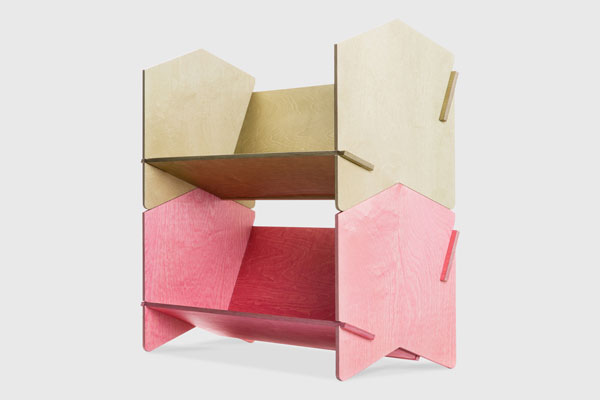
Shanghay Chair (produced by Hay)

Bench in the Danish Pavilion (by BIG) at Shanghai Expo 2010
The Shanghay chair, Skibsted pointed out, is representative of this vision. Conceptualised as a single segment of the 264-metre-long social bench that orbits the Danish Pavilion at the Shanghai Expo 2010, Shanghay epitomises how architecture, public furniture and industrial design can merge. Beyond the conceptual, what does the exercise of developing a bench from a building, and a chair from a bench teach us? And why is it important that we start doing that?

Bunch of Bulbs (limited edition)
“[Industrial] design is very new phenomenon in human history,” Skibsted reflected. “Architecture has a much longer history; if you say, when was music invented, when was painting invented, when did we start building housing, these things are prehistoric, you cannot find a time to pinpoint it.”
“But for industrial design,” he continued, “there is a very clear time in the mid-1800s in England where the first design agency emerged. It was not like people didn’t make chairs before that, but chairs were not made by designers. A lot of things have happened to art, music and architecture, but design is still a very immature creative discipline and you expect it to develop.”


iFlash One bicycle light (produced by iFlash)
One way industrial design can move forward, Skibsted suggested, is by exploring the intrinsic values it shares with architecture: “With the Shanghay chair, you see how design fed off an architectural vision. With regard to making an icon, you really need to have that vision there. The great thing about such type of architecture is that it inherently has a vision built right into it so you can lend that vision to design.”
KiBiSi is also interested in pushing design, which they feel “looks dominated”, towards the conceptual. “A strong product must have strong idea,” Skibsted said. “Another idea we have is that every company should have an ‘instant icon’ – a product that gains the status of being a cultural icon, not by aesthetics, but by the newness of its idea.”

Tracks Leather headphone (under development for Aiaiai)
Skibsted cited the examples of the Polaroid camera and the Walkman, and explained: “The Polaroid was an instant icon because it looked like an old camera but the idea of developing photos instantly was a totally new idea. The Walkman to me was also an instant icon; it did not look highly distinguishable; playing a tape was not totally surprising. But the idea of having this very small thing, the idea that you would have your private space among people in public had a newness.”

Roulade sofa (produced by Versus)
Skibsted was also quick to point out that KiBiSi does not aspire to be an icon-generating machine. Rather the partners see themselves as a strategic design studio, somewhat like a consulting firm.
“Instant Icons are things you do not always want to do because while they will have a lot of cultural impact, they might not be a commercial success. What you want to do is look at your portfolio and see if you need that kind of product or not.”

Puma Pico bicycle

Biomega OKO bicycle
One successful instant icon they have developed is the Puma Bicycle, which can be found in the collections of the world’s leading museums. As Skibsted pointed out, it was not merely design, but an entire branding vision that made it culturally important. “The problem with bicycles is that they are not integrated; they are a host of different parts, and you can’t start branding many objects. The more the bicycle becomes one object the better,” he explained.

Hang Around and Toss Around spoon (produced by Muuto)
As Skibsted summarised the KiBiSi ethos of the “hybrid outfit”, of “integrating as much as possible”, what surfaced as an interesting point is how the group is in itself a nicely-integrated practice – a great branding project that is poised to be, I think, no less than an instant icon.

The KiBiSi team: Lars Larsen, Bjarke Ingels and Jens Martin Skibsted
KiBiSi
kibisi.com
INDESIGN is on instagram
Follow @indesignlive
A searchable and comprehensive guide for specifying leading products and their suppliers
Keep up to date with the latest and greatest from our industry BFF's!
The Retail Design Institute will host an evening to celebrate its 50th anniversary and the Best of 2010 at the 40th annual International Store Design Awards.
The event will be held at the Times Centre Stage in Times Square, NYC.
Retail Design Institute
retaildesigninstitute.org
The internet never sleeps! Here's the stuff you might have missed