The home of architecture and design in the Asia-Pacific
Get the latest design news direct to your inbox!

Get the latest design news direct to your inbox!
The legality of replicating designs remains complex, but there are a few steps designers can take to protect their designs. Intellectual Property Lawyer Sharon Givoni offers some concrete advice for Australian designers.
July 30th, 2014
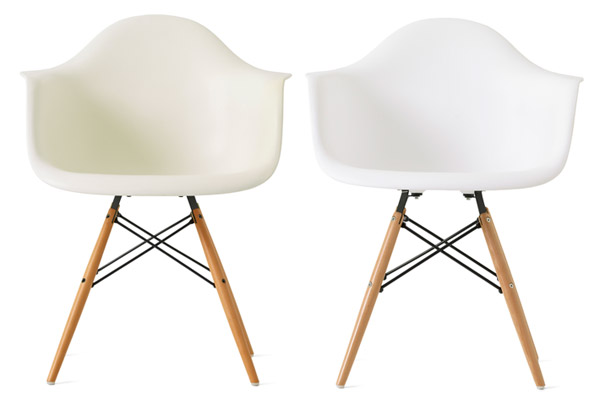
Image above: Eames DAW Shell Chair – original & replica, visit estmagazine.com.au/eames-daw-shell-chair to find out which is which.
In 2011, some readers may recall that Herman Miller took legal action against Australian replica furniture label Matt Blatt.
Herman Miller, who owned the rights for the Eames brand furniture[i], argued that Matt Blatt was engaging in misleading conduct and also infringing its “EAMES” trade mark by producing replicas of the furniture and selling it for a cheaper price (in some cases much cheaper with prices varying as much as third or more).
The matter resolved itself out of court.
While the exact terms of settlement were confidential, Matt Blatt was (and still today is) able to continue to sell the replica pieces but it’s website has to clearly state that its replica products are not affiliated with or authorised or manufactured by the owner of the genuine article and clearly identifies its range of products as ‘replicas’ of the originals[ii]. In fact, the website (as at 26 July 2014) states on the home page that:
Matt Blatt’s replica products are not manufactured or approved by, or affiliated with, the original designers, manufacturers or distributors including Herman Miller, Charles or Ray Eames and Fritz Hansen.
How does the law protect designs?
Basically the copyright law in Australia generally protects two–dimensional works such as drawings (including drawings of models and prototypes) as artistic works and three-dimensional works that have not been mass-produced. The technical term in the law for mass-produced is ‘industrially applied’ and indeed, some designers would be familiar with it. It means when fifty or more of an article has been produced or offered for sale but in some cases can be less.
When you think about it, it’s a small number. It also means that if you make a product that sells really well you may kick yourself for not registering the design.
The reason is that you need to apply for registration before and not after you have release that design into the public domain.
Be warned: the public domain includes putting a picture of it on the internet and showing it at an expo or design show so the definition is very broad.
Also, copyright in the underlying drawing of a design or product such as a sketch, plan etc will be ALSO lost once the product is mass-produced so you cannot rely on a copyright claim in that respect.
An exception to the rule – ‘works of artistic craftsmanship’?
A three-dimensional design may still be protected under copyright law if it can be classed as a ‘work of artistic craftsmanship’.
This is quite a complex area of the law however as the phrase has not been defined in the relevant Act and even the courts have struggled with it.
Design Registration
A registered design gives the owner the exclusive right to use that design in the marketplace, and making it known that you have a design registration can deter others from copying. In addition to not having been in the public domain the design must be new and distinctive. This means that your design must not look like any other design that already exists in the global marketplace (including your own earlier design).
How do you register a design?
Design registration is done by filing an application with a government body known as IP Australia. It is recommended that you engage a lawyer or a patent and trade mark attorney to register your design, as the process technical and needs to be done just right.
How can you enforce your design against a copycat?
Once you get a design registered, this alone will not give you legally enforceable rights.
To obtain an enforceable right, further examination must be sought and the design must be certified which involves an extra step taken out by the Government.
In this sense, registration can be likened to a ‘shield’ whereas certification can be likened to a ‘sword’. Be careful of sending legal letters yourself as it is an offence to make groundless legal threats of design infringement.
Design registration lasts for five years and you can renew your registration for a further five years.
Conclusion
What can you take away from all this?
Effectively, if your design is two-dimensional, such as a drawing or print, then it will most likely be protected under copyright law as an artistic work, so long as certain threshold requirements are met, for example that it is original (in the sense that it is has not been copied from someone else).
If however the design is three dimensional and you have or will commercialise it – design protection should be considered.
About the author
Sharon Givoni is a Melbourne-based intellectual property lawyer with clients in the retail, manufacturing and design industry. Sharon can be contacted by email (sharon@iplegal.com.au) or called on 0410 557 907 or 03 9527 1334. Her website is www.sharongivoni.com.au.
IMPORTANT DISCLAIMER: This article is of a general nature only and must not be relied upon as a substitute for tailored legal advice from a qualified professional.
[i] Warwick Mihaly, ‘Herman Miller vs. Matt Blatt’, 7 November 2011, available at: https://panfilocastaldi.wordpress.com/2011/11/07/herman-miller-vs-matt-blatt/.
[ii] Andrew Fuller and Sabiene Heindl, LexisNexis: Australian Intellectual Property Law Bulletin, 2013, 26(2) IPLB.
INDESIGN is on instagram
Follow @indesignlive
A searchable and comprehensive guide for specifying leading products and their suppliers
Keep up to date with the latest and greatest from our industry BFF's!
The internet never sleeps! Here's the stuff you might have missed