The home of architecture and design in the Asia-Pacific
Get the latest design news direct to your inbox!

Get the latest design news direct to your inbox!
The unique environmental management system initiates a new approach to environmental thinking at Brickell City Centre, Swire Properties’ new Stateside development.

September 8th, 2016
Pictured above: the steel, glass and fabric Climate Ribbon hangs over the pool area at EAST, Miami
Construction of Brickell City Centre in Miami is underway, and one of its most exciting and unusual features might just be the CLIMATE RIBBON™.
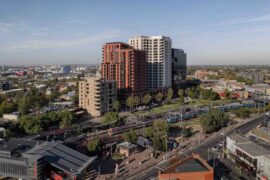
Brickell City Centre is a new mixed-use Miami development by Swire Properties Inc, the US subsidiary of Hong Kong’s Swire Pacific Limited. Spread over several city blocks and 4.9 million square feet, Brickell City Centre encompasses a hotel, EAST, Miami, two condominium towers, retail space, offices and more. Led by Arquitectonica, with the involvement of Clodagh Design, Studio Collective and Hugh Dutton Associés (HDA), the development is set to open on 3 November 2016, at a cost of just over US$1 billion.
That price tag includes US$30 million spent on the Climate Ribbon, an innovative environment management system that covers 150,000 square feet. Made of glass and steel, with fabric blades of shading lining the underside, the Climate Ribbon creates a microclimate for Brickell City Centre’s pedestrianised areas. It provides shade to shops, restaurants and cafes with the development. It is also a source of natural ventilation, its wave-like form capturing Miami’s summer trade winds, using them to create breezes in the shopping mall and other public spaces.
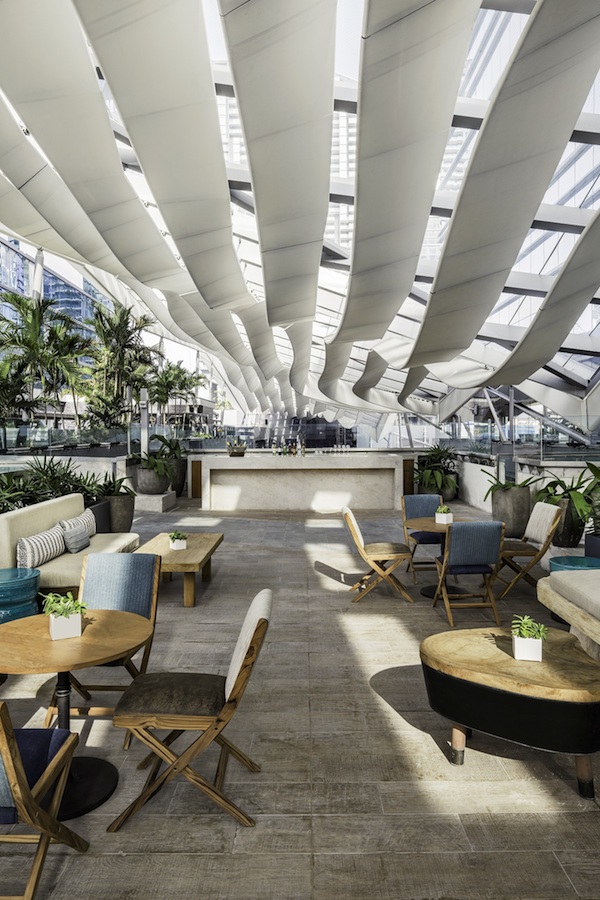
The dynamic forms of the Climate Ribbon move overhead at The Shruberry, an outdoor venue at Brickell City Centre
Its undulating structure has another benefit, too: it channels rainwater for use in irrigation, planting, landscaping and more.
The Climate Ribbon is the culmination of years of testing and researching on the part of Swire, Arquitectonica and HDA. “The Climate Ribbon is a technical exercise in advanced computational design,” says Hugh Dutton, founder of Paris- and Hong Kong-based firm HDA, which designed the structure. “The computer is used to manage complex geometries by handling masses of three dimensional data. Sophisticated engineering computation processes use non-linear analysis methods to best simulate how forces are resolved in the different parts of the whole.”
According to Dutton, “We must work with nature and not against her. We must understand and respect her energy in the sun, wind, rain, and gravity.”
To understand just how the Climate Ribbon could and should interact with nature, Dutton and the rest of the team undertook various simulations to predict nature’s behaviour and to adjust the Climate Ribbon accordingly. These simulations looked at the movement of trade winds, as well as tracking rain-flow and the path of the sun throughout the day and throughout the year.
The architects worked with Canadian consulting engineers and scientists RWDI to do physical testing in a wind tunnel, so as to understand how air flows here and the possible impact of hurricanes. They even undertook studies of thermal comfort to assess temperatures inside and out, while computers spent days calculating the exact angle of each blade of architectural fabric.
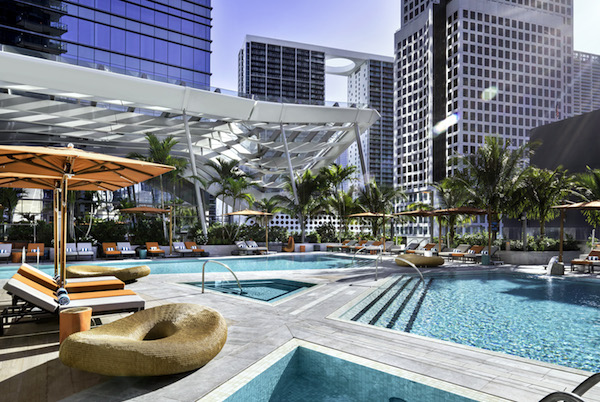
Light and shade at play in the Climate Ribbon, poolside at East, Miami
Made from highly durable yet supple fibreglass mesh coated with a polymer, the architectural fabric used on the blades could, if you laid it out, stretch for 14,225 square metres. Then there are the 915.345 tonnes of steel that give the Climate Ribbon its structure and its stability; not to mention the 6,678 square metres of heat-strengthened safety glass that echoes the flow of the fabric and steel below it.
There is a sense of movement to the Climate Ribbon, even though it is, as Dutton points out, static. It “is designed to create a dynamic in light,” he says. “It expresses the movement of the sun and how light changes every moment of the day … The blades allow glimpses of Miami’s blue skies and pick up the crisp light in a composition of translucent, reflective and indirect light that varies throughout the day, highlighting the fluidity of the Climate Ribbon.”
Brickell City Centre
brickellcitycentre.com
INDESIGN is on instagram
Follow @indesignlive
A searchable and comprehensive guide for specifying leading products and their suppliers
Keep up to date with the latest and greatest from our industry BFF's!
The internet never sleeps! Here's the stuff you might have missed