The home of architecture and design in the Asia-Pacific
Get the latest design news direct to your inbox!

Get the latest design news direct to your inbox!
Australian-based design firm Sumu Design has created a temporary haven for today’s well-heeled travelers with the new Qantas Hong Kong lounge writes Christie Lee.

June 17th, 2014
Airport lounges are getting increasingly more luxurious. Yet more and more, today’s well-heeled jet-setters are looking beyond self-serve buffets, newspaper racks and television screens. With Qantas Airways’ new lounge at the Hong Kong International Airport, Australian-based design firm Sumu Design has conceived a space that combines sleek lines and luxurious materials while at the same time paying tribute to Hong Kong’s unique cityscape.
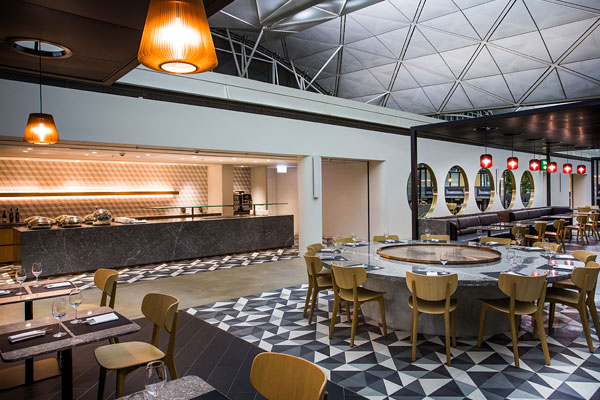
Available for both First and Business class passengers, as well as eligible frequent flyer members, the 2000-square-metre lounge accommodates up to 300.
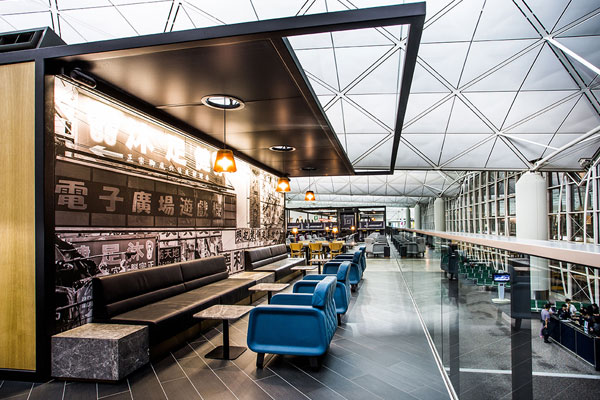
According to Felice Carlino, Director of Sumu Design, the Qantas Singapore lounge (see our feature here) and the Qantas Hong Kong lounge are based on a similar design approach, but while the former is located in a confined space, the latter is situated in the open cabin, from where passengers can enjoy views of the airport apron and surrounding terminals. From its location, the lounge also gets plenty of natural light by day.
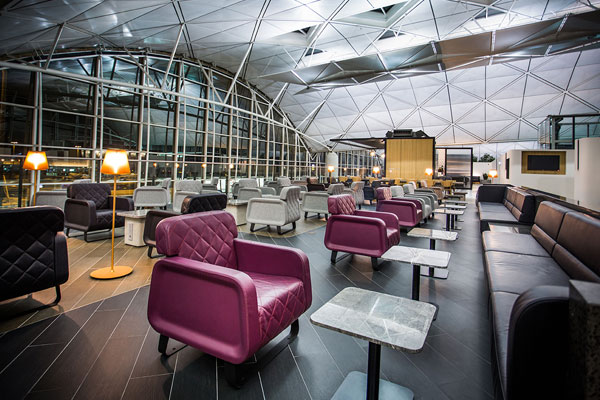
The layout of the lounge reflects the city’s unique landscape. “Hong Kong is the perpetual Asian city: a fluid, swiftly evolving metropolis surrounded by stunning wilderness. It is a vibrant, vertical city split by an expanse of water and surrounded by calm and nature. Hong Kong also represents both a vital business gateway into China and a home away from home for a large international business community,” Carlino says of the inspiration behind the design.
Taking up shop at the centre of the lounge, the bar and dining areas represent the bustling Hong Kong Island and the Kowloon Peninsula, while the spacious lounge area is a nod to the city’s sprawling beaches and hilly regions.
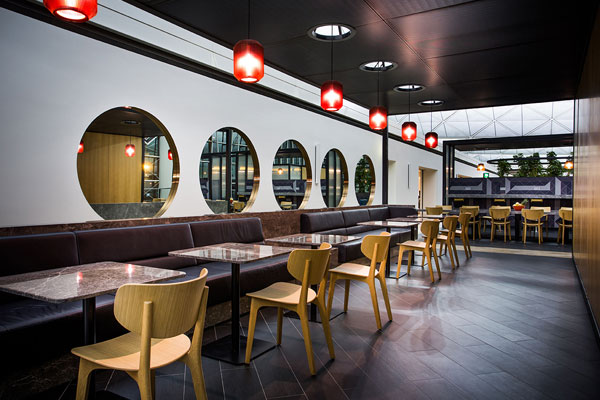
Another striking feature that has always differentiated Hong Kong from other metropolitan cities is its readiness to expand not only horizontally, but vertically, with ever taller skyscrapers built year on year. This unique aspect of the city is translated into the canopy-like steel structures that form the skeleton of the lounge. They also act as sleek dividers, creating ample private and secluded spaces for the traveler who wants to be away from the action – albeit temporarily. “They provide an escape from the hustle and bustle of the city, while still remaining connected to the action,” explains Carlino.
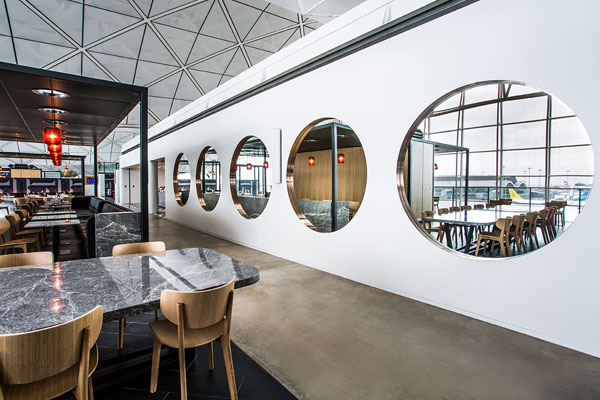
According to Carlino, the mix of raw and polished finishing “reflects at once a colonial and modern Hong Kong.” The raw concrete that is being liberally used in the bar and tables is juxtaposed with the leather banquette seating and timber textured floor tiles. Meanwhile, the wall tiles are a spin on a classical Chinese geometric pattern.
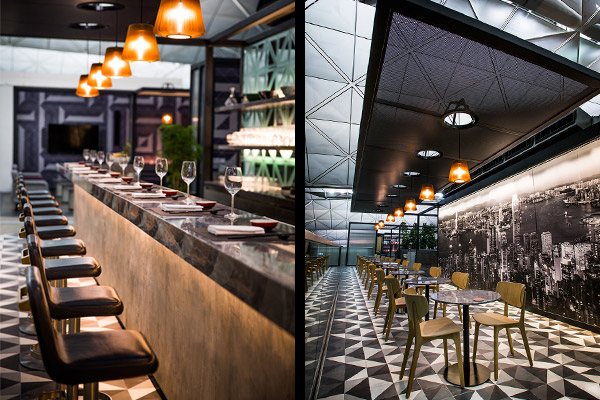
The Qantas Hong Kong lounge was designed by Sumu Design in collaboration with Caon Studio and PDM International Hong Kong.
Photography © Eddie Yeung
Sumu Design
sumudesign.com
PDM International
pdmdesign.com
Caon Design
caonstudio.com
INDESIGN is on instagram
Follow @indesignlive
A searchable and comprehensive guide for specifying leading products and their suppliers
Keep up to date with the latest and greatest from our industry BFF's!
The internet never sleeps! Here's the stuff you might have missed