Alessi is in it for the long haul: the “Italian Factory of Design,” as they call themselves, has been around for almost a century, and in Hong Kong since 1985. According to Luca Alessi, International Sales and Development Manager – Asia Pacific, the houseware company’s longevity has something to do with the constant creativity it generates through new products. There is, he says, always something to keep the brand’s fans excited.
Formerly a product manager and trade marketing manager at fellow Italian brand Delonghi, Luca Alessi is a member of the fourth generation of his family to carry the Alessi torch. He tells us about preserving the Alessi legacy, and much more.
Did you live and breathe Alessi when you were growing up?
Absolutely. It’s something that at the beginning you don’t really understand; I was just growing up in a house full of beautiful toys. The more you grow up, though, the more you feel and touch, the more you feel part of it. It’s a big responsibility, but at the same time, a big honour.
My uncle and parents didn’t push for us to be part of the business, to be part of management. At the same time, you grow up with it.
How do you keep Alessi’s heritage intact while ensuring the company thinks progressively?
We have been able to establish a reputation, not only with the public, but also with the designers. From the big names right down to the students, the designers are really willing to work with us, because we take the time to satisfy their emotions, and we’re able to bring to the market things that others might not consider manufacturing.
We strongly believe that creativity is a word that is very infinite. So we keep discovering and changing by working with creative people.
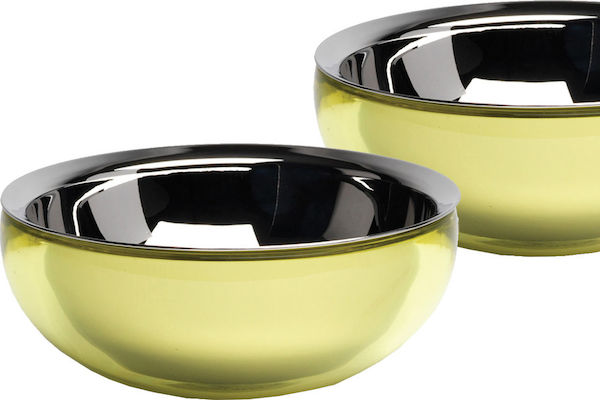
Miriam Mirri expands the iconic Love collection for Alessi with the Love bowl
How do you work with designers? What’s the process?
We have fundamentally two ways of working with them. First, we are not a traditional industrial manufacturing company. We see ourselves more as a mediator. We stay in-between: on one side, there are the most creative talents in the world, from artists to architects and designers, and on the other side, there’s the dream of the company.
Secondly, my uncle Alberto manages the product development. He’s a very sensitive person who has built up the company into what it is today. He’ll look at the catalogues and say, ‘I think this bowl is looking a bit outdated,’ and he’ll go to several designers and see what they can do to refresh it.
We strongly believe in the quality of the object – we’ll put student products on the market. They literally come knocking on the door of our factory with their projects, and we decide if their projects are good and then we’ll put them out there.
We have a very big range of products. We touch every area of the home, and we have about 5,000 products in the schedule. We don’t call our catalogue a catalogue, really; we call it an ‘encyclopaedia’, because it is a combination of many areas of design. We have designers from the US, the UK, Hong Kong, China, Australia … Each of them brings their own culture to the design that they make. Our catalogue is, as a result, such a combination of different design languages.
Alessi’s design language feels very coherent, despite the melting pot of cultures, ideas and products in the mix. Why is that?
We don’t have an exact answer to that, but we believe it’s the cultural project that’s behind it all that enables us to achieve this feeling.
To explain, there’s this invisible borderline for mass production. On one side of the borderline is the world of not possible, with all the products and ideas people don’t understand. Whereas they understand the products in the world of possible.
People won’t go for the not possible because they don’t understand it and they are afraid it’s going to be a flop. But then all you’re bringing to the market is something that already exists. The cultural job that not only Alessi, but also about other Italian design companies have taken on is to stay as close as possible to this line. We like to push shapes and innovations. Sometimes we fail, but these failures are as important as our successes, because they enable us to feel where that line is.
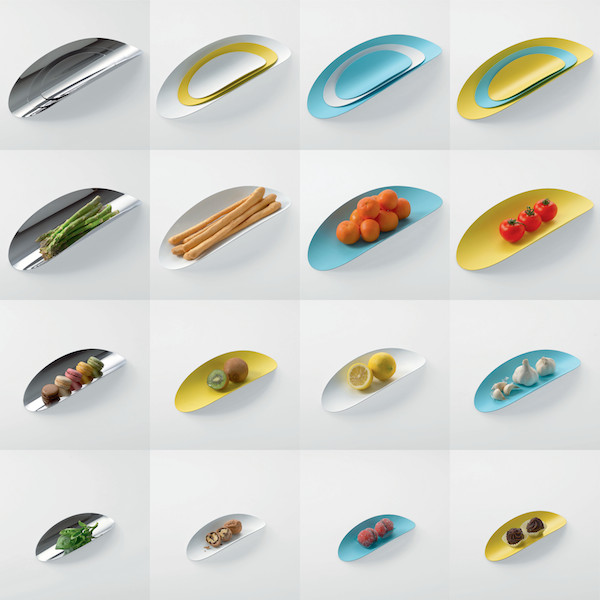
New designs by Abi Alice for Alessi
Please tell us about the 2016 collections.
We have a few products from Abi Alice, an Australian designer, in the collection. She basically launched this centerpiece project, based on metal. She’s always been very into understanding the geometry of shapes. Also she followed a brief Alessi gave her that related to technology we have in the factory to laser cut and bend metal. She came up with this idea of having these products that are very minimalist and very simple, but at the same time, very functional. You can use them in the living room, in the kitchen, wherever.
We’ve also got this clock called Time Maze by Daniel Libeskind. It’s a good addition to the famous architects who work for us. It’s the first project he’s done for us. For Libeskind, he sees time as not being something that goes in a straight line, it changes depending on whether you find a job, you get married, and so on.
2016’s not finished, either – trust me, some very nice projects are still to come.
Alessi
alessi.com