The home of architecture and design in the Asia-Pacific
Get the latest design news direct to your inbox!

Get the latest design news direct to your inbox!
Arch Studio transforms houses built between the Qing dynasty and the 1980s into a contemporary tea café. Sylvia Chan writes.

August 11th, 2015
The House in Hutong, designed by Arch Studio and completed in January this year, is a tea café transformed from five courtyard houses built between the Qing dynasty and the 1980s in Beijing. Located in the traditional Hutong district, the teahouse also has a hidden gym for those in the busy capital city who desire a workout along with a quiet afternoon of reading and tea drinking.
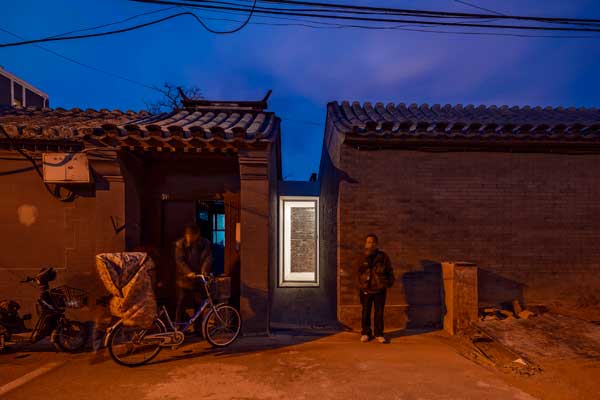
The entrance to the teahouse is marked not by any signage but a simple glass door in steel frame, and is virtually hidden in the narrow hutong.
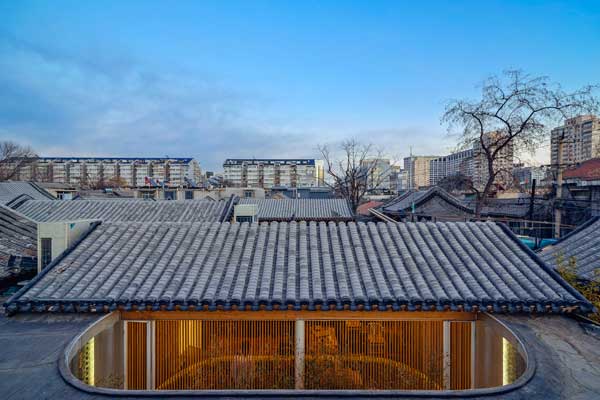
Having passed through the glass door, one is greeted with a space filled with light. Three large courtyards in the 450 square metre L-shaped teahouse, separated from the interior with curved glass yet accessible through glass doors, are planted with bamboo. The courtyards light up the internal space while bringing in elements of nature.
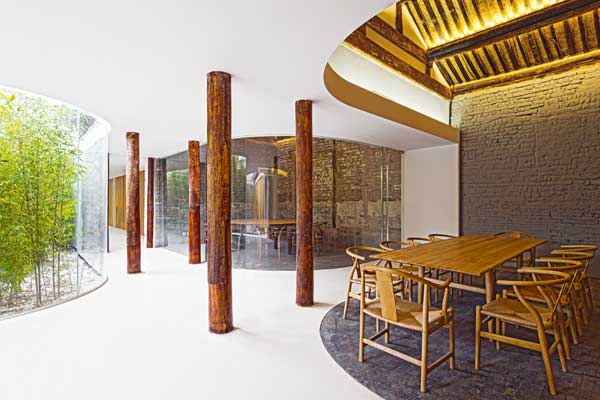
The teahouse features two dining rooms, three tea rooms, a book café, a kitchen, the above mentioned gym, and an office. When presented with the site, originally a company clubhouse, Arch Studio conducted a thorough research on the courtyard houses to identify the historical value of each. According to Arch Studio, the brick walls and wooden structure of the north wing suggested that it predated to the Qing Dynasty, while the decaying wood of the east and west houses indicated that they were built in the 1970s and 1980s. These findings drove the project’s design and restoration work. Han Wenqiang, founder and principal of Arch Studio says, “The site is not a typical siheyuan – it is an L-shape. The main character of the site is the long and narrow courtyard. The five courtyard houses are also from different generations.”
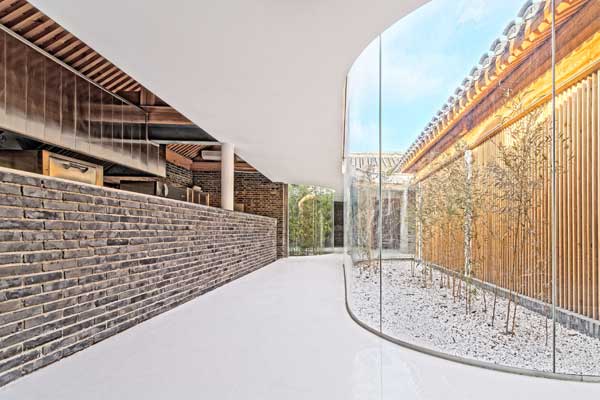
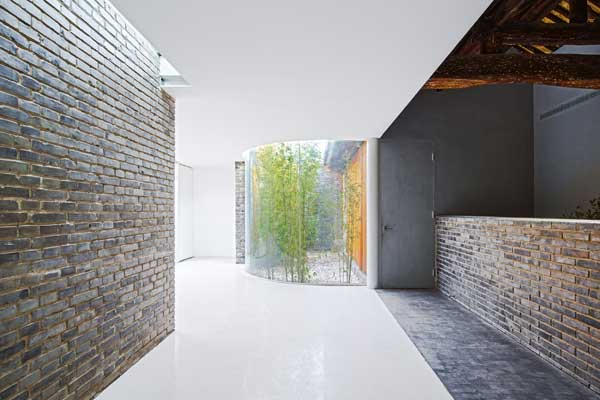
Minimum restoration was done to the north wing to preserve the existing appearance of the oldest structure of the teahouse. Only bricks from the seriously damaged parts of the structure have been replaced. For structures deemed to be less historically significant, the decayed wooden elements have been replaced with steel beams and columns. The dilapidated east and west wings, in contrast, have been demolished and rebuilt into a wooden structure with a pitched roof.
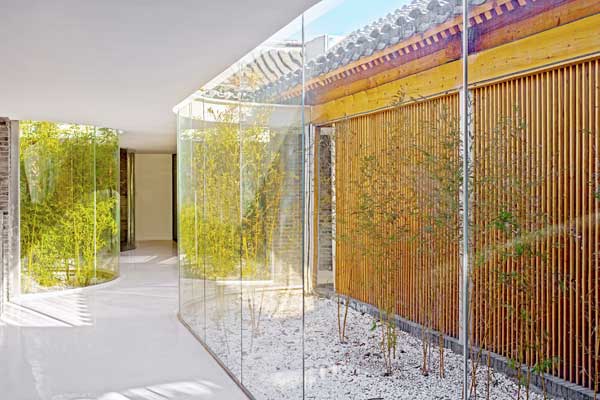
The different rooms in the teahouse are connected by a streamlined covered corridor, resulting in a totally enclosed teahouse that can be air-conditioned. Painted in white, the smoothness of the corridor contrasts with the rough brick walls of the existing structures, underscoring the dialogue between traditional and contemporary architecture within the teahouse. The three courtyards in the teahouse bring nature further into this dialogue, while offering unique views to those in the dining rooms and tea rooms.
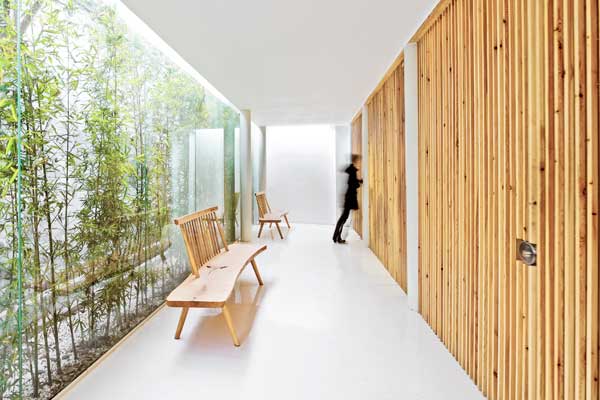
“The streamlined corridor [that connects the rooms] was first conceived for a practical purpose: Beijing is cold in the winter and hot in the summer, so we have to separate the interior from exterior. The corridor also organises the rooms in the courtyard. We were inspired by the corridor in traditional Chinese architecture – it is an important element that brings a rich experience and creates a quiet and calm atmosphere,” said Han.
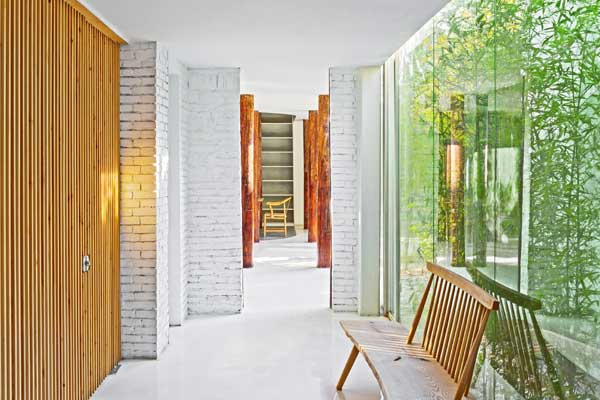
The House in Hutong is a project that experiments with the balance between conservation and development. Hans says, “The space is a medium through which people engage in dialogue with each other and with nature. The ancient Chinese talked a lot about unifying with nature – human beings and nature can form a mutual relationship. The fast [pace of] development [in] China brings a lot of problems exactly because we have ignored the relationship between people and the environment. That’s why we hope to bring back the casualness and austerity that generates dialogue [between people and nature] through our teahouse.”
Arch Studio
archstudio.cn
INDESIGN is on instagram
Follow @indesignlive
A searchable and comprehensive guide for specifying leading products and their suppliers
Keep up to date with the latest and greatest from our industry BFF's!
The internet never sleeps! Here's the stuff you might have missed