To arrive at the Russell & George studio is a distinctly low-key experience. The firm is housed within a red-brick warehouse in an everyday street setting in inner city Melbourne. However, to hit the doorbell and gain admittance into their inner domain is to be transported into a fluid, dichotomous space.
Its open plan nature gives it an unstructured feel. Desking is stand-alone, grouped in a magnetic-like proximity.
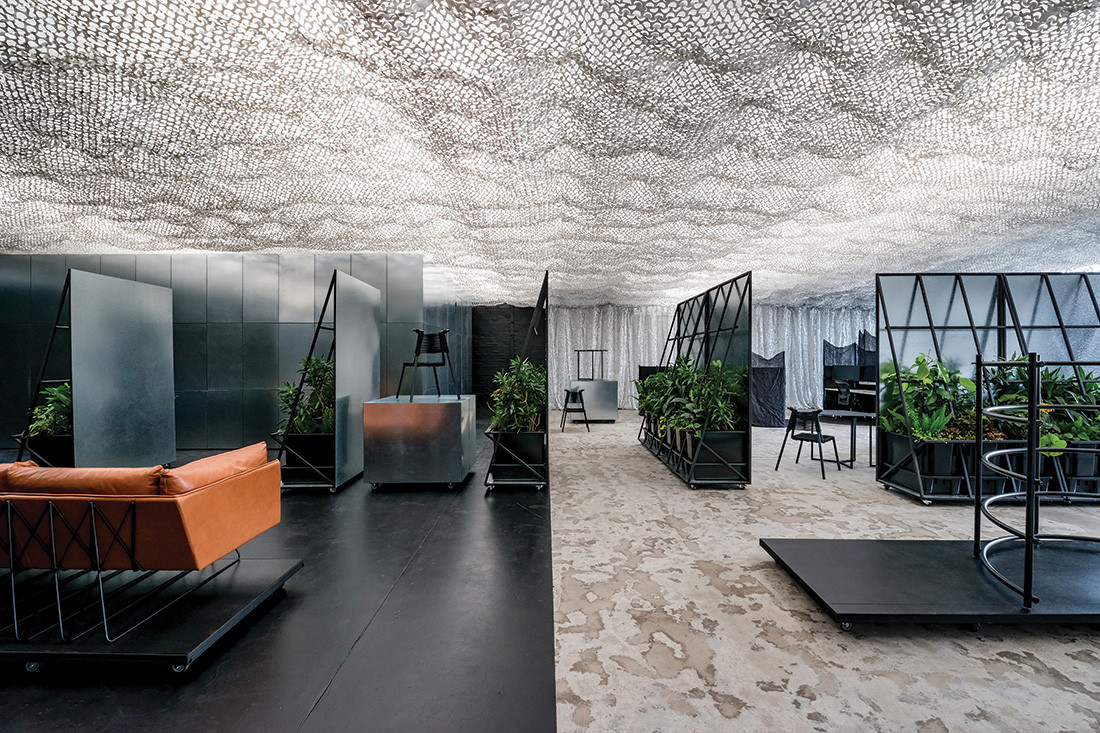
Tall, steel room dividers – almost like theatre set modules – stand sentinel, ready to move into formation.
Beyond, a stark stripe, which runs from the ceiling right down the wall and across the floor, bisects the room. Stepping from light into dark, a neatly faceted steel module houses all the studio’s services. This is Space & Time.
Founders Byron George and Ryan Russell are renowned for their unique working process. Core to this is a research phase and abstraction process that sees them investigate beyond the boundaries of the norms, “slamming” vastly disparate operating models to re-model the basic, functional needs of any given context. “What we’re looking for are new narratives,” comments Russell.

Perhaps that’s what pegged them The Work Space accolade at the INDE.Awards 2019. The Jury commended Russell & George on the studio’s “molecular reconfigurations” which essentially “create an experimental workplace designed to evolve and intrigue”.
Even the conference room table is unstructured, in the sense that everyone sits at a slightly awkward angle, in an off-centre fashion. “It breaks down social conventions,” says Russell – with the intention that people are thrown into intimate engagement and open up a little more.
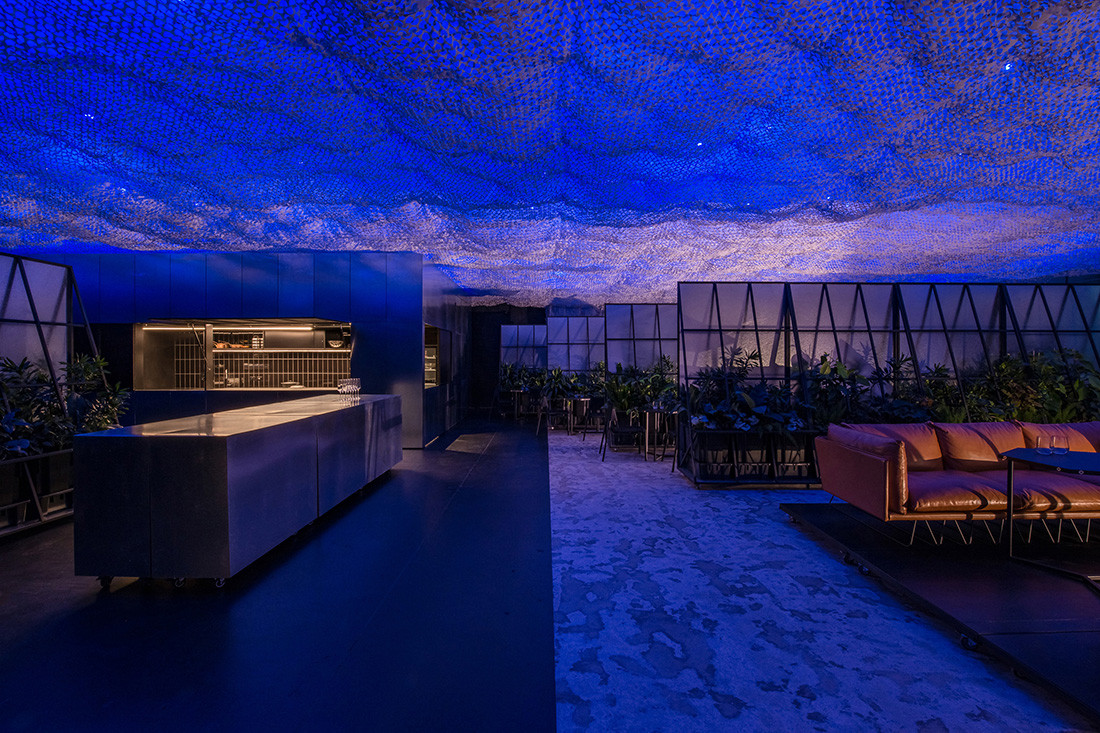
To bring it all back around, one of the most exciting aspects of Space & Time, as Russell & George has dubbed its headquarters, is that it poses a question. What if a space could have a mood and change itself based on what it felt like at the time? Transition from dinner to breakfast to lunch, exercise to work to part: one space, multiple functions, multiple experiences governed by one factor: the time of day.

But even your circadian rhythms are sent slightly askew – if Russell & George so choose. The canopied ceiling, artificially backlit, directs mood and time depending on the space’s use.
Facilitating what Russell & George see as an open horizon of uses and functions for the space, are dynamic, reconfigurable elements. Nothing too fit-for-purpose, lest it limits the possibilities. Whether workplace or workshop, café or restaurant, retail space or showroom, public space or gallery, installation or event space…

“How do you design uses that aren’t yet ascertained?” states Russell & George. “Do you design a plain white box? Do you design for easy and cheap demolition? We believe that good installation design comes not from standing back, but from being bold. Elements that can be transformed without changing them. Raw materials that don’t require sacrificial finishes.”
The space, through its very fluidity, redefines how interior space is used, reused and reorganised. The studio pegs it as futuristic and discipline crossing. Despite that, it is very liveable and serviceable – in all its embodiments.
Photography by Paul Martin.
The INDE.Awards 2019 Work Space award was proudly presented by 2019 category partner, Colebrook Bosson Saunders.
Got an award-winning project to enter into the INDE.Awards 2020? Entries open soon! Sign up for updates here.