Every Saturday, Danish furniture designer, Hee Welling takes his two daughters to a local drawing class in Denmark. No distractions or mobile phones, just 90 minutes focus with a pencil and paper.
Drawing is as enjoyable to him today as it was when he was a child, and as the designer of the iconic About A Family, he knows what he needs to create his best work: focus, precision and time.

“I want to be able to sit with a single project and work at it eight hours a day. I want to completely go into the core of the project,” he says.
As a long-time collaborator, design giant HAY brings Welling’s designs to life. And together, they’re adapting to global challenges to help designers work better. He was in Australia to launch a new extension of the About A Family (AAC, AAS, AAL), entitled AAC100s (About A Chair 100).

Instead of losing the skills of joinery and cabinetry making, HAY combines tradition with technology. Sub-contractors and sub-suppliers use the computer as a tool with robots and CNC machines during production, freeing up Welling’s time for design.
“But of course, we still want the human touch,” he says. “So, the person controlling it will be the last hands touching it. They will go over the piece with sandpaper or a small knife and make the small joineries look 100 per cent perfect.”

At his studio, computers and 3D programs are part of daily life but he and his small team of three have an adjoining workshop so they can produce samples, joinery and test dimensions by hand.
“It’s dangerous,” he says. “No matter how good or skilled you are the computer will always be a flat screen. You don’t get the feeling of the connection or try it on your body to find the right angle or corner so.”

Welling says sustainability is now front and centre for the industry, as evidenced at the Stockholm Furniture Fair, the most important event for Scandinavian furniture. In the last two years, he says 80 per cent of new products contain a tag that they comprise 100 or 50 per cent recyclable material or use 30 per cent less power to optimise production. Previously, there was no nothing.
“If the whole industry decides to do this in smarter ways to take care of the environment, we can actually make a big difference.”
At HAY and for Welling, even one of his chairs in production is by the hundreds of thousands, so making small changes can make a big impact.

For example, everything in his chairs can be detached. The prototype shells are 100 per cent pure polypropylene, which can be recycled continuously, along with the wood bases and four screws.
He adds there will also be better management of colour in the next few years. Facilities will continue to separate materials, but also colours, making it easier for the large quantities of furniture that HAY and Welling specify.
For Welling, it’s not about winning awards or industry recognition. It’s a shared vision with HAY; leaving the planet in a better place and seeing people able to afford and love their furniture.
“It’s what my heart beats for,” he says. “But the problems will not be seen by me, but by our children. If we all do our best, I think we still have time to change it.”
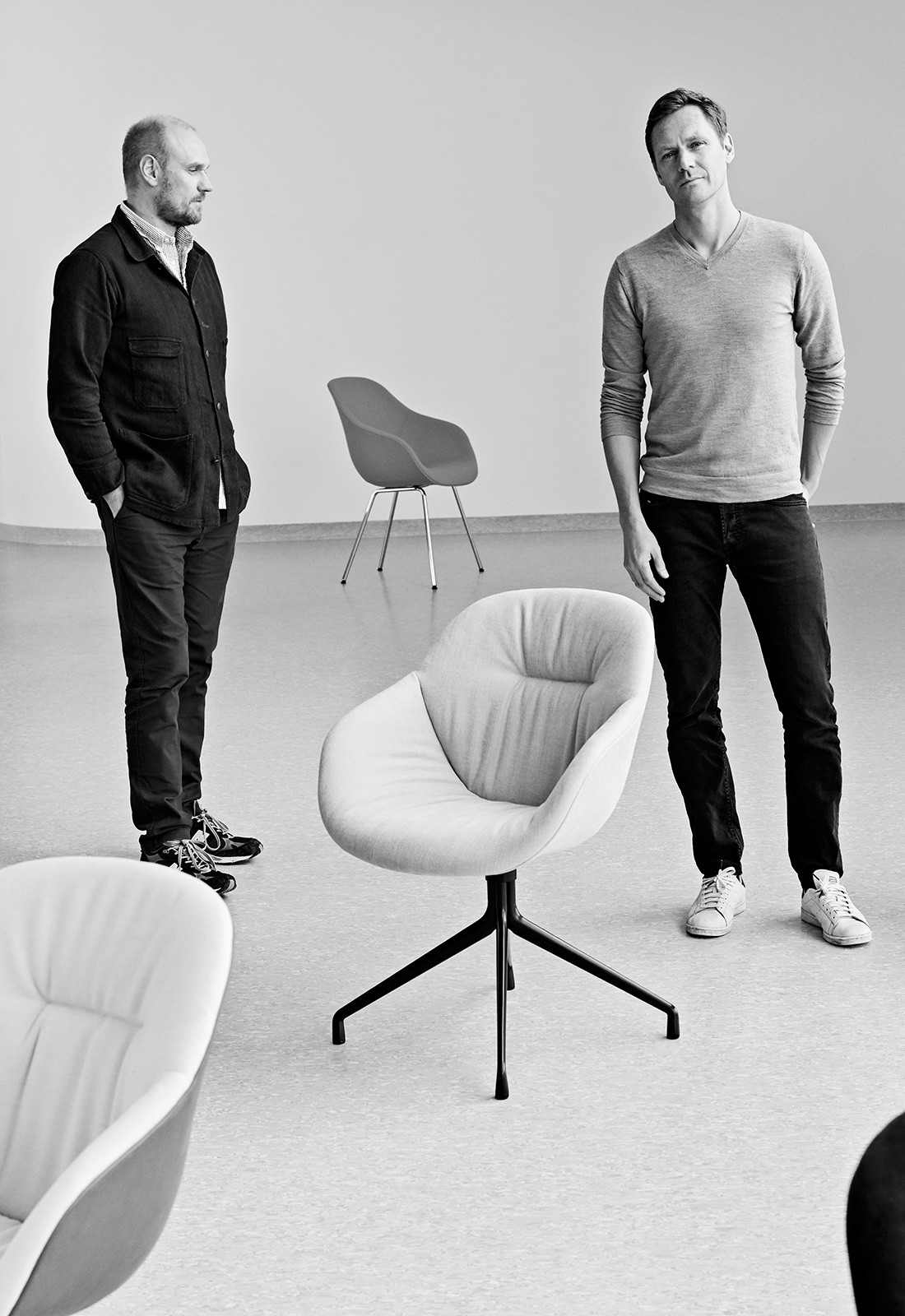
Photography by Fiona Susanto.
–
HAY is in Australia as part of Cult. Read more about HAY here. And join our mailing list for more design inspiration.