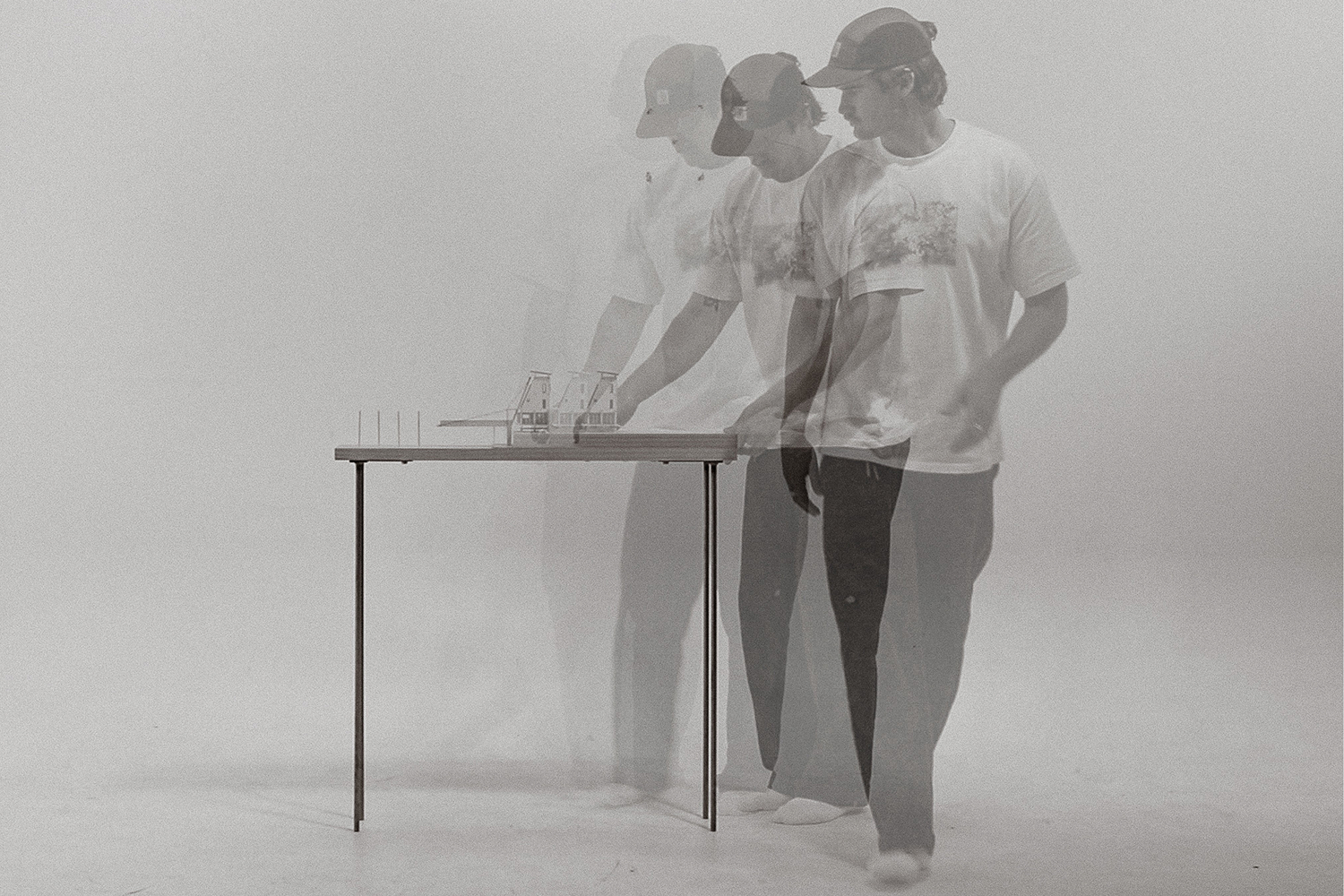
When Jin Kuramoto visited Melbourne with Conde House recently, it wasn’t to promote any particular product. He has a close and collegiate relationship with the brand, which now has a flagship showroom in Melbourne thanks to an exclusive supplier relationship with Apato. Conde House invited Kuramoto to visit Australia as both partner and collaborator – a unique relationship for a designer to have with their client.
In speaking with Kuramoto, it quickly becomes clear why his presence is valued above all else.

Fading by Harmony for Peronda, image courtesy Peronda.
He comes from a carpentry background – a practical approach to design which saw him in good stead when he attended design college in Japan. Having completed his studies Kuramoto could have headed directly into furniture design, but he chose to pursue work in the electronics industry with NEC Corporation.
Designing mobile phones, laptops and PCs had a strong social aspect to it. His human-centred devices gave him insight into the nature of intuitive functionality, while the trends of electronics taught him the ebb and flow of business, not to mention the full-cycle process of planning, designing, engineering and producing.

WIND room divider acoustic panels. Designed by Kuramoto for OFFECCT.
In establishing his own studio, Kuramoto looked to move back into furniture design. But his approach was now informed by an appreciation for brand strategy, combined with his practical hands-on knowledge of design, and an ability to dream big through sensory engagement (working with the hands, observing with the eyes).
“I’m very practical in creating a new object but I’m also thinking with my brain. However, our brain is not good for creation.” The brain, he says, is good at editing and rationalising a multitude of references.
“I believe the only way to create new things is by accident; accidentally making something by hand,” says Kuramoto. “So I’m always using materials and making a lot of prototypes. It’s about playing around with materials and [arriving at] a new vision.”

Most chair designed by Kuramoto for Hukla. Photo by Takumi Ota.
He also highlights the power of observation. Anything can happen beneath the hand’s touch but – “observation is to look very carefully” – to be totally engaged in the pursuit and responsiveness to the process.
When collaborating with manufacturers and retailers, Kuramoto is not always material or form-led. “We have to think brand first, then make the item or object,” he says. Strategic design thinking – gleaned from the electronics industry – comes together with a hands-on approach to make a uniquely brand-oriented creative approach.
.
“I believe the only way to create new things is by accident; accidentally making something by hand.” – Jin Kuramoto
.
In engaging with Conde House (a furniture manufacturer which has an impressive list of designers in its portfolio), Kuramoto initially presented not his designs but his “way of thinking” for the brand. “They have a lot of techniques and nice machines in their factory”, he says, highlighting Conde House’s super-forming and super-bending capabilities. Kuramoto has been hard at work experimenting with new concepts that employ these innovative production techniques. The results of this collaboration will be launched in June this year.
Among Conde House’s other design collaborators is the venerable Naoto Fukasawa, a notable global design luminary. Kuramoto’s friendship with Fukasawa is one of shared interests and informal mentorship. Advice and knowledge exchange happen in a very relaxed fashion over golf games. To have the opportunity to spend time with fellow designers outside of the more formal industry scene is “quite different”, he says.

Most chair designed by Kuramoto for Hukla. Photo by Takumi Ota.
Kuramoto also has a love of teaching and passes his knowledge on to a new generation of designers through lecturing at Musashino Art University, Tokyo. Some of his students have even come to work for him, and so the cycle of mentorship and practice continues. But it’s not all about work, as Kuramoto points out. “How to enjoy life is the most important thing.”
Keen for more Japanese design inspiration? Read our countdown of ways to get a Japanese design fix locally.
–
And keep on top of the latest, sign up for our newsletter.