The home of architecture and design in the Asia-Pacific
Get the latest design news direct to your inbox!

Get the latest design news direct to your inbox!
Ingrid Fuary-Wagner introduces Australia’s first zero-emission and self-powering teaching and research building.
June 22nd, 2010
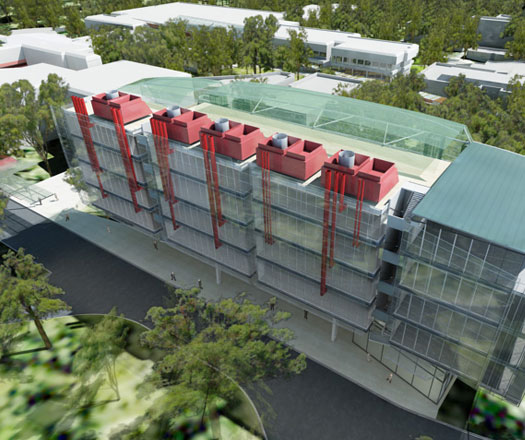
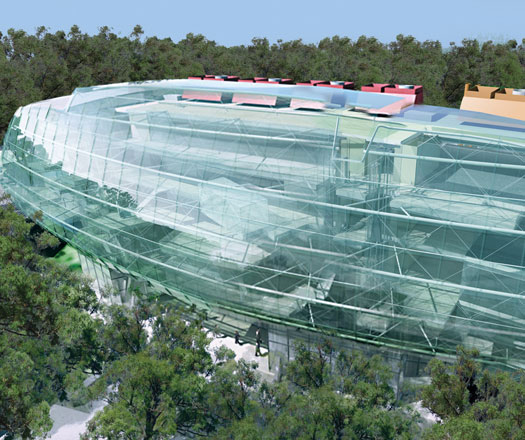
Australian architecture firm Cox Rayner has designed what will be the country’s first zero-emission and self-powered teaching and research building driven by solar-powered hydrogen energy.
The $32 million Sir Samuel Griffith Building will be built just south of Brisbane in Nathan, one of Griffith University’s satellite campuses.
The solar-panelled glass façade will generate its own power supply while at the same time flaunting its skeletal structure and the 4000m² of usable floor space across its six levels.
What looks like an outlandish blimp-like structure from one angle, the building will include natural ventilation, grey water recycling and advanced water collection.
According to Griffith University’s Vice-Chancellor, the world-class building will offer inspiration to both Australian and overseas communities interested in genuine sustainable energy options.
“This building, which will generate its own power supply, is a model for remote communities that are ‘off-grid’ and cannot access power in Australia and across the world,” Professor O’Connor said.
A $22 million grant from the Australian government will assist in its construction as part of the government’s Education Revolution initiative, aimed at encouraging world-leading infrastructure investments that will transform Australian tertiary education and research.
Cox Rayner
cox.com.au
INDESIGN is on instagram
Follow @indesignlive
A searchable and comprehensive guide for specifying leading products and their suppliers
Keep up to date with the latest and greatest from our industry BFF's!
The internet never sleeps! Here's the stuff you might have missed