The home of architecture and design in the Asia-Pacific
Get the latest design news direct to your inbox!

Get the latest design news direct to your inbox!
For the London Design Festival, Ronan and Erwan Bouroullec created a massive installation so visitors could better experience the Raphael Cartoons. Ben Morgan kicked back to learn all about it.
October 14th, 2011
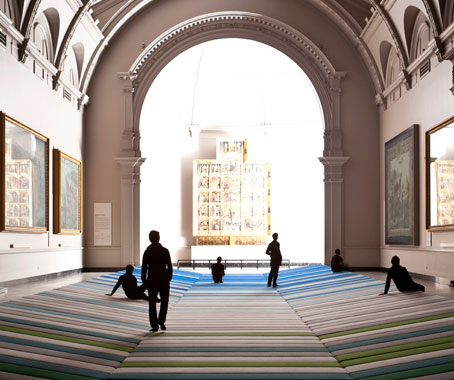
There was something magical afoot at the Victoria & Albert Museum throughout the London Design Festival. Ronan and Erwan Bouroullec (affectionately known as the Bouroullec Brothers) partnered with leading design textiles manufacturer, Kvadrat, to create the ’Textile Field’ installation in the Raphael Gallery.
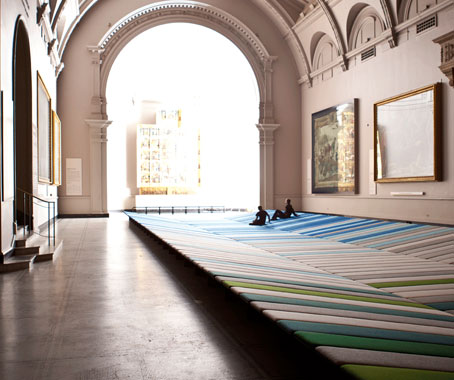
The designers were told earlier this year that the museum would like them to do something, somewhere in their grand buildings – an open brief. Walking around the museum, Ronan felt that the Raphael Gallery was actually the least impressive.
“The gallery itself is unremarkable, visually, and I felt it was an awkward space,” he says. The pair noticed the interaction between visitors and the large artworks hung on all walls was quite limited; with people so overwhelmed with reverence for the pieces they spent little time enjoying them.
Their solution was to create ’Textile Field’, a series of upholstered oblong ’tiles’ in varying shades of green, blue, grey and white running the length of the hall – aimed at echoing a simple perspective technique used in the paintings, where distance is suggested through colours gradually fading to white on the horizon.
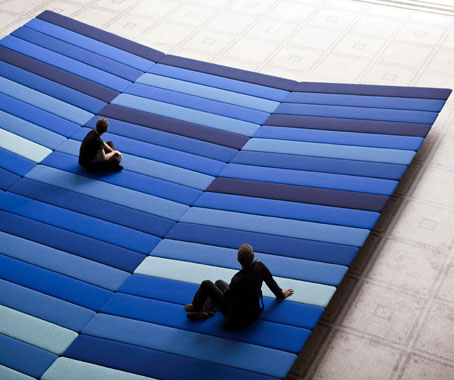
A central row of tiles is flanked on either side by gently sloping rows, mimicking the bottom of a hill in a park. The padded structure allows people to lie comfortably and take in the Raphael Cartoons.
“Seeing the people using it as it was intended is very exciting,” Ronan recalls. Although the Textile Field was created specifically for this space, he imagines it could translate easily to other similar situations.
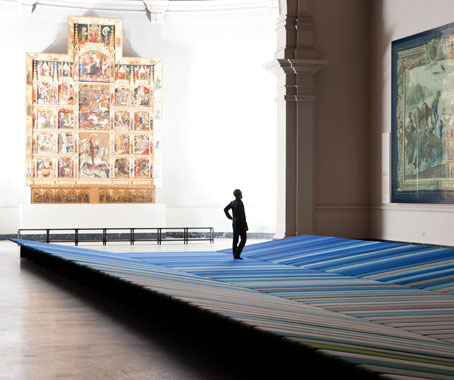
“When we see how simply this works, we see how it could work well in other spaces too.”
The Textile Field is undoubtedly a new way to experience art. Let’s hope it catches on.
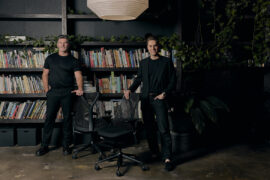
Ronan & Erwan Bouroullec
bouroullec.com
INDESIGN is on instagram
Follow @indesignlive
A searchable and comprehensive guide for specifying leading products and their suppliers
Keep up to date with the latest and greatest from our industry BFF's!
The internet never sleeps! Here's the stuff you might have missed