The home of architecture and design in the Asia-Pacific
Get the latest design news direct to your inbox!

Get the latest design news direct to your inbox!
A two-day symposium marked the arrival on our shores of a massive collection of books belonging to the renowned British architect, historian and critic. Marta Catalan Eraso reports on the translocation of critical discourse.

June 7th, 2016
The above image of Kenneth Frampton was taken by Jeff Barnett-Winsby
Kenneth Frampton is one of the most relevant figures in 20th century architectural theory discourse, and, on 27 and 28 May 2016, he gave a series of public lectures at The University of Hong Kong (HKU) to talk about the relocation of his personal architectural tomes to the Special Administrative Region.
This distinguished collection contains more than 10,000 books, consisting primarily of volumes on architecture and urbanism. Frampton assembled this collection over half a century of teaching across universities including Princeton University, and Columbia University, where he is Ware Professor of Architecture.
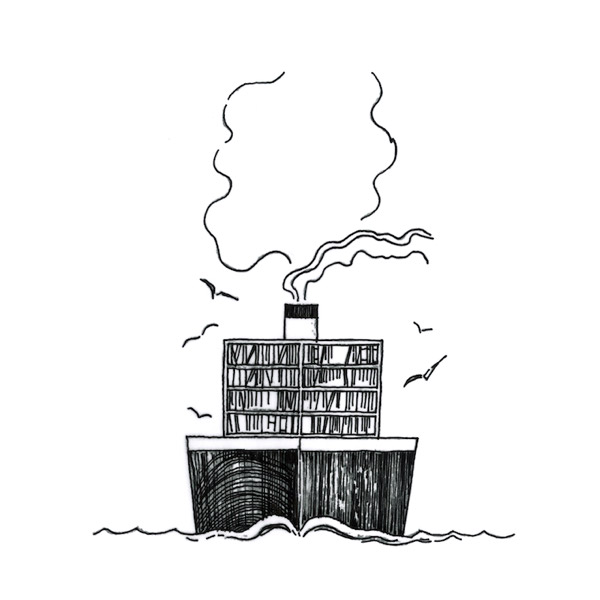
Kenneth Frampton’s library on the move, as sketched by Frampton himself
Frampton’s work has had great impact in Asia, especially since the most recent re-editions of his most acclaimed book, Modern Architecture: A Critical History. By acknowledging and modifying his own gaps, Frampton expanded on his original work: in the revised edition, he talks about globalisation and how this is affecting the architectural landscape all over the world.
The titanic process of transporting and reorganising the library has involved quite some time and the effort of many people. As Silvia Kolbowski, an acclaimed artist and Frampton’s wife, put it, “The library has been relocated to a place where jetlag is inevitable.”
To convince Frampton to move the library here, Tao Zhu, Associate Professor at HKU’s Department of Architecture, offered several reasons as to why this university was the perfect place to host his books. “HKU is a world-class international university committed to English teaching. It has the best English library collection in the region – a region that is in the middle of the fastest urbanisation process in the world, and it’s in the dire need of developing its critical discourses,” he explained.
The presentation of the library to HKU was celebrated with a two-day symposium. To further discuss the relevance of critical architecture histories, Frampton and an array of well-established architects from around the world – selected by Frampton himself – gave several talks and engaged in different conversations, in the form of roundtables. Among those participating was Thomas Herzog of Thomas Herzog Architekten, Pekka Helin of Helin & Co Architects, and Hong Kong’s own Rocco Yim of Rocco Design Architects Limited. “Frampton’s library [coming to Hong Kong] is a dream coming true,” said Yim.
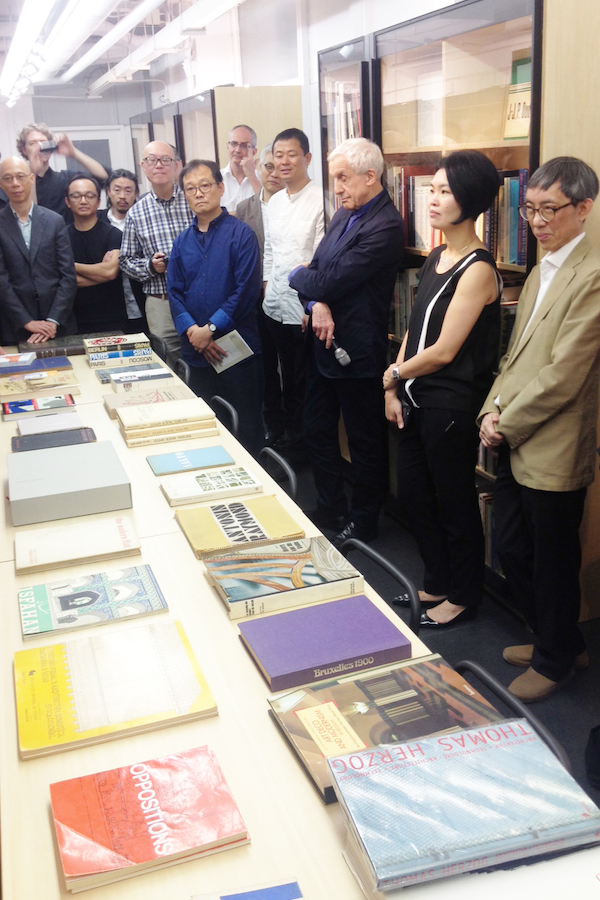
Frampton’s books on display at the symposium
Yim and Frampton maintained an excited debate throughout the symposium, in relation to architectural production in Hong Kong. Frampton was highly impressed by the transport infrastructure in Hong Kong, and the efficiency of the MTR; and yet, he criticised the presence of meaningless capitalism, which is increasingly leading to the production of dull high-rises in the city.
In order to explain the Hong Kong approach to high-rises and how we react to circumstances, Yim showed images of local popular culture, including a school in a rooftop. “We are resourceful, flexible, efficient, practical and this is translated into stacking up, mixing uses, blurring the boundaries and embracing diversity,” said Yim.
Kolbowski closed the discussion on meaningless high-rises by saying that it’s not that so much about the quality of these buildings, but rather, the fact that, in New York for example, “high rises are increasingly left empty and used merely to park money.” Is Hong Kong’s own situation similar? In which case, the question remains: is this ultimately what we envision for our architecture of the future?
The University of Hong Kong
hku.hk
Department of Architecture
arch.hku.hk
INDESIGN is on instagram
Follow @indesignlive
A searchable and comprehensive guide for specifying leading products and their suppliers
Keep up to date with the latest and greatest from our industry BFF's!
The internet never sleeps! Here's the stuff you might have missed