The home of architecture and design in the Asia-Pacific
Get the latest design news direct to your inbox!

Get the latest design news direct to your inbox!
As the Escher x nendo | Between two worlds exhibition continues to draw in crowds, we consider the timeless appeal of the Dutch master for architects and designers.

M. C. Escher: Convex and concave March 1955, lithograph. Escher Collection, Gemeentemuseum Den Haag, The Hague, the Netherlands © The M. C. Escher Company, the Netherlands. All rights reserved.
Paper architecture is a practice of drawing and designing, without the goal of ever building. On the page one can dream up a visionary or utopian idea for what a building, or even a city could look like.
It’s a big call but I’m going to go so far as saying that 20th-century Dutch artist M.C. Escher was the original paper architect.

M. C. Escher: Belvedere May 1958, lithograph. Escher Collection, Gemeentemuseum Den Haag, The Hague, the Netherlands © The M. C. Escher Company, the Netherlands. All rights reserved.
Most would recognise Escher’s work from his iconic optical illusions but there is much more to his body of work than staircases leading to nowhere. Escher was able to not only push the boundaries of what is possible in a drawing, but also what is possible in architecture. His work was well ahead of its time, featuring towers held up by impossibly spindly piloti, or axonometrics with multiple vanishing points.

M. C. Escher: Day and night February 1938, woodcut, printed in grey and black inks Escher Collection, Gemeentemuseum Den Haag, The Hague, the Netherlands © The M. C. Escher Company, the Netherlands. All rights reserved.
Commenting on the influence of Escher’s foresight on the architectural world, Tony Ellwood AM, director at the NGV says, “Escher’s artistic practice, due to its complex play with space, logic and mathematics, has had an indelible impact on architecture and design for many generations. This rich legacy was the catalyst for the NGV to conceptualise the idea of pairing Escher with nendo. We can’t wait for audiences to explore how art can be perceived and experienced differently through the lens of design.”

M. C. Escher: Ascending and descending March 1960, lithograph. Escher Collection, Gemeentemuseum Den Haag, The Hague, the Netherlands © The M. C. Escher Company, the Netherlands. All rights reserved.
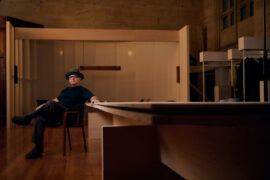
From the exhibition design side of things, Japanese powerhouse studio nendo, fronted by Oki Sato, has taken reference and inspiration from the conceptual background of Escher’s work.

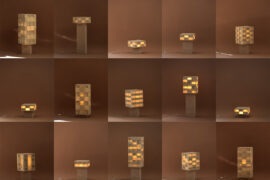
A model of nendo’s development for the exhibition.
The result is a combination of thoughtful exhibition design and inspirational artistic work. And nendo’s execution of the final design is not without surprises.
Escher X nendo | Between Two Worlds is open at the National Gallery of Victoria until 7 April 2019.
INDESIGN is on instagram
Follow @indesignlive
A searchable and comprehensive guide for specifying leading products and their suppliers
Keep up to date with the latest and greatest from our industry BFF's!
The internet never sleeps! Here's the stuff you might have missed