The home of architecture and design in the Asia-Pacific
Get the latest design news direct to your inbox!

Get the latest design news direct to your inbox!
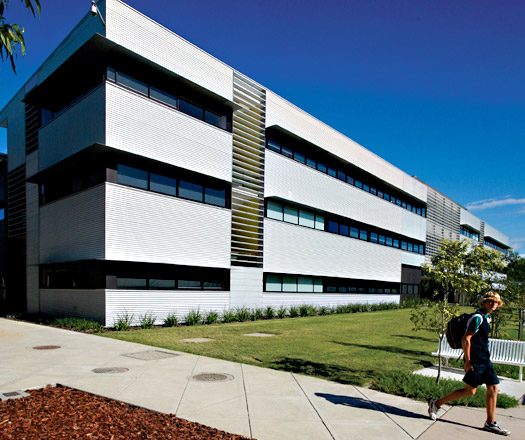
It may be one of Australia’s youngest universities, but the campus of the University of the Sunshine Coast can already boast an enviable quality of design. Michael Keniger reflects on the Chancellery building, designed by architectus.
June 2nd, 2008
Since the admission of the initial cohort of students in 1996, the University of the Sunshine Coast campus at Sippy Downs in Queensland rapidly acquired form and substance as its key teaching, research and administrative buildings took shape.
The lay-out of the campus, governed by Mitchell Giurgola Thorpe and Geoffrey Pie’s masterplan, recalls aspects of Thomas Jefferson’s ‘academical village’ at the University of Virginia. Its key feature is a continuous linear court through the heart of the campus that provides a unifying space for the separate disciplines and support services that address the court.
The University Library (Lawrence Nield and John Mainwaring) is given special prominence by stepping into the vista along this space. The importance of the library to the life of the university is emphasised by its jagged sculptural silhouette and by the cascading planes and articulated structure of the 3-storey public veranda-cum-portico that directly engages with the court. This emphasis is amplified by deliberate contrast with the ordered and relatively sedate colonnades that line the court and that unite and mask the separate buildings along its length.
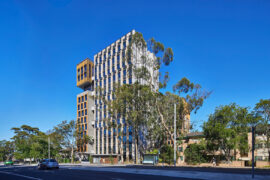
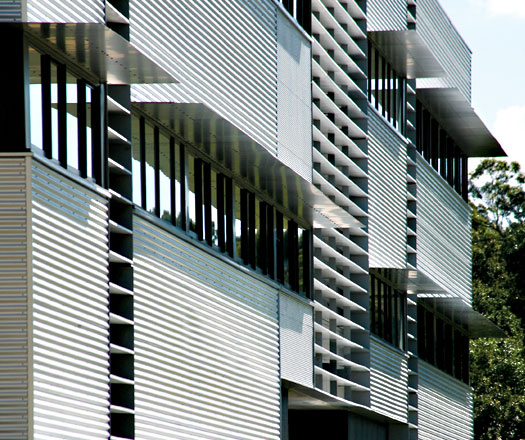
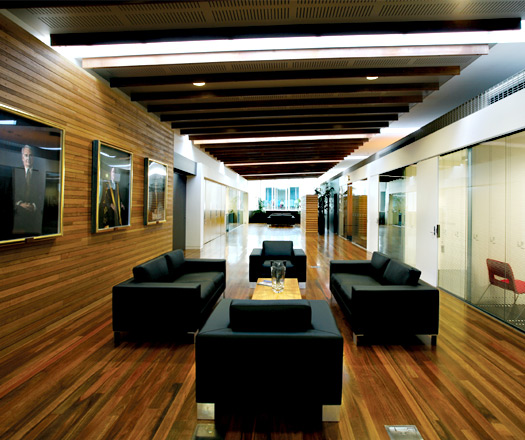
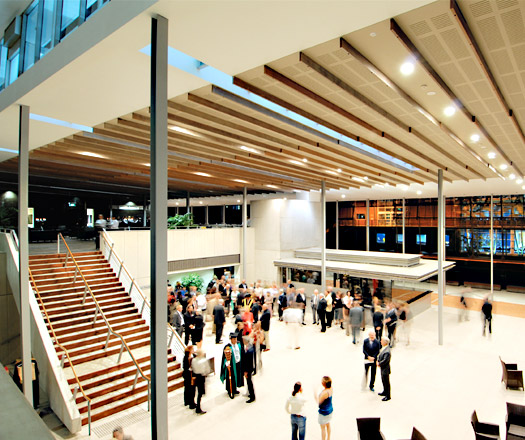
The most recent element to be added to this central composition is the Chancellery building which completes the southern edge of the court directly opposite the veranda elevation of the Library. Lindsay and Kerry Clare, design directors of architectus, brought to bear their proven understanding of the special qualities of the sub-tropical coastal environment and lifestyle of the Sunshine Coast in generating and refining the design of the Chancellery.
The function of a chancellery is to house the principal officers of a university and their supporting administrative staff together with the meeting rooms for the governing council. All too often they are singled out through their siting and design as separate and reserved territories, aloof, dignified and secure – a cut above the university as a whole. In contrast, the location and design of the Chancellery at the University of the Sunshine Coast resonates strongly with the characteristics of openness and welcoming sense of inclusion fostered within the university by the Vice-Chancellor, Professor Paul Thomas, over the hectic period of its establishment and initial growth.
The brief for the Chancellery included the accommodation for the Vice-Chancellor and the Deputy Vice-Chancellor, Pro-Vice Chancellors and their administrative support together with the meeting rooms for the Council, teaching and research spaces, a lecture hall, academic offices, a café, the university’s boardroom and the offices of the indigenous support unit. This juxtaposition of functions enables the building to serve as a microcosm of the university as a whole with a dynamic driven by events and functions and the rhythm of the academic day, week and year….
To read the whole article, see Indesign Magazine Issue #33, currently in newsagents.
architectus
www.architectus.com.au
INDESIGN is on instagram
Follow @indesignlive
A searchable and comprehensive guide for specifying leading products and their suppliers
Keep up to date with the latest and greatest from our industry BFF's!
The internet never sleeps! Here's the stuff you might have missed