The home of architecture and design in the Asia-Pacific
Get the latest design news direct to your inbox!

Get the latest design news direct to your inbox!
Chinese architect Zhang Ke designs an auspicious installation for Moroso at this year’s Milan Design Week. Rachel Lee-Leong has this story.
April 20th, 2012

The Year of the Dragon is said to be a lucky year for the Chinese. This couldn’t be truer for Zhang Ke. With this invitation by Moroso to design an installation for its showroom based on the theme ‘The Year of the Water Dragon’, the Chinese architect is exhibiting during Milan Design Week for the very first time.

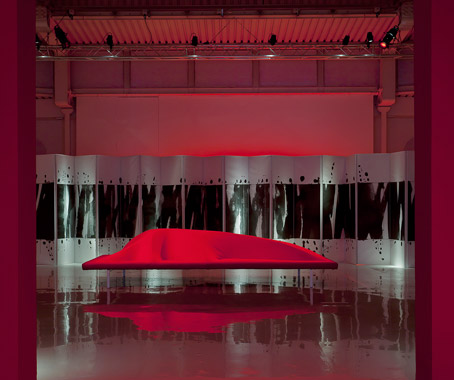
A single red sofa, named the Hidden Dragon, sits dramatically in the middle of the showroom. Surrounding it is a fluid series of screens featuring abstract calligraphy work. In the air, music hearkening to 1920s Shanghai plays and the scent of Tibetan incense adds to a multi-sensory experience. Zhang Ke speaks to us about his installation.

“In the West, people see the dragon as a creature. But if you check ancient Chinese history and tales, the dragon is really something ever-changing, all-elusive. It’s invisible, immaterial. It’s never a physical image. But movement is always there. You never imagine a dragon just sitting there; it’s always moving. [With the sofa], what you see is only the movement of the water dragon.
[Moroso] wanted me to do a dragon, I said ‘No no no. I’m not going to do a dragon. I’ll do a hidden dragon’. You know, they’re romanticising Chinese culture. But we were able to keep it abstract and give people the space to think further.

If you see it from a distance, it’s really like a mountain on the water. It’s a distant hill, a landscape on the water.
As an object, I go back to the relationship of the body and the furniture. So it’s more of a bodily landscape. It’s a landscape related to human bodies.
At first, it was quite a struggle. But it came to be quite easy as soon as we found out that it’s not about a fixed image – it’s about movement and it’s related to water. Then the ink and water calligraphy became a good starting point. You can sense the flow of water. It’s about reinterpreting and reinventing the essential experience of ‘Chinese-ness’ rather than doing something that people already know about Eastern philosophy.”
Stay tuned to Indesignlive for more from the 2012 Milan Furniture Fair.
INDESIGN is on instagram
Follow @indesignlive
A searchable and comprehensive guide for specifying leading products and their suppliers
Keep up to date with the latest and greatest from our industry BFF's!
The internet never sleeps! Here's the stuff you might have missed