The home of architecture and design in the Asia-Pacific
Get the latest design news direct to your inbox!

Get the latest design news direct to your inbox!
How can design education keep pace with change? We quizzed Rosanne Somerson, President of leading US institution Rhode Island School of Design, during her recent visit to Singapore for Brainstorm Design.

March 23rd, 2018
Let’s start by talking about how today’s designers need to navigate change and solve problems in different ways than their predecessors.
We’re living in a time when things are changing really fast, and problems are accelerating because we’re living differently. The creativity of designers is having more impact than it has in the past. This generation is the first that’s grown up with apps, so they’re used to a different kind of access and connectedness. This is also a generation that’s living in fear like no other generation.

Rosanne Somerson, President of RISD
If ‘design’ is becoming a more significant force behind innovation in many fields, what will a design school be in the future?
That’s a great question. If one gets a really great design education, it’s not about a prescriptive path; it’s about learning a way of thinking in any setting. One of the big ways that design education is changing has to do with the fact that who gets a design education is changing. We’re making a big push at RISD about inclusivity. This year, the racial dynamic of the majority of students under 18 shifted for the first time, and that’s only going to increase.
Our students in this generation are increasingly redefining the fluidity of identity – of barriers in every sense. So for design education to be relevant, it has to include multiple voices. Faculty are changing the curricula to bring in different role models, to think about different definitions of what constitutes histories, and to consider what will be relevant to our students when they’re leaders in ten and 20 years.
You referred to culture there. How about the kinds of functions that design is applied to?
The way we’re living is changing dramatically, and design itself as a discipline still includes products, but the nature of products has changed. Also, designers’ ideas can be applied to many different outcomes – not just products. It’s gone from products to services to systems. For example, we have students who are working on new forms of healthcare, marine life habitats for areas affected by climate change, venture capital, insurance structures – things that are systems rather than individual products. And there are increasing opportunities for design expertise to be brought into those realms.
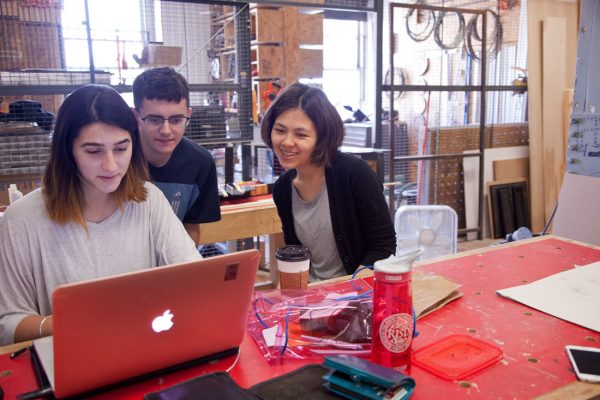
In line with those shifts, has your curriculum changed?
Yes, but not across the board. There are still some faculty that are teaching in ways they have taught successfully for years. But over the last five years, we’ve hired 50 new faculty and they’re far more international, of different ages and backgrounds. So naturally they bring in different perspectives. Any good education should have a core foundational mission that identifies what the school is about, but it should also be dynamic. I would say that our curricula are dynamic.
How do you think your curricula might change in the future?
At RISD we have a commitment to disciplinary rigour. We believe in taking students on a path where they have to really invest in learning something – they have to become experts in some way. But they can use that expertise in far-reaching ways.
We’re also creating some new facilities that are laboratories for research specifically around things like natural systems, colour and perception, complexity, and things that are not associated with the standard disciplines of architecture, industrial design, furniture design, painting and printmaking. These are thematic principles that can be informed by the subject areas we teach but also create new kinds of combinations and opportunities from those disciplines.
I was expecting you to mention things like digital techniques.
That’s just assumed in everything now. It used to be a separate thing. Technology is embedded in everything that happens through the range of design disciplines and the fine arts.
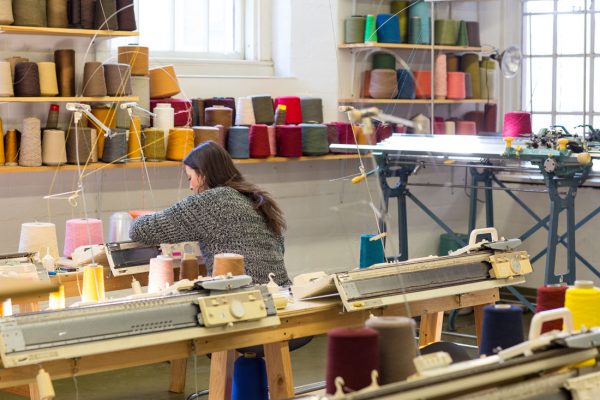
You also still emphasise drawing in your foundation-year course, and I assume that’s by hand.
Definitely. I think drawing is the foundation of creative thought. We teach drawing not as a form of representation but a form of thinking. Our students do eventually learn how to render on the computer and they all graduate with those capabilities, but in the first year it’s an embodied learning. When you’re drawing with your whole body – with your arm and your eye and connecting hand and eye – there are kinds of intelligences that just can’t form any other way. And those are really the basis of creativity.
Educator Rosanne Somerson is RISD’s seventeenth President and also a furniture designer/maker. She previously served in the role of Provost and Chief Academic Officer. She simultaneously maintains a creative practice, designing and creating furniture for exhibitions and commissions. She also consults on innovative educational and creative practice for institutions and industry.
Images: RISD/Jo Sittenfeld.
INDESIGN is on instagram
Follow @indesignlive
A searchable and comprehensive guide for specifying leading products and their suppliers
Keep up to date with the latest and greatest from our industry BFF's!
The internet never sleeps! Here's the stuff you might have missed