The home of architecture and design in the Asia-Pacific
Get the latest design news direct to your inbox!

Get the latest design news direct to your inbox!
A retrospective exhibition featuring the works in progress, paintings, drawings and models by the late Zaha Hadid will open doors into the investigative processes that continue to instigate the practice today.
May 25th, 2016
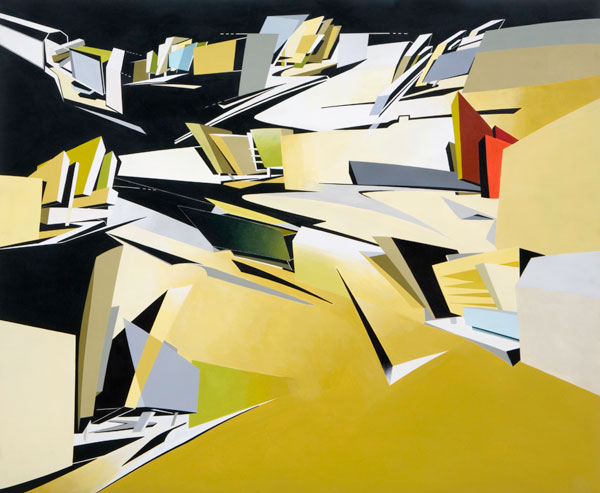
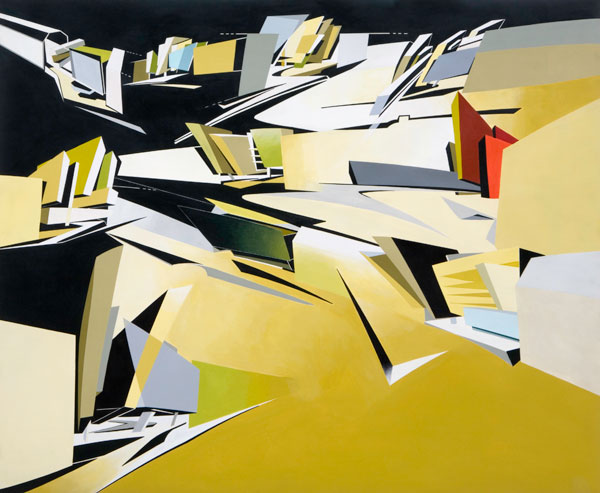
Top Image: Hafenstrasse Hamburg, 1989. © Zaha Hadid Architects
During a conversation with Hans Ulrich Obrist, co-director of the Serpentine Galleries in 2011, the late Zaha Hadid spoke about the power of experimentation, “I know from my experience that without research and experimentation not much can be discovered. With experimentation, you think you’re going to find out one thing, but you actually discover something else.”
Since the founding of her eponymous studio in 1972, this spirit of discovery and investigation remains unaltered. The mediums might have changed, thanks to major technological advancements, but experimentation remains key to the Pritzker Architecture Prize-winning studio, in which projects are backed by decades of research and exploration spanning fields of urbanism, architecture and design.

The Peak, Hong Kong, 1982-83. © Zaha Hadid Architects
It makes sense that a tribute to Hadid’s four decades of work in architecture and design will provide an intricate look at her works in progress, including seminal paintings, drawings and models. The exhibition – hosted by cultural institution Fondazione Berengo – will be held at the Palazzo Franchetti in Venice, Italy from 27 May to 27 November 2016, coinciding with the Venice Architectural Biennale 2016.
Works on display go as far back as Malevich’s Tektonic (1976-77), as well as Hadid’s fourth-year project at the Architectural Association School in London that bridged the River Thames. Viewers can also study equally powerful but unrealised projects by the firm, including the Peak Club, Hong Kong (1982-83), Hafenstrasse, Hamburg (1989), and Grand Buildings, Trafalgar Square, London (1985).
The period when the practice participated in multiple competitions, but did not succeed in any were deemed vital by Hadid, who previously said, “Maybe now I would do them differently, but these unrealised projects were at the beginning of our research into that kind of work – and therefore, very important in the development of our repertoire which led to the remarkable projects we build today.”

Hafenstrasse Hamburg, 1989. © Zaha Hadid Architects
Hadid engaged with Russian avant-garde during the early states of her career, experimenting with compositional techniques spanning fragmentation, layering and porosity, which are common threads in her projects. She described how the early methods that the office adopted to construct drawings and models often led to new discoveries. “The whole system of drawing led to ideas, putting one sheet over another and tracing and reworking, like a form of reverse archaeology in a way, leading to a layering process where distortion in the drawing could lead to distortion in the building,” she said.

The World (89 Degrees), 1983. © Zaha Hadid Architects
The Zaha Hadid exhibition at the Palazzo Franchetti Campo Santo Stefano, Venice, Italy will take place from 27 May to 27 November 2016.
Zaha Hadid Architects
zaha-hadid.com
INDESIGN is on instagram
Follow @indesignlive
A searchable and comprehensive guide for specifying leading products and their suppliers
Keep up to date with the latest and greatest from our industry BFF's!
The internet never sleeps! Here's the stuff you might have missed