The home of architecture and design in the Asia-Pacific
Get the latest design news direct to your inbox!

Get the latest design news direct to your inbox!
Geyer recently completed Citi’s ‘Regional Design Guidelines’ and the design for the Citi office operations in Singapore’s Asia Square.

November 15th, 2012
The need for flexibility is a key consideration in the design of today’s workplaces. For Citi, this requirement is joined by the need for rationalisation and greater consistency in its substantial regional portfolio of office accommodation.
Geyer were engaged to develop ’Regional Design Guidelines’ for Citi embracing Asia and Australia, drawing on best practice in Citi’s recent fitouts as well as global and regional industry benchmarks. The intent was to provide a framework and set of guidelines that would assist local project teams to plan and manage new fitouts more efficiently.
The resultant guidelines outline Citi’s workplace design objectives, floor zoning and planning principles, personal and shared support space allocation, references to ’Citi Workplace Strategy’ (a policy on flexible working), building selection, security, signage, and guidelines for the design of specialist areas.
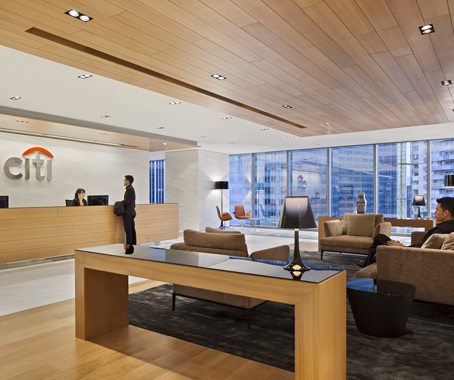
Client reception area
Geyer were also commissioned to design Citi’s new office operations in Singapore’s Asia Square. Consumer, corporate and private banking groups are consolidated in a single tenancy – the first time in Singapore that all three groups have been collocated.
A single client floor was created, which is shared by all groups. Citi branding is consistent across the floor, while some smaller and more discreet meeting rooms were planned with a slightly more ’hospitality’ look and feel for private bank clients. The accommodation also includes Citi’s largest and best-equipped trading floor in the region.

Formal meeting room
A key objective for Citi was future flexibility and space-planning efficiency. To this end, Asia Square’s large (approximately 35,000-square-foot) and regularly shaped floor plates facilitated the development of a work floor ’template’ that is 80-90% applicable to all groups. It provides for modular and consistent allocation of meeting and focus rooms, offices, workstation clusters and storage. This, says Geyer, significantly reduces the ongoing cost of churn due to the constant resizing and restructuring of departments.
The streamlining of workspace allocations was Geyer’s other significant strategy for enhancing flexibility. A workstation design was implemented that enables fast and cost-effective modification to accommodate intensified project teams or contractors.

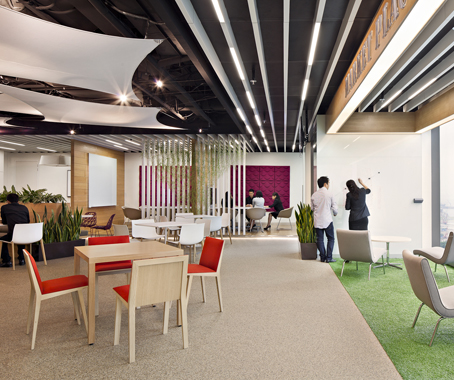
The Marketplace
The Marketplace was provided as a central area for work and interaction. This flexible, informal and energetic environment combines technology, unique settings (as well as seminar rooms), and a fully equipped cafe. It can be opened up for town hall-style meetings and social events.
Geyer were involved in supporting the change and communications associated with the transition to the new work environment, and are also currently advising Citi on the planning and concept for a number of other projects in Asia.
Top image: informal meeting zone.
Photographs by Owen Raggett.
Geyer
geyer.com.au
INDESIGN is on instagram
Follow @indesignlive
A searchable and comprehensive guide for specifying leading products and their suppliers
Keep up to date with the latest and greatest from our industry BFF's!
The internet never sleeps! Here's the stuff you might have missed