The home of architecture and design in the Asia-Pacific
Get the latest design news direct to your inbox!

Get the latest design news direct to your inbox!
Singapore’s compact city to be exhibited in Paris, with an aim to create discourse on potential city planning solutions for an increasing world population.

May 28th, 2015
Top: Rendering of Paris Tube View. Photo: Curators of 1000 Singapores: Eight Points of the Compact City
In celebration of 50 years of diplomatic ties between Singapore and France, 1000 Singapores: Eight Points of the Compact City will draw parallels between Singapore and Paris, with regards to urban planning strategies, human capital investments and infrastructure improvements.
As a city designed to hold 6.9 million people within a 718 kilometers square island, the intricacies of Singapore’s urban system will be examined in the exhibition.

PSA From Pinnacle, Singapore. Photo: Darren Soh
Showcasing how compact cities can possibly be built in the future, the exhibition aims to promote discourse on future inhabitation and livelihood, in light of an increasing world population highlighted in the following key figures:
Projected by the UN, the world will reach a population of 9.5 billion by 2050 – a 2.25 billion increase within a span of 35 years.
If 50 per cent of this new population live in cities, 1.125 billion people will be urbanised by 2050.
This could mean that 4.5 new Singapores or 2.5 new Paris Metropolitaine Areas will need to be built within 35 years – an incredibly fast development rate, considering each city took at least fifty years to mature.
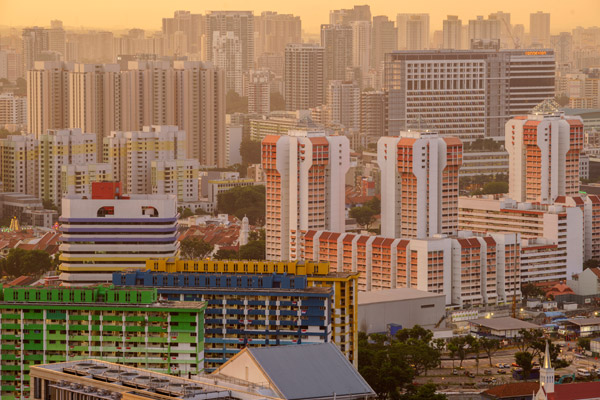
View of Rochor, Singapore. Photo: Darren Soh
Held at the prestigious architecture gallery, Cité de l’Architecture et du Patrimoine in Paris, 1000 Singapores is curated by Khoo Peng Beng, Erik L’Heureux and Florian Schätz – recurring curators from the 2010 edition of the exhibition, 1000 Singapores – A Model of the Compact City held in Venice, Italy.
The exhibition, commissioned by DesignSingapore Council, will span 33 metres with eight large-scale models complementing eight points of the compact city: Density, Territories, Nature, Infrastructure, Urban Models, Governance, Economics and Architecture, where diagrams, drawings and photographs reflecting Singapore’s urban planning for the past 50 years will be exhibited.

Top: Paris Tube View. Photo: Curators of 1000 Singapores: Eight Points of the Compact City
1000 Singapores: Eight Points of the Compact City will be held from 15 June – 14 September 2015, at the Cité de l’Architecture et du Patrimoine, Paris, France. A public forum consisting of presenters and panelists from both counties will be held on 17 June 2015 at the museum’s auditorium.
The exhibition is set to return to Singapore between the end of 2015 and early 2016.
INDESIGN is on instagram
Follow @indesignlive
A searchable and comprehensive guide for specifying leading products and their suppliers
Keep up to date with the latest and greatest from our industry BFF's!
The internet never sleeps! Here's the stuff you might have missed