The home of architecture and design in the Asia-Pacific
Get the latest design news direct to your inbox!

Get the latest design news direct to your inbox!
Ross Gardam shares insights into his design philosophy, the making of his award-winning Méne light, and the evolving landscape of sustainable craftsmanship.

March 30th, 2025
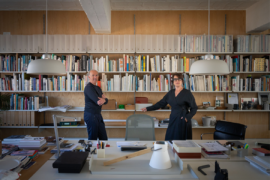
Ross Gardam, an acclaimed product designer based in Melbourne, seamlessly merges traditional craftsmanship with modern techniques to create stunning lighting and furniture pieces. A past winner of the INDE.Awards, his design philosophy revolves around material exploration, geometric elegance, and meticulous attention to process. In this exclusive interview for the SpeakingOut! series, proudly supported by the American Hardwood Export Council (AHEC) as partner of The Object category at the 2025 INDE.Awards, Gardam delves into his journey, inspirations, and the intricate process behind his award-winning piece, Méne.

A Journey Rooted in Craftsmanship
Growing up surrounded by industry and craftsmanship, Gardam’s design journey was influenced by his family’s deep-rooted expertise in making and engineering. His grandfather, a cabinet maker and builder, and his father, a mechanical engineer, instilled a strong practical foundation. “I spent a lot of time in workshops and factories, which shaped my approach to materials and process,” Gardam recalls. However, it was during his industrial design studies at university that he truly embraced the conceptual side of design, evolving from a hands-on creator to an innovative designer of beautiful objects.

The Creative Process: From Brief to Form
Gardam’s design process is highly structured, with the brief playing a pivotal role in shaping his work. “My early pieces lacked a rigid framework, which made them difficult to commercialise,” he shares. Over time, he refined his approach, ensuring that material selection, production techniques, and sustainability principles drive his designs. He describes his aesthetic as a continuous exploration of geometric form, often leaning toward minimalism. While some designers experience “light bulb moments,” Gardam’s process is more painstaking – often spanning 12 months or more – where rigorous experimentation refines each product to its purest form.
The Making of Méne: An Exploration of Glass and Light
Gardam’s award-winning light, Méne, exemplifies his dedication to craftsmanship and innovation. Inspired by ocean ripples and the way light interacts with water, Méne was developed using a complex glass-blowing technique called “optic moulding”. Working alongside the JamFactory in Adelaide, Gardam and his team pushed the boundaries of traditional glass-blowing, creating large-scale, uniquely textured pieces. “It was a huge challenge – the scale alone required extensive R&D and mould production,” he explains. The piece debuted at Milan’s prestigious Salone del Mobile, but not without its hurdles. “The day before dispatch, three pieces arrived broken. It was a mad rush, but thanks to incredible teamwork, we managed to deliver them on time”.

Shaping the Future of Design
Beyond his individual creations, Gardam’s work contributes to broader industry movements, particularly in sustainability and the fusion of craft with modern technology. His ability to reinterpret traditional techniques in contemporary contexts has cemented his place as a leader in Australian design. By continuously pushing material limits while maintaining a strong connection to craftsmanship, his work sets a benchmark for the future of product design.
Ross Gardam’s journey exemplifies how passion, precision, and perseverance come together to create exceptional design. We extend our thanks to Ross for sharing his insights and to AHEC for their support of this SpeakingOut! Episode and The Object category at the 2025 INDE.Awards.
For more inspiring conversations, check out the full interview here.
Don’t miss the opportunity to showcase your innovative projects – enter the 2025 INDE.Awards now!
INDESIGN is on instagram
Follow @indesignlive
A searchable and comprehensive guide for specifying leading products and their suppliers
Keep up to date with the latest and greatest from our industry BFF's!
The internet never sleeps! Here's the stuff you might have missed