In a landscape clouded by data and greenwash, Product Aware offers architects and designers a common language for sustainability. Embraced by suppliers – including Milliken – it is setting a new benchmark for trust and bringing clarity and accountability to material specification.
Specifying materials has never been simple. For every new project, architects and designers navigate a maze of labels, data sheets, and marketing claims – each promising a sustainable solution but rarely speaking the same language. Too often, decisions come down to what’s easiest to justify or cost effective rather than what’s most responsible.
Story continues below advertisement
Product Aware was created to change that. An independent, open-access platform, it distils complex sustainability data into five clear pillars: human health, climate and ecosystem, circular economy, waste minimisation, and social responsibility. In doing so, it provides a framework that allows architects, designers, and suppliers to work from the same page, replacing confusion with clarity.
“It’s about moving sustainable specification forward as a collective,” explains Lucy Sutton, Associate Director at Bates Smart and a core member of Architects Declare. “We came together as volunteers to create a tool that reflects shared priorities across the industry. It’s not perfect, and it will continue to evolve, but it’s already shifting the conversation.”
It’s a conversation that is urgently needed. The built environment is responsible for nearly 40 per cent of global carbon emissions, and yet, as Sutton points out, sustainability has historically sat outside the basic criteria for product selection, overshadowed by budget, aesthetics, and functionality. Product Aware makes it harder to ignore, with plain-English questions and transparent data that bring issues such as embodied carbon, circularity, and modern slavery into the heart of decision-making.
Story continues below advertisement
For Dr. Matthias Irger, National Head of Sustainability at Cox Architecture – which helped to build Product Aware before donating it to Architects Declare – the platform’s greatest strength is its independence. “Transparency is one of the most important things to combat greenwashing,” he explains. “We wanted a free, unbiased database that any practice could trust.”
That open visibility is already shaping behaviour, with new suppliers and products added to the platform weekly. “Once the first movers, like Milliken, joined, momentum built quickly,” says Irger.
Story continues below advertisement
For Milliken – which is widely recognised as a leader in sustainability – joining Product Aware was a natural step. “Being part of Product Aware is about transparency and accountability,” says Deepak Chopra, Milliken’s National Sales Director. “It’s not just another label or certification. It’s a way for clients, architects, and designers to see the story behind the product and to trust that our sustainability claims are backed by verified data.”
This visibility is also practical. Product Aware functions like a toolbox, allowing specifiers to filter by criteria – recycled content, embodied carbon, local sourcing, take-back schemes – and compare options at a glance. It also allows the A&D community to track measurable improvements – for example, a radical reduction in the embodied carbon of a Milliken carpet tile would be reflected in real time in the Product Aware database – and it places smaller, emerging suppliers on the same playing field as the major players.
“As more specifiers engage with Product Aware, it creates an environment where circularity, carbon reduction, and whole-of-life solutions become the norm rather than the exception,” says Chopra. “That kind of visibility pushes the whole industry forward.”
Different practices emphasise different pillars, reflecting the breadth of sustainability itself, and each member of the Architects Declare will find their own value in the platform. For Karlee Blackburn of NH Architecture, the framework helps avoid “regrettable substitutions”, where a product chosen for low carbon might conceal human health or transport issues. For Dr. Kavita Gonsalves, Sustainability Design Lead at Populous, the lens of social responsibility is vital for making the invisible visible: “It’s not just about recycling or PV panels,” she says. “Every material carries a story – of place, communities, workers, landscapes, by-products, and planetary health. Product Aware provides the potential of moving beyond green gloss to championing products that protect people and ecosystems alike.”
Together, these perspectives illustrate the power of Product Aware: it doesn’t dictate a single definition of sustainability, but ensures the full picture is always visible. And that, in turn, makes conversations with clients easier. “It gives us leverage,” says Blackburn. “We can show it’s not just our opinion but an industry framework.”
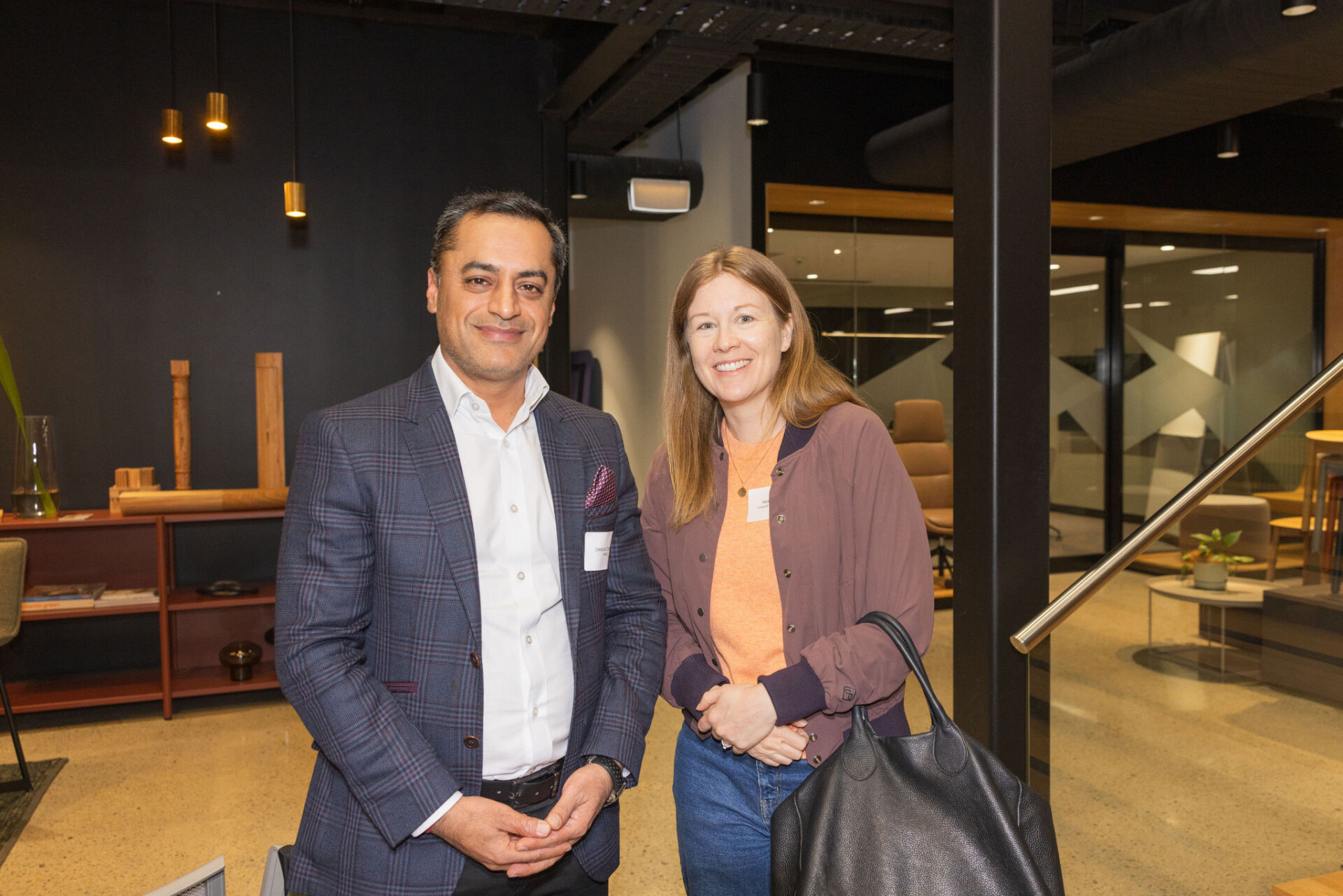
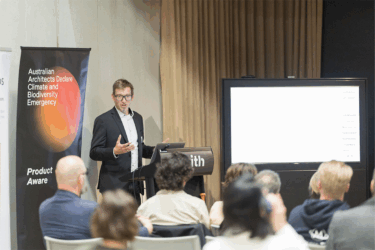
This development represents a significant advancement for the industry by fostering enhanced communication among architects, designers, developers, and the construction sector. Additionally, the team has organised the National Symposium for Product Aware – a series of events held across Australia designed to increase awareness and promote engagement with industry stakeholders.
For Chopra, the message is simple: every specification matters. “Every choice at the specification stage sends a ripple through the supply chain,” he says. “Ask the tough questions, demand transparency, and think about both day one and end-of-life. If you do that, you create solutions that are not only beautiful and functional, but truly sustainable.”
It’s a sentiment echoed by Sutton, who believes the real power of Product Aware lies in how it reshapes the very criteria for making choices. “What’s exciting about an initiative like this is how it positions sustainability as a key part of decision-making around product selection,” she says. “By having clear, open-source criteria written in plain English, we can see a future where sustainability sits alongside cost, aesthetics, and functionality – and that gives me a lot of hope for how climate action can be embedded in the future of architecture and design.”
Event Photography
Ben Appleton (Canberra)
Brandon Grey Media (Brisbane)
Alexandra Bogdanova & Tyrone Branigan (Sydney)
Matt Houston (Melbourne)
Milliken Floors
Product Aware
Architects Declare
Suppliers Aware