The home of architecture and design in the Asia-Pacific
Get the latest design news direct to your inbox!

Get the latest design news direct to your inbox!
Paul McGillick visits Brisbane’s Gallery of Modern Art to experience Matisse – Drawing Life, a retrospective of some of the artist’s best work on paper.
December 5th, 2011
This is possibly the finest exhibition ever to tour Australia. With over 300 prints and drawings, and including a number of paintings, this exhibition is not just comprehensive, but also fully representative of Henri Matisse’s finest work on paper.

Océanie, le ciel (Oceania, the sky) 1946, Screenprint on linen, 169 x 359cm
Collection: National Gallery of Australia © Succession H Matisse.
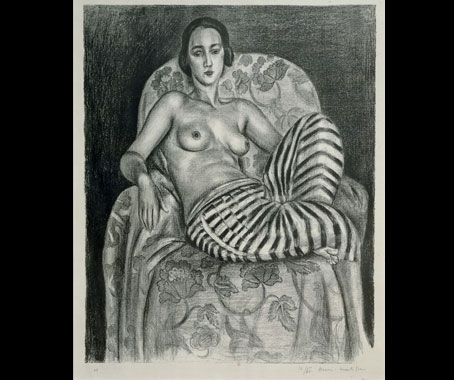
Grande odalisque à la culotte bayadère (Large odalisque in Bayadère culottes) 1925
Lithograph on paper, 75 x 56cm
Collection: Département des estampes et de la photographie, Bibliothèque nationale de France, Paris
© Succession H Matisse
Matisse, who died in 1954, is arguably the most innovative artist of the 20th Century. He was also the most influential because he so thoroughly re-examined the tradition of Western art, while bringing it together with the great decorative tradition of the East.
Matisse is an artist’s artist. But he is also totally accessible to a broad public because of the way he is able to communicate so directly, in particular the way he can communicate the sheer joy of art.
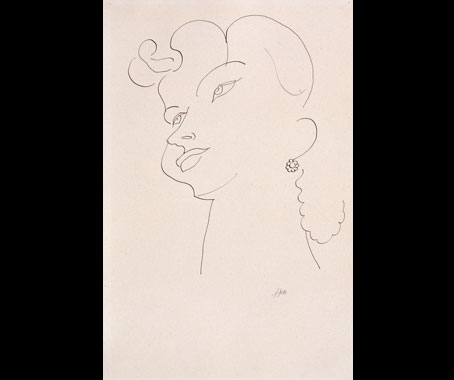
Tête de femme de trois-quarts (Woman’s head, three-quarter profile) 1939
Pen and Indian ink on Bristol paper marked ’CF’, 48.1 x 31.5cm
Collection: Musée Matisse, Nice © Succession H Matisse
Image courtesy: Ville de Nice – Service photographique
Matisse distils things down to their essentials. Like a magician, he can sum up the character of a person with just a few marks on the paper. But he is no caricaturist. Matisse sought emotional truth and immediacy in everything he produced. And there is no clearer route through to his art than through the works on paper.
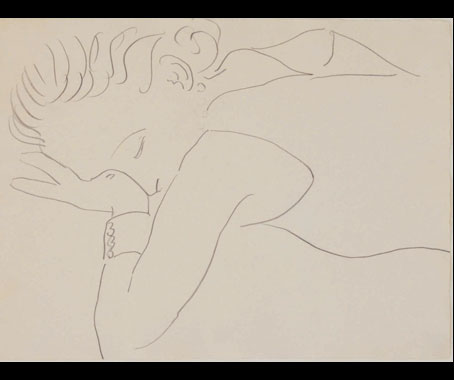
Modèle endormie (Sleeping model) 1935
Pencil on paper, 27.5 X 38cm
Private collection © Succession H Matisse

Acrobate (Acrobat) (from the series ’Danseuses acrobates’ (’Acrobatic dancers’)) 1931
Lithograph on tinted Arches wove paper, 48.2 x 17.7cm
Collection: Département des estampes et de la photographie, Bibliothèque nationale de France, Paris
© Succession H Matisse
He drew in ink and pencil. He was a master printmaker in all mediums. But, for me, he is at his most illuminating in the linocuts where his black is a colour, irradiated by the spare white lines.

Corbeille de bégonias I (Basket of Begonias I) 1938
Linocut on G. Maillol wove paper, 40 x 44.5cm
Collection: Département des estampes et de la photographie, Bibliothèque nationale de France, Paris
© Succession H Matisse
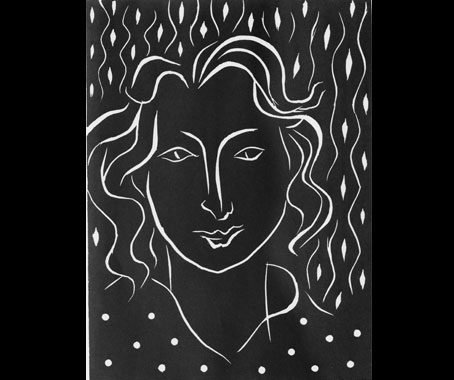
Primavera (Spring) 1938
Linocut on Daragnès wove paper, 52 x 33cm
Collection: Département des estampes et de la photographie, Bibliothèque nationale de France, Paris
© Succession H Matisse
He drew with impressions and incisions, but also with a pair of scissors with the astonishing late paper cut-outs.
The exhibition is organised chronologically. Largely black and white with a few paintings thrown in to create colour punctuations the exhibition seems to build to a climax as, near the end, we discover the luminous room of linocuts before the final explosion of colour with his ’Jazz’ suite.
In fact, one of the many pleasures with this show is the design of the exhibition which becomes a journey of discovery with our perceptions gently nudged at every corner.
Matisse: Drawing Life. Gallery of Modern Art, Brisbane.
Until March 4, 2012.
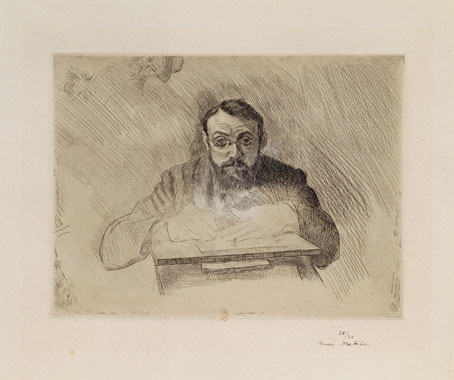
Top image: Henri Matisse gravant (Henri Matisse etching) 1900–03
Drypoint on wove paper
14.9 x 20cm
Collection: Département des estampes et de la photographie, Bibliothèque nationale de France, Paris
© Succession H Matisse
Paul McGillick is Editorial Director of Indesign Publishing
INDESIGN is on instagram
Follow @indesignlive
A searchable and comprehensive guide for specifying leading products and their suppliers
Keep up to date with the latest and greatest from our industry BFF's!
The internet never sleeps! Here's the stuff you might have missed