The home of architecture and design in the Asia-Pacific
Get the latest design news direct to your inbox!

Get the latest design news direct to your inbox!
Currently on show in Shanghai, Street Food Lighting by Seethisway brings life into otherwise dark and abandoned areas with video projections of street food stalls and markets from around the world.

March 5th, 2014
Street food markets are common informal economies in countries such as China, Thailand, Indonesia and South America, just to name a few. Not just a place where you can savour fresh local food on the spot, it’s streets also serve as a meeting point for people who want to enjoy a meal in an easy and informal way before heading home. The stalls are open till late, keeping these areas active and vibrant at night.
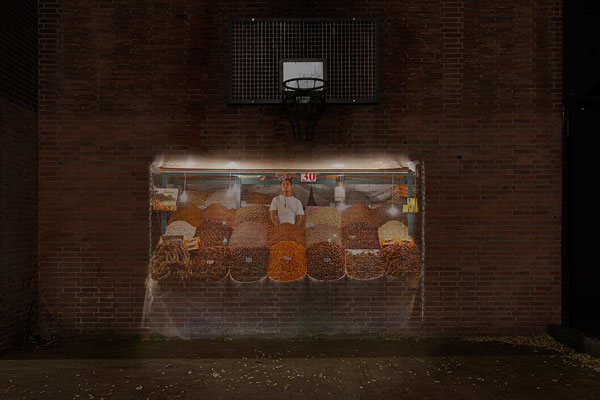
Street Food Lighting
A project by research-oriented studio Seethisway, Street Food Lighting aims to illuminate some of the darkest corners in our cities with a whole new media experience: video projections of bright food stalls and night markets from all over the world. Abandoned facades, closed storefronts or pitch-black alleys usually look unwelcoming at night because of inadequate lighting, resulting in a dark and unsafe environment. This project aims to bring them back to life at night where food stall video projections from far-flung places light up the streets in a surprising and unexpected way.
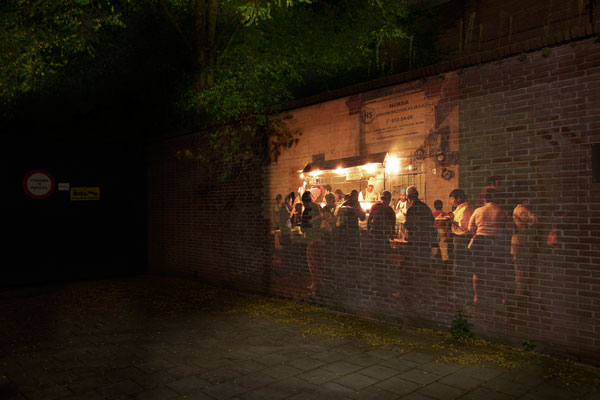
Street Food Lighting
‘I’ve always been fascinated by how much life there is in the streets of what we call undeveloped countries such as Thailand or Indonesia for example,” says Madrid-born Jorge Mañes Rubio, founder of Seethisway. “I think it’s important to share this vision, because probably we have a lot to learn from them. Even at night, when we think the streets might be dangerous or hostile, they are bursting with life, especially when there’s a small food stall that prepares some of the local food. People meet, talk, eat and socialise together till late around the lights of these little businesses. But somehow in Europe we tend to value the privacy of closed spaces more, which we perceive as safer.”
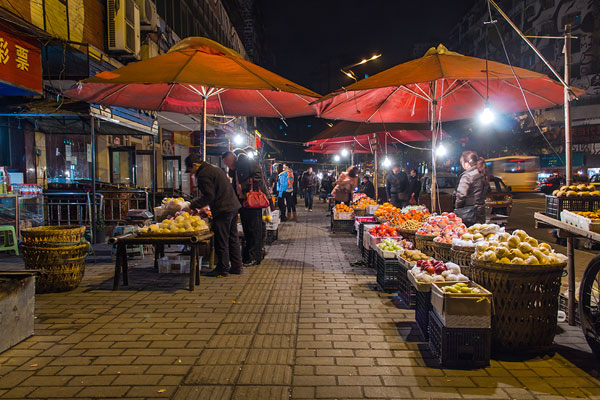
Actual market scene
‘In this project I would like to use the city as a canvas to show the habits of different cultures. To promote our streets as places for social learning and exchange, making them brighter, safer and more interesting while at the same time bringing art and design to neighbourhoods and people who normally don’t interfere with it.”
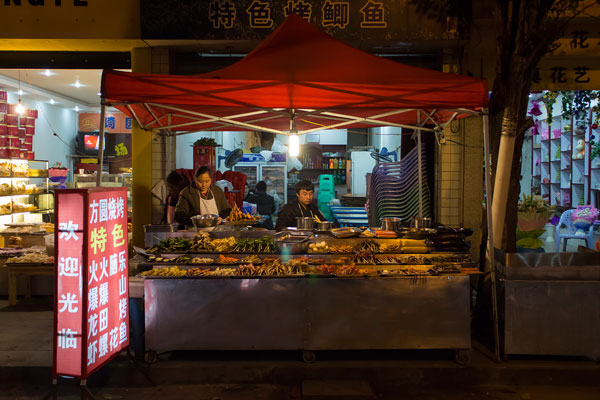
Actual market scene
Street Food Lighting received the second prize in the Your Street Eindhoven design contest, organised by Design Indaba, Capital D and Premsela, Nederlands Instituut voor Design en Mode.
Seethisway
seethisway.com
‘Street Food Lighting’ at NighTime-Dreamreal is on from 3 December 2013 to 30 March 2014 at Power Station of Art PSA, 200 Huayuangang Road, Huangpu, Shanghai, China.
‘Street Food Lighting’ at Functional Dissonance will be held from 14 March to 6 April 2014 at Festival Bo:m, Amado Art Space, 8, Itaewon-ro 54-gil, Yongsan-gu, Seoul, South Korea.
INDESIGN is on instagram
Follow @indesignlive
A searchable and comprehensive guide for specifying leading products and their suppliers
Keep up to date with the latest and greatest from our industry BFF's!
The internet never sleeps! Here's the stuff you might have missed