The home of architecture and design in the Asia-Pacific
Get the latest design news direct to your inbox!

Get the latest design news direct to your inbox!
Elana Castle looks through her design lens at two of the stellar installations from this year’s extraordinary burn.

November 19th, 2018
Burning Man celebrates the annual creation of a temporary city in the remote Black Rock Desert of Nevada. Each year, an extraordinary city unfolds across seven square miles of remote and barren terrain.
“The emergence of a place called Black Rock City is both a magical experience and an extremely practical one,” explains Kim Cook, Burning Man’s Director of Art and Civic Engagement. “For example, each year there is urban planning, there is a Federal Aviation Administration approved airport, a hospital, and there are public plazas and open spaces, all of which require thoughtful design and planning.”
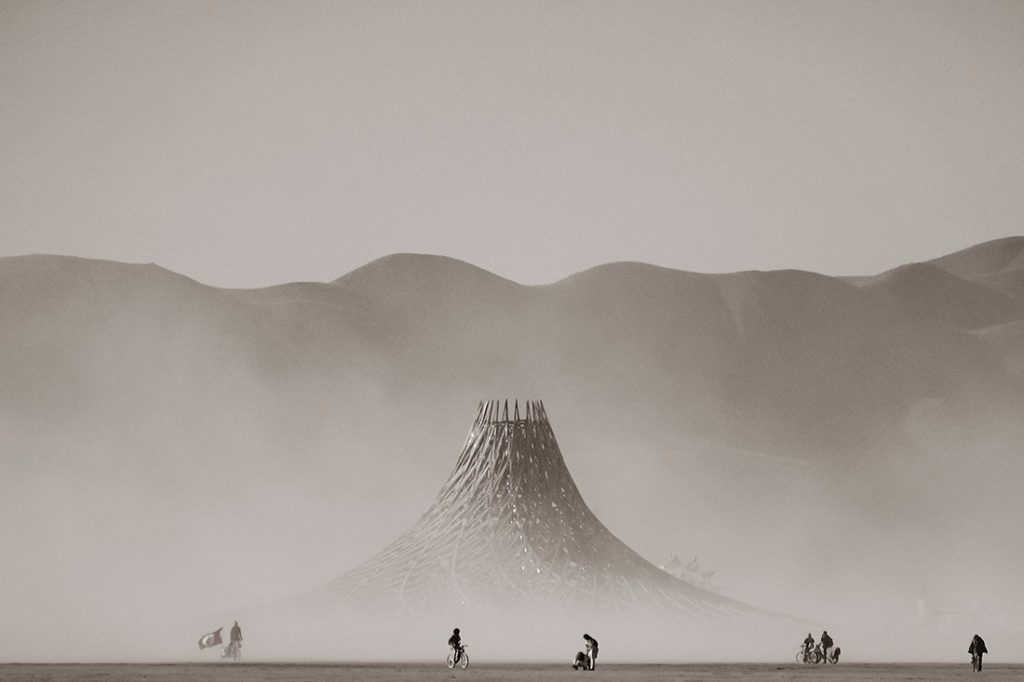
Temple Galaxia by architect Arthur Mamou-Mani. Photo by Jordan Laboucane
In addition to the overarching civic infrastructure, the Burning man team oversees the creation of over 300 artworks each year, providing consultative engineering and safety resources. They also support the Mutant Vehicle Community which brings hundreds of motorised “art cars” to the playa.
As expected, there are numerous challenges associated with producing work of monumental scale in an isolated and harsh locale. “That’s the fun part, because this scale and this location, is what brings about the incredible community of Burning Man,” explains Kim. “A core part of the unique artwork generated from this culture is the co-creation, problem solving, and massive invitation to respond to the scale of the desert with your own vision. There are large pieces of heavy equipment, there are dust storms to contend with, and frequently forgotten or missing tools; all of these needs, and many more, are met through ingenuity and effort, innovation and collaboration. Thus, the challenges are actually the hidden gift of Burning Man; it is the way in which the vernacular of this art has evolved.”
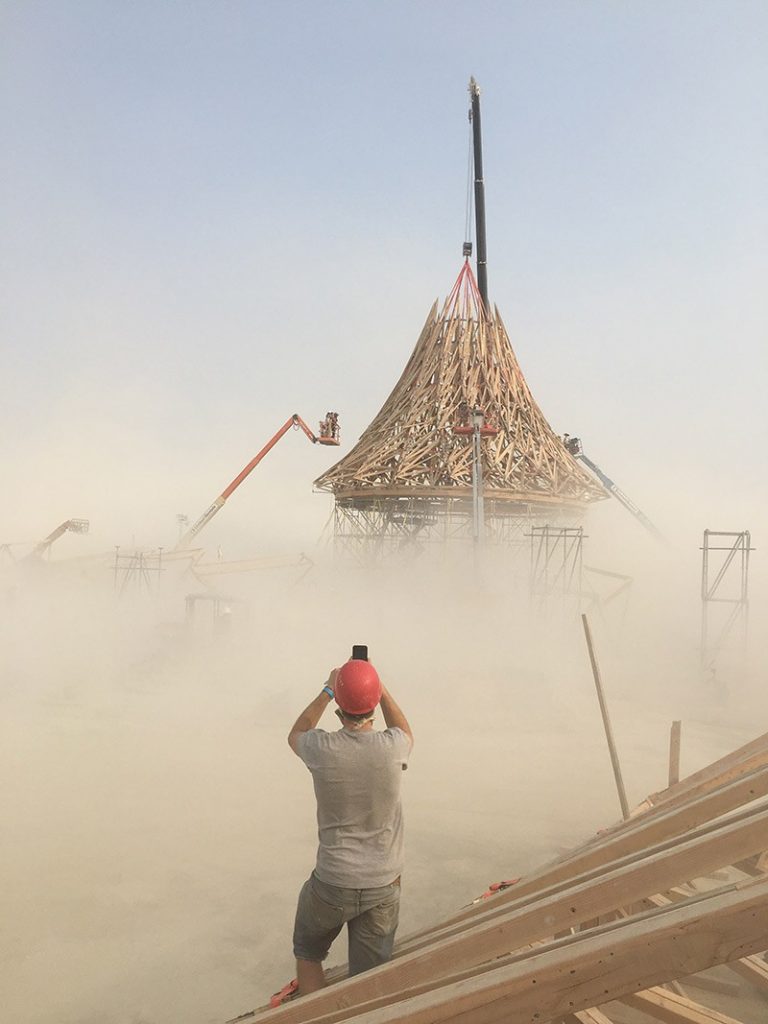
Temple Galaxia by architect Arthur Mamou-Mani, under construction. Photo by Andros Antonades
One project, which experienced numerous construction challenges this year was perhaps one of the playa’s most celebrated – architect Arthur Mamou-Mani’s Temple Galaxia. While the temple is a regular Burning Man landmark, which offers “a portal for healing, and sharing emotional experiences”, it is conceived of differently each year, bringing new experiences and visuals to the playa.
“Galaxia has been the most challenging project of my life by far,” explains Arthur. “We built it in the desert, in 22 days with volunteers with most of the funding raised by us. All of the pre-fabrication was organised across continents and done after hours. What a journey!”
The temple (which is burned at the conclusion of the week,) was formed from 20 timber trusses that converged as a spiral towards a singular point. The timber modules offered spaces to rest, write and contemplate and as participants walked through the path, they thinned out towards the sky and toward the central mandala.
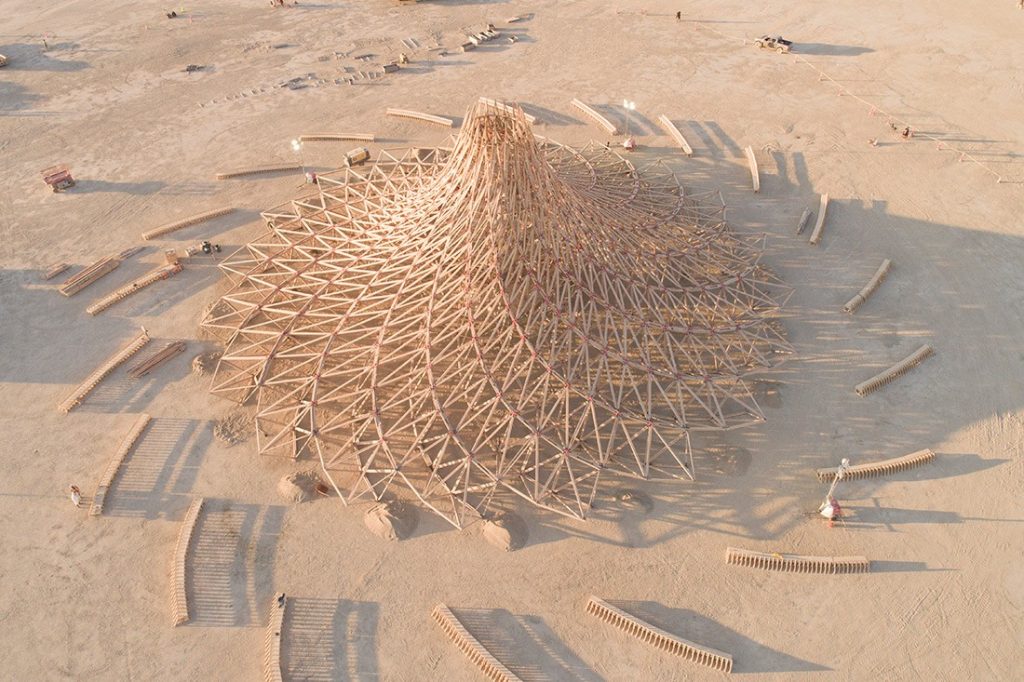
Temple Galaxia by architect Arthur Mamou-Mani. Photo by Jamen Percy
“The idea of creating a temple for everyone – a space in which people could feel connected with other humans and beyond that to the landscape and the stars above – the power of this idea gave me wings. It is so much easier to push yourself when you know the result will have an impact on people’s life, when what you produce is meaningful to others,” adds Arthur.
The Orb was another object of immense fascination on the playa this year. Conceived by Bjarke Ingels (BIG) and Jakob Lang as a “new perspective of the playa,” The Orb took the form of a 100-foot reflective, inflated mirror sphere, supported by a 32-metre inclined steel mast. It was designed, inherently, as a mirror to reflect the dynamic movement of life on the playa and other artworks in proximity.
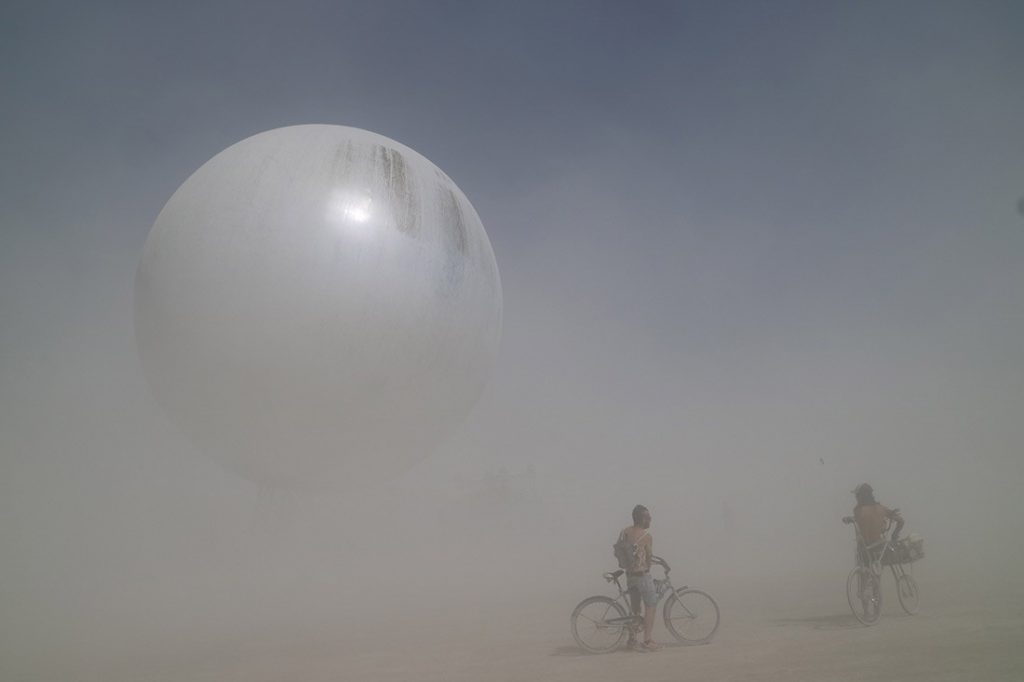
The Orb, designed by BIG. Photo by Alberto Quintans
“The designers worked side by side with us to learn the cultural standards, and they tried not to promote this as a BIG project, but rather as a group of people who were making art together,” adds Kim. “The more important story is that the people from BIG who came to Burning Man were changed by the event. They were not able to erect their sculpture with the tools and equipment that they brought.
“Like all artists who come to Burning Man, they had to rely on friends, comrades, relationships forged in the desert heat to solve their design challenges. It was through the ability to create new fittings in the field, develop a two crane pick system, and leverage the use of bodies and trucks as ballast that their vision was ultimately realised. These lessons of hardship, endurance, and triumph are equally important for a design firm that is internationally known, as they are for any person who comes to Burning Man.”
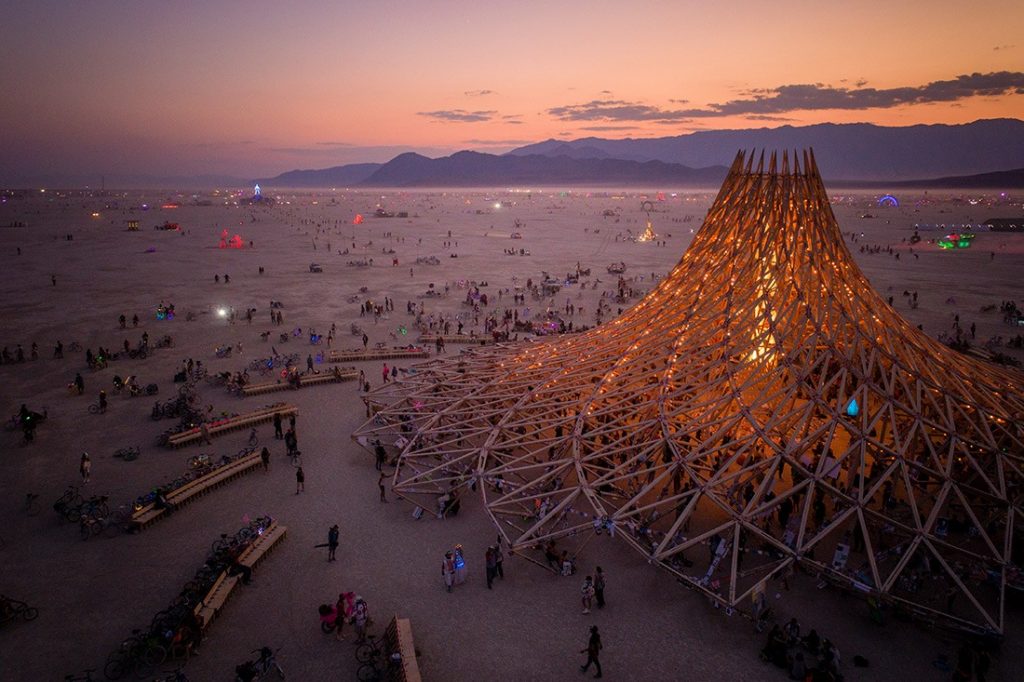
Temple Galaxia by architect Arthur Mamou-Mani. Photo by Jamen Percy
A significant element attributed to the continued fascination with Burning Man, is the idea of a city that emerges for one week of the year and then “disappears”. “While ephemeral, Burning Man is also, impactful and lasting,” says Kim.
“Because it is done year over year, and because the conditions begin with an open expanse of land, we are able to test, build, innovate, re-create, and learn from year to year. We’ve developed approaches to building secure shelter that have translated into refugee camps, we’ve seen the emergence of talented artists who are increasingly making work in the outside world that is interactive and based in community engagement, and the culture is spreading, with people who visit this city in the desert then bringing aspects home with them to their personal lives and the world around them. The involvement of the extended worldwide community means that we are constantly inspired by and learning from the contributions of the many people who participate in the building of this city.”
Read about other ideas where design takes insight from obscure places.
INDESIGN is on instagram
Follow @indesignlive
A searchable and comprehensive guide for specifying leading products and their suppliers
Keep up to date with the latest and greatest from our industry BFF's!
The internet never sleeps! Here's the stuff you might have missed