The home of architecture and design in the Asia-Pacific
Get the latest design news direct to your inbox!

Get the latest design news direct to your inbox!
Hong Kong representative Tsang Kin-wah unleashes his worry and rage at the Venice Biennale. Christie Lee reports.

June 25th, 2015
Top image: TSANG Kin-Wah, The Infinite Nothing: I, 2015, Multi-screen video and sound installation, Dimension variable. Image courtesy of the artist
It is hard to walk into Tsang Kin-wah’s multi-media exhibition at the Venice Biennale without feeling a bit disoriented – there is so much beauty, yet a copious amount of anxiety. Indeed, one might say that the success of ‘The Infinite Nothing’, curated by M+ chief curator Doryun Chong and Stella Fong, lies in its ability to surprise with its blatant morbidity as its demand for quiet introspection.
The Hong Kong artist’s aesthetics have undergone several experimentations in the past decade. Having broken into the scene in the early 2000s with his wallpaper art, which sees disturbing torrents of profanities being delicately packaged as flower patterns, Tsang is increasingly leveraging on technology for his craft. And it is this melding of the latter with former that allows the Hong Kong Pavilion to, quite literally, shine at the 2015 Venice Biennale.
Located across the Arsenale entrance, the Hong Kong Pavilion is hard-to-miss, with the title of the exhibition rendered in tidy block letters on the wall next to the entrance.

TSANG Kin-Wah, The Infinite Nothing: 0, 2015, Multi-screen video and sound installation, Dimension variable. Image courtesy of the artist
Step through the black curtains, one is immediately bathed in florescent swirls of light. It takes a second for the eye to adjust to the play of light and shadow. Even for those who have been to Tsang’s past exhibitions, dead-pan statements as “in whole or in part”, “his own judgement over his own self” and “the endless nothingness” still surprise.
The exhibition draws upon Nietzsche’s pronouncement of the death of the Christian God, “are we not straying as through an infinite nothing? Do we not feel the breath of empty space?” Projected against the cold, damp walls of the industrial warehouse, the images, first trifling the mind with a sense of desolation, quickly gives way to a skittish panic as one steps into the second, smaller room, where statements swirl at great frequency around the viewer.
The projection continues in a third chamber, where irregular industrial marks provide a contrast to the perfectly crafted swirls. After a moment, everything stops – music and image – and the viewer is being pulled from an existential crisis back to reality. The journey has ended.
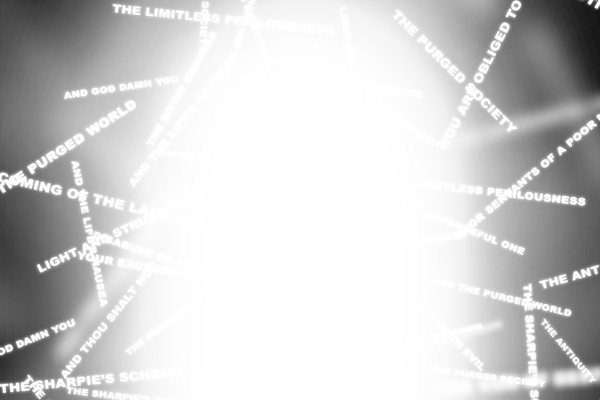
TSANG Kin-Wah, The Infinite Nothing: I, 2015, Multi-screen video and sound installation, Dimension variable. Image courtesy of the artist
It all fits in nicely with All the World’s Futures, the theme for this year’s Venice Biennale. Okwui Enwezor’s show has thus far divided opinions in the art worlds: one side applauding its ability to align art with global woes, and the other bemoaning it for being a lacklustre and all-too-literal look at all that is wrong with the world.
Amid all the controversy, Tsang’s morbid yet meticulously crafted installation provides some sort of a compromise. While the artist’s last major exhibition prior to the Biennale, ‘Ecce Homo Trilogy II’ at Pearl Lam Galleries, poked fun at the materialistic evils that lies beneath a capitalist society’s shiny sheen, ‘The Infinite Nothing’ is especially relevant in a country which has seen its share of religious upheavals throughout the centuries, and boasts some of the world’s most historical churches.
INDESIGN is on instagram
Follow @indesignlive
A searchable and comprehensive guide for specifying leading products and their suppliers
Keep up to date with the latest and greatest from our industry BFF's!
The internet never sleeps! Here's the stuff you might have missed