The home of architecture and design in the Asia-Pacific
Get the latest design news direct to your inbox!

Get the latest design news direct to your inbox!
The designer speaks to Beverly Cheng about his exhibition, Konstantin Grcic – Panorama ahead of its Asian premiere at the Hong Kong Design Institute.

Konstantin Grcic’s creations are a varied bunch, ranging from contemporary furnishings for big brands such as Vitra, Magis and Flos through to his recent collaboration with fashion label Hugo Boss on a racing yacht design. Although he started off as a cabinetmaker, Grcic is best known for his contemporary designs that experiment with the latest technology and materials. Chair One, for example, was his first project using aluminium die-casting, which proved to be a good choice for outdoor usage as it could withstand the wear and tear of public use. Other pieces have the user’s needs in mind, such as the collection of 360° chairs and stools, which were designed to serve as a perch for people who frequently need to get up while working, instead of furniture to lounge on.
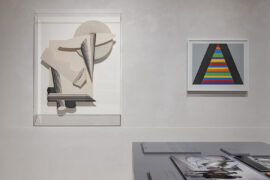
These two chairs are among the works on display at Konstantin Grcic – Panorama, an exhibition, which the designer is quick to point out isn’t a retrospective, but a look at his work over the past two decades and his visions for the future. The four-part exhibition guides visitors through an imaginary home setting adorned with Grcic’s designs, a working studio for a behind-the-scenes look into his creative process and an immersive urban environment anchored by a dystopian landscape. The final section displays a collection of personal belongings that have impacted Grcic’s life, including keepsakes from his childhood, mementoes from design mentors and projects that helped shape his development as a designer.
This is the largest solo exhibition of the designer’s work and was organised by Vitra Design Museum in 2014, premiering in five European cities before its Asian debut at Hong Kong Design Institute last month. It’s the first time the exhibition has been shown in a learning centre and it will remain free to the public until 2 April 2017.
Why do you think it’s important to see design in a museum context?
In my own career, I’ve seen certain design exhibitions that were very important to me. I saw projects done by other people because they were being shown in a museum. The museum is different from the shop. In the museum, it’s on display in a cultural context, telling a story, explaining something and making me look at it differently than a consumer but as someone who’s looking at a piece of work.
What would you like the visitor to take away from this exhibition?
For the visitor, I think it should have a note of a very personal exhibition. I’m allowing the visitor to see something that’s quite close to me, especially in the last part of the exhibition where it becomes more narrative, where I’m talking about things and telling stories.
The first item you placed in your Object Space section is an Enzo Mari Box Chair. How did your role models influence your approach to design?
I’ve always had lots of heroes or role models. People whose work I admire in a way that I find them inspirational and encouraging, but at the same time knowing that it’s their work, not mine. I know how difficult it is and I can appreciate some of the radical products they’ve made.
Are you nostalgic when you look back at the past 20 years of your career?
It’s always kind of strange looking at my body of work being displayed; it’s kind of like looking at portraits of myself. At the same time, it helps me reflect like looking at an album of photos through the years. I remember certain situations, some things I’ve forgotten and I see it in a different way than when it actually happened – it is a form of reflection, a personal reflection.
Konstantin Grcic – Panorama runs from 26 November 2016 to 2 April 2017 at the Hong Kong Design Institute, 3 King Ling Road, Tseung Kwan O, Hong Kong.
INDESIGN is on instagram
Follow @indesignlive
A searchable and comprehensive guide for specifying leading products and their suppliers
Keep up to date with the latest and greatest from our industry BFF's!
The internet never sleeps! Here's the stuff you might have missed