The home of architecture and design in the Asia-Pacific
Get the latest design news direct to your inbox!

Get the latest design news direct to your inbox!
This four-day event considered the ever-pressing issue of urbanisation, and how the design and architecture community can build up in a sustainable and efficient way.
March 16th, 2016
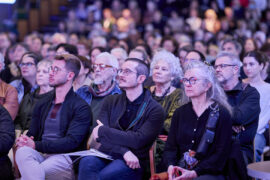
Between 7 and 10 March 2016, designers, architects, educators, engineers, urban planners and government officials met and looked skywards. Under discussion was how we can use vertical space in a way that addresses urban density and sustainability issues, while enhancing liveability.
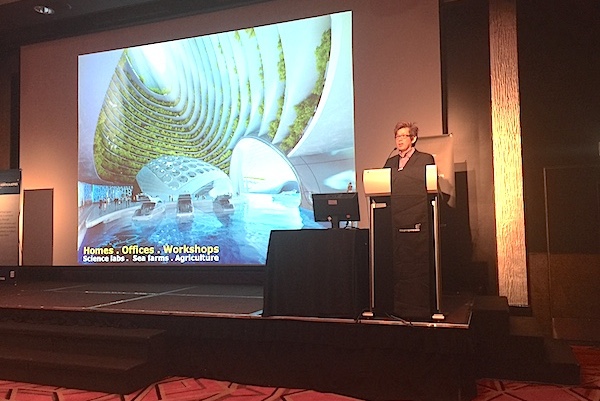
Vertical Cities opened with the keynote presentation by James Law, Chairman, CEO and Chief Cybertect at James Law Cybertecture. He spoke about an idea his design firm is working on now – the concept of “anti-gravitational outpod structures,” which consist of aluminium pods that can slot onto shelves built into a circular steel and concrete core.
James Law Cybertecture is designing each pod to have its own independent energy supply, which should, Law hopes, increase overall building energy efficiencies by up to 40 or 50 percent, because resources aren’t being wasted. He also proposed that each outpod could be a family’s home for life, flown from place to place as they move via a helicopter-like technology James Law Cybertecture is developing with a leading drone company.
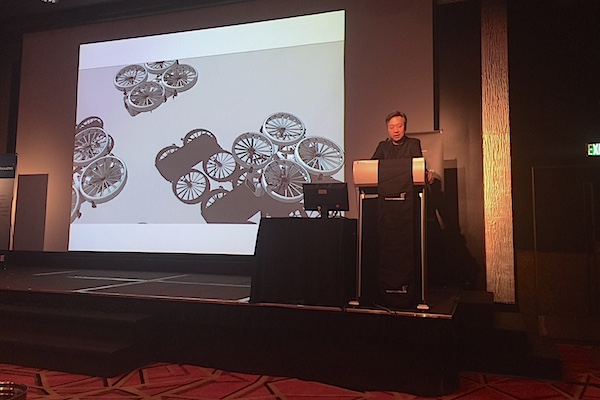
James Law presented an animation of the technology they are developing in partnership with a leading drone company
Next up was William Lau of Singapore’s A. Alliance Design International, who spoke about biomimicry – he proposed that we find solutions to urban density that are not only sustainable, but that also emulate natural processes tried-and-tested through mutation and evolution. Among the most exciting concepts he put forward were Vincent Callebaut‘s ideas for a floating city inspired by the lilypad, and “oceanscrapers” based on the form and behaviour of a particular species of bioluminescent jellyfish.
Also part of the programme were discussions about how we address wind challenges as we build up, how we can work with nature to make the most of renewable resources such as geothermal energy to make one-building cities completely sustainable, and much more. Other speakers included Dato’ Dr. Ken Yeang, Managing Director of Ken Yeang Design International Ltd, Professor Jason Pomeroy of Pomeroy Studio, and Christopher Law of The Oval Partnership.
marcus evans organises sports, entertainment and business conferences, summits and corporate marketing events around the world. With speakers presenting case studies and ideas at Sheraton Hong Kong Hotel & Towers from days one to three, and a full-day site tour of Guangzhou on day four, this year’s Vertical Cities was the fifth annual event of its kind.
Vertical Cities
verticalcitieslse.marcusevans.com
Marcus Evans
marcusevans.com
INDESIGN is on instagram
Follow @indesignlive
A searchable and comprehensive guide for specifying leading products and their suppliers
Keep up to date with the latest and greatest from our industry BFF's!
The internet never sleeps! Here's the stuff you might have missed