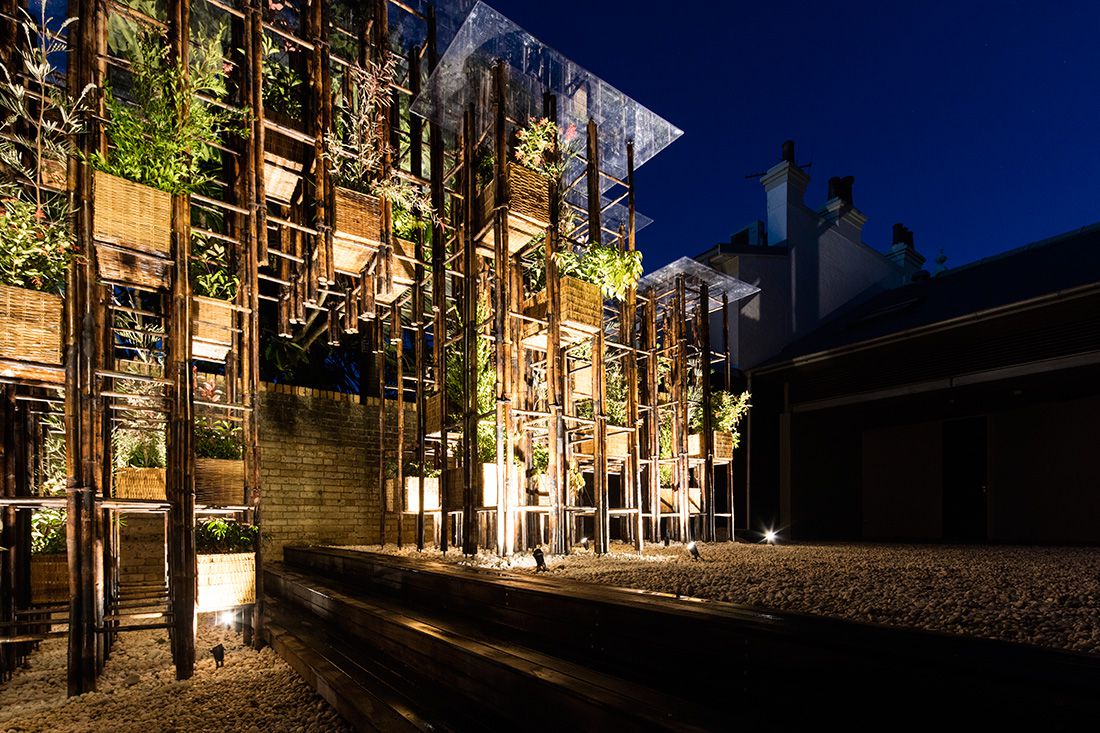
Sherman Contemporary Art Foundation’s (SCAF) Fugitive Structures is in its fourth and final iteration – final at least within the original framework of the program. Titled Green Ladder, and designed by Vo Trong Nghia of Vietnam based Vo Trong Nghia Architects (VTNA), the temporary installation has been crafted by binding simple bamboo ladders together to form a multi-tiered structure. The choice of bamboo — the world’s fastest growing plant which is sustainable, lightweight and low maintenance — is a material perfectly aligned with VTNA’s passion for truly green architecture.
The vision and brief for Fugitive Structures involved an intimate, functional pavilion, to be designed by emerging architects from Australia, the Asia Paciic Region, or the Middle East. A heightened visitor experience was sought, as were an original architectural vocabulary and experimental methodologies. The series proceeded with the same rallying cry Serge Diaghilev issued in 1913 to Jean Cocteau, the scenarist for his Ballets Russes production, Parade: ‘étonne-moi!’ (surprise me).
Indeed for SCAF founder and executive director, Dr. Gene Sherman, experimental architecture is typically difficult to conceive. “Experimentation, whether in art, design, fashion or film – all of which falls under the remit of SCAF– requires the capacity to accept the metaphorical highways and byways of learning by trial and error,” she says. “Architectural experimentation and innovation are clearly no different: successful research and development stages might ultimately produce unpredictable outcomes; during the implementation phase, highly logical and carefully thought-through decisions can often be disrupted by unexpected obstacles. In staging these experimental structures various problems have arisen. Many have been surprisingly easy to solve; others, more complex. And yet for all its challenges, the Fugitive Structures series has been hugely satisfying.”
The first Fugitive Structures pavilion, Andrew Burns’ Crescent House (2013), quietly achieved many of Fugitive Structure’s goals. The following year, Robert Beson and Gabriele Ulacco of AR-MA took experimentation further with Trifolium (2014). Most recently, Sack and Reicher + Muller with Eyal Zur (SRMZ) created the most fugitive and ephemeral of the pavilions, Sway (2015), which extended across SCAF’s courtyard garden, and was the most expansive, occupying the greatest number of square metres.
“It seemed to me from this single image and brief description that Vo Trong Nghia’s work focused on architecture in relation to society rather than on buildings designed to dazzle and impress. The more I discovered about Vo Trong Nghia, the more I understood that his practice aims to return nature to the urban environment, which he achieves via built structures that determinedly ‘green’ cities with multiple vertical and horizontal roof gardens,” Dr. Sherman continues. “The concepts of architecture as design, architecture as aesthetic endeavour, and architecture as form following function combine in Vo’s work to create architecture with a social agenda – his buildings connect communities at the most fundamental level.”
Green Ladder is on display at Sherman Galleries in Sydney until 10 December 2016.